MusicRadar Verdict
It’s always easier to have everything in one place, and for the most part, that is exactly what Universal Audio’s Paradise Guitar Studio does. It brings together a selection of UA’s well-regarded digital amplifier modelling products and combines them with a comprehensive list of effects to make what will be, for many guitarists, the only plugin you will ever need.
Reasons to buy
- +
Almost everything a guitarist might need in a plugin.
- +
Features UA’s well-regarded amp and cab models.
- +
Comprehensive selection of effects.
- +
Excellent value for money.
Reasons to avoid
- -
Slightly fiddly to use for making fine adjustments.
- -
Signal chain images lack detail.
- -
Mics cannot be moved or swapped.
- -
No metal-focused amp model.
MusicRadar's got your back Our team of expert musicians and producers spends hours testing products to help you choose the best music-making gear for you. Find out more about how we test.
What is it?
Recording guitar at home has never been so easy. Nailing that perfect tone used to require the hiring of an expensive studio and an engineer with the know-how to place an appropriate mic in that perfect spot to get the best from your carefully curated gear. This, of course, still has its place, but the advent of digital modelling technology has allowed many of us to record high-quality guitar tracks from the comfort of our own homes. Universal Audio is one such company that has driven this change.
It has a strong pedigree in audio recording gear that stretches back to the 1950’s, and has been an important figure in utilising digital technology to recreate classic audio gear in plugin form.
Expanding from the recording world into the live music space, UA has, in recent years, launched a collection of high-quality digital pedals, most notably its guitar amp pedals in 2021, as well as effects such as the Golden Reverberator, Starlight Echo Station, and others.

The amp pedals are particularly interesting as they provide amp modelling to those who want to keep it simple by ditching the screens and almost infinite options provided by the likes of the Line 6 Helix and Neural Quad Cortex, and instead focusing each pedal on a few versions of a single amp with a familiar selection of knobs and switches.
With a selecition of these pedals already available in plugin form, Guitar Paradise Studio offers five - the Ruby (1963 Vox AC30 Top Boost), Lion (three ‘60s Marshall Plexi’s), Dream '65 (1965 Fender Deluxe Reverb), Enigmatic (Dumble Overdrive Special) and Woodrow (1955 Fender Tweed 5E3 Deluxe) - along with the Showtime plugin (Fender Showman) and a collection of drives, fuzzes, modulations, delays, reverbs, compressors and other utilities, all packed into one plugin.
This makes for a comprehensive recording suite that, on paper, should provide everything a guitarist needs for recording guitar tones of professional quality.
Specs

- Launch price: $199
- Type: Amp and FX modelling plugin (hosted)
- Features: 11 UA Amp Plugins - Ruby, Lion, Dream, Woodrow, Enigmatic, and Showtime. 35 cab/mic combinations, over 25 effects
- Platforms: Windows and PC
- System requirements: macOS Big Sur 11 or higher/Windows 10 or higher/10GB SSD storage
- Formats: VST3, AU, AAX
- Contact: Universal Audio
Usability

Usability rating: ★★★★☆
Paradise Guitar Studio’s interface is fairly straightforward, but it is not perfect
Getting the plugin fired-up in PreSonus Studio One, Paradise Guitar Studio’s interface is fairly straightforward, but it is not perfect.
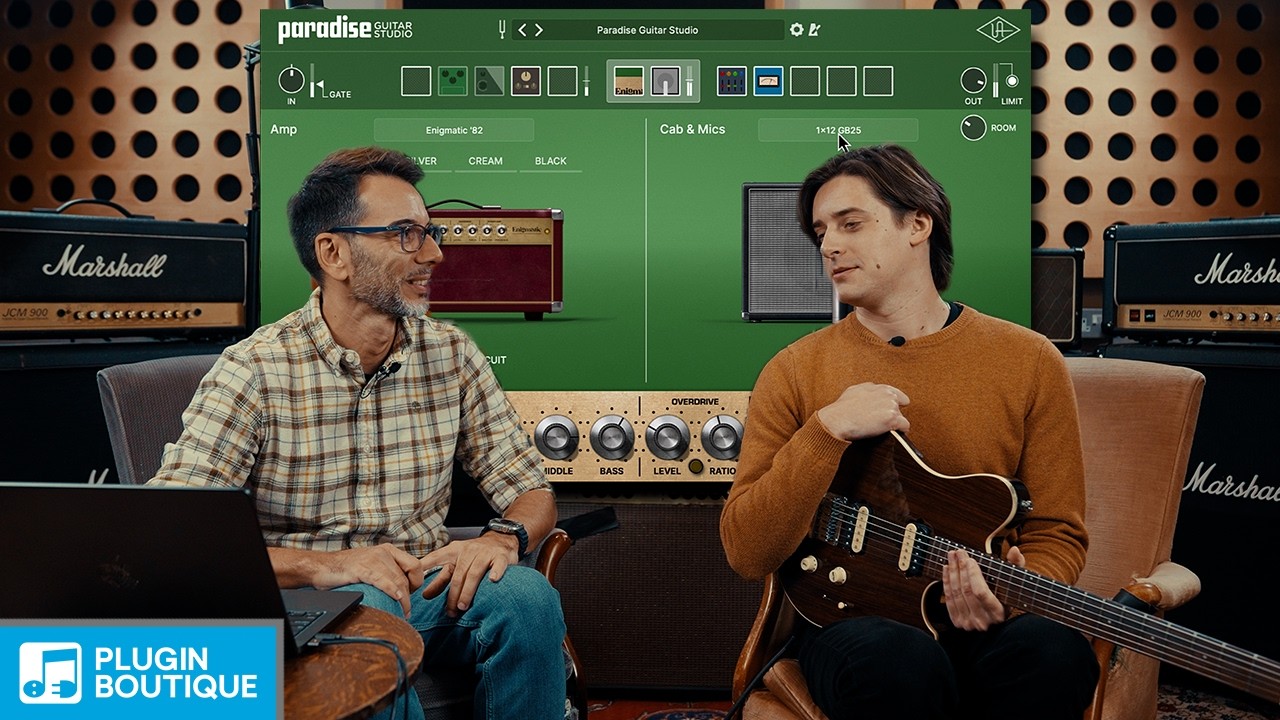
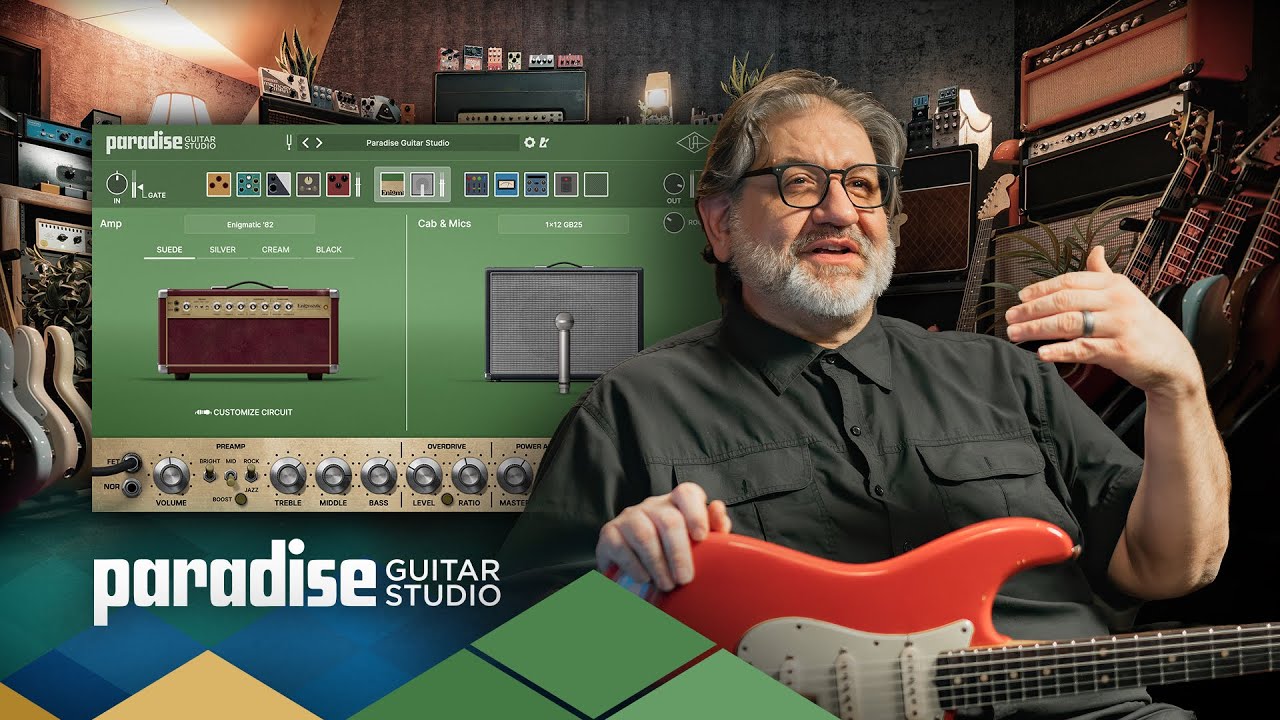
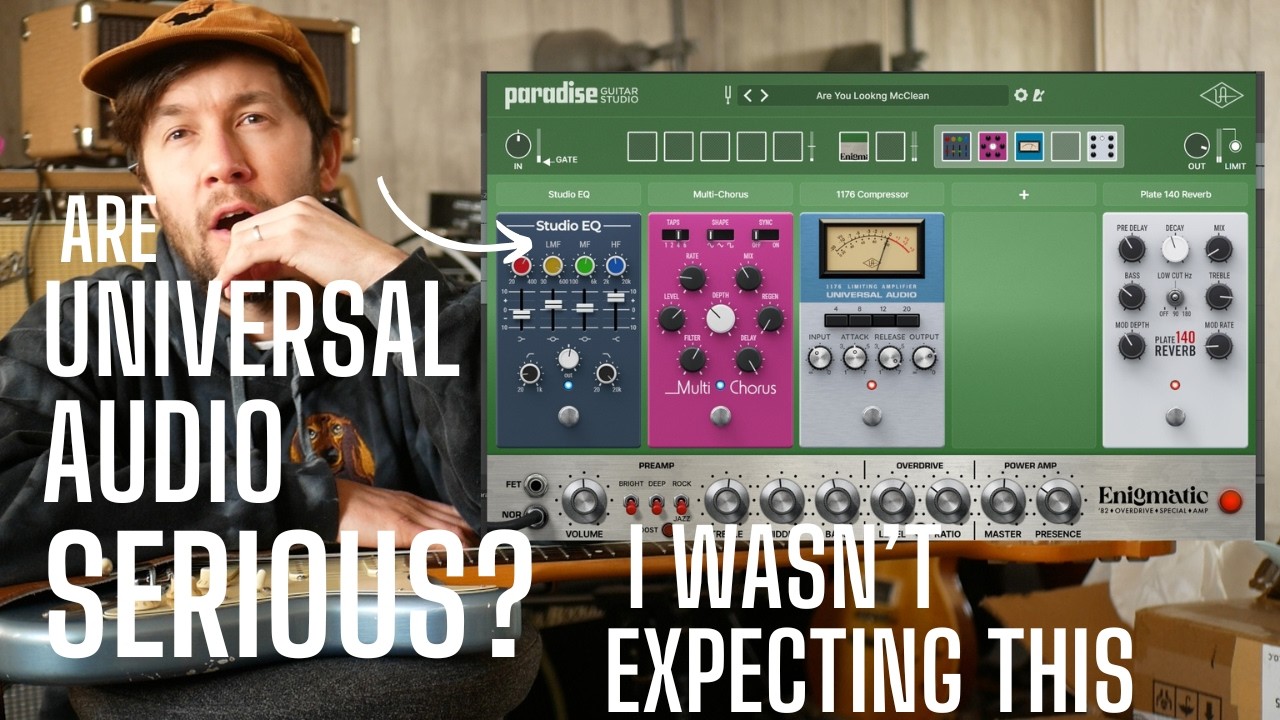
At first glance, it’s an easy setup to get your head around. The signal chain, along with the Input, Gate, Tuner, preset selection, settings, Output, Limiter, and Room send, is displayed along the top. Below that are large and detailed images of the amp and cab or effects (depending on what section of the signal chain you have selected), and at the very bottom is a panel consisting of the amp settings. Simple.
There are over 300 presets to get you started, through which you can explore the full breadth of what the software can do. All these presets are displayed in one big, very long list with tags that help narrow down that selection, as well as a Favorite function to get straight to the ones you love.

The user presets menu has its own dropdown, which you can sort into folders to then store your presets via projects or whatever you like. I have previously complained about the lack of ability to do this on other plugins, so I’m glad to see it here.
In tweaking presets, I find that the images used in the signal chain displayed along the top of the page lack detail. This makes it tricky to quickly see what is loaded into each block.
The chain is split into three sections: the pre-amp effects featuring five blocks, the amp and cab, and then another five blocks of post-amp effects.
On selecting each of these sections, all the blocks are displayed at the centre of the screen, with detailed images through which you can adjust the parameters via the familiar depictions of all the controls and switches associated with the modeled gear, along with a drag-and-drop style interface to move the effect order around. So this part is very intuitive.

The general adjusting of knobs and switches is as it would be on real-life gear, which results in a positive, tactile experience; however, there is no way to type in values for these adjustments. This feels like a bit of an oversight, as moving some of the smaller knobs to a specific number can be quite fiddly.
When selecting an amplifier, there is no suggestion of an appropriate cab to pair with it. For those getting to grips with these sounds, it would be nice to have a little guidance here. Having said that, there are plenty of presets to glean this information from.

The Gate, Limiter, and Tuner utilities are all simple to use, with the expected associated controls popping up upon selecting each one. A couple of useful tweaks here are that the Gate and Limiter can be adjusted via a little draggable icon by the In and Out meters. And the Tuner can be set to Mini-Tuner mode, in which it is always displayed in miniature form alongside the preset drop-down.
These are minor things, but adjusting the Gate and Limiter as well as keeping an eye on your tuning are all things that are important when nailing that perfect take and tone, adding to what, despite a few niggles, is a smooth experience overall.
Sounds

Sounds rating: ★★★★½
Given the impact that UA made with its Amp Pedals, I am excited to get stuck into the plugin equivalents within Paradise Studio. Each of the aforementioned models is a faithful recreation of the original gear, complete with a full suite of controls and switches, including convincing versions of the reverb and tremolo featured on the Dream '65 and Showtime.
This makes the plugin a good choice for those looking to experience the sounds of some rare, vintage amplifiers that a lot of us will never get the chance to touch, let alone play.
With the exception of the Showtime, each amplifier boasts options based on the different inputs of the real amp or its common variations. For example, the Lion can be either a Marshall Super Bass, Super Lead, or Brown, which is a Variac-modded Super Lead.

The Dream, Lion, Ruby, Enigmnatic and Woodrow also feature a Boost, appropriately chosen by UA to get the most out of each amp as you push it into overdrive. This Boost changes depending on the variation of the amp/input selected, too. In short, the variety on offer is astounding.
Starting with the Ruby, it brings that trademark Vox chime, and the tendency to get a bit too bright. As does the real thing, lending credence to the idea that these amps have been accurately modeled - warts and all.
Easily my favourite setting on the Ruby, and perhaps the whole plugin, is the Normal channel, with the Volume gunned with the Boost dimed. Here, the Boost operates as a treble boost circuit, resulting in the amp kicking out a mid-forward, highly rewarding Brian May-style tones.

The Woodrow brings a clean with a mid-focused nature and a familiar aggressive breakup that the Fender Tweed Deluxe amps are known for, while the Dream '65 does a more scoopy Fender clean and a convincing edge of breakup sound that just begs to be pushed with a boost.
I don’t get on that well with the Showtime, as it seems to lack the dynamic of the other models. It’s still a nice-sounding, high-headroom clean, but just doesn’t feel as lively, so I am more likely to reach for the Dream '65 or the Woodrow for all things Fender.
The opposite is true of the Enigmatic. It has a bright, mid-forward nature reminiscent of the Dumble tones used by the likes of Robin Ford, which leaves nowhere to hide, with all the nuances and mistakes within my playing, clearly represented. It’s a lot of fun.
There are tons of options, as with the real thing, and I find that it’s worth spending a bit of time learning how to get the best out of it, as it is very easy to tweak your way into an unpleasant tone. Again, as with the Ruby, it’s a warts-and-all type situation, but when you nail that sustaining, mid-forward gain, or lush clean, it's totally worth the effort.

Lastly, the Lion can do a Hendrix-esque edge of break-up thing, that ACDC drive, or an all-out Van Halen-like Brown sound. Stick the included Tube Screamer model (more on that later) in front of it and you're in that heavy, saturated, classic rock heaven.
The only thing missing is an all-out metal amp. In Universal Audio’s amp pedal stable sits the Anti 1992 and the Knuckles, which are based on the iconic Peavey 5150 and Mesa Boogie Dual Rectifier repectively. If one of these were included in the Paradise Guitar Studio plugin, it would easily become a one-stop shop for guitar tones of almost any genre.
With over 300 presets, there is more than enough to get anyone started if you want to skip a bit of tweaking. A couple of my favourites are the B-Man 4x10 Clean, which provides a nice, warm, mid-forward clean utilising the Woodrow ‘55 and suiting my Telecaster perfectly, and the entertainingly-named 80’s Hair Snakes, using the Lion amp for those Marshall tones and the Micropitch Shifter for some ‘80s flavoured wobble.

Looking at the cabs, I note that we cannot change the mics or mic position. None of the amplifiers shy away from bright high-end, so the ability to play around with these settings would be helpful, but alas, this is not to be.
The upside of this is that Universal Audio has expertly curated the cabinet and mic combinations, making it easier to get great tones.
And, to be fair, we are not short of options here. There are 34 mic and cab combinations in total, with everything represented from a Fender Style 1x12 loaded with an Oxford 12K5-6 speaker, right up to a Marshall style 4x12 with Celestion V30’s. The microphones are equally as varied, covering everything from a Shure SM57-inspired dynamic mic, through to a Royer 121 ribbon.
The real fun, though, comes with pushing these amps. For this, we have four drives. The TS Overdrive (Tube Screamer 808), Gold OD (Klon Centaur), Nashville Overdrive (Nobels ODR-1), and RAW Distortion (Pro Co RAT).

Using the Dream ‘65 as a pedal platform within the plugin, the TS does a great job of that compressed, mid-humped, Tube Screamer thing. The Gold Overdrive is mid-boosted at a higher frequency than the TS, just as you would expect with a Klon-type drive.
However, in a clone of the Klon, that mid bump would usually become more pronounced as you dial in the gain - this doesn’t happen here. So it’s not a wholly accurate recreation, but it's fun all the same.
The Nashville Overdrive provides a more full-range type of tone, with the RAW Distortion bringing that all-out saturation worthy of its status as a RAT model. All in all, a great selection of drives.

Fuzzes are well represented, too, with the Big Fuzz (EHX Big Muff) and Vintage Fuzz (Dunlop Fuzz Face). Both these models are convincing replications of the originals they are inspired by, with the Big Fuzz bringing that smooth, mid-scooped eq and the Vintage Fuzz being fat and aggressive.
Both include common mods, as the Big Fuzz has a switch to take out the Tone stack from the circuit. To my ears, this results in a tone that is a tad too bright. The Sputter control added to the Vintage Fuzz, however, makes things all spitty and angular, which is just a ton of fun.
No plugin with the Guitar Studio moniker would be complete without a little wobble, and here, there are plenty of modulation options. There’s the Blue Flanger, Brigade Chorus, Micropitch Shifter, Multi Chorus, Orange Phaser, Trem 65, and Vintage Vibrato.
Covering all bases when it comes to modulation, it really is a complete and very capable suite in this regard. I particularly love the Multi Chorus. It provides a glassy type of movement with plenty of high end information retained, and a comprehensive suite of controls that results in a very polished and highly customisable chorus sound.
The Micropitch Shifter is another favourite, as I find it particularly useful when set post-amplifier in stereo. Here, it can be used to create a doubling effect, giving the impression of a wide stereo spread to your guitar through two separately tweakable delays and/or pitch changes. It’s hard to turn it off once you’ve heard it.
EQ needs are also suitably covered with two EQ effects. The first being the Studio EQ, which is a four-band parametric EQ that also features high- and low-pass filters. And then the 10-Band Graphic EQ, which, based on the Boss GE-10, does exactly as it says on the tin.

Also modelled is Universal Audio’s legendary 1176 Compressor. It’s a simple setup with Attack, Release, Input, Output, and a 4/8/12/20:1 selectable ratio. But it covers everything from super squashy to a subtle polish.
That’s not the only compressor option, however, as the Red Comp model provides the famous MXR Dynacomp sound. It’s a little less transparent than the 1176, slightly coloring the tone in a warm and rewarding way.
Everyone likes a little space. To that end, there are four reverbs to choose from. The Digital Reverb, Reverb 224 (Lexicon 224), Plate 140 Reverb (EMT 140 Plate Reverb), and Drip Spring 65 Reverb.
The Digital Reverb is nice and easy to use, the 224 allows a lot more tweaking, the Plate brings the brighter plate-style thing and also boasts plenty of room for adjusting, and finally, the Spring 65 is a simple spring reverb with plenty of that drippiness on tap and three reverb tanks to choose from. Again, it’s a pretty comprehensive selection of high-quality options.

Sticking with the theme of creating some space, the delays here also cover pretty much every echo style you're likely to need. There’s the Memory Delay with some analogue warmth, the Digital Delay sporting plenty of controls and wide stereo sounds, the EP-III Tape Echo that emulates the Echoplex III Tape Delay, and the Pitch Shift Delay, which contains some outlandish sounds via heavily modulated, stereo repeats.
Playing around with them, I find the digital delay particularly rewarding. With a Low Cut, a High Cut, and modulation adjusted via Rate and Depth controls on top of the Time Feedback and Mix you would expect on any Delay, it runs the gamut from warm, texture-adding repeats to the crystal clear digital high fidelity thing, great for time-based acrobatics.
Both the Memory Delay and EP-III Tape Echo emulate pedals that are known not only for their delay sounds, but also for how they color a tone in general. A nice touch with the UA Paradise Guitar Studio plugin versions of these is the option to turn this color on or off.
The EP-III in particular provides a nice bump to the higher mid-range, so I am inclined to leave the color switch on.
Verdict

So it’s fair to say that what we have here is an incredibly capable plugin. Elements of the user interface, such as the lack of ability to type in parameter values and the detail-lacking images of the signal chain, do put a bump or two in the user experience, but overall, it remains fairly straightforward to use thanks to the utilization of the familiar knobs and switches that we would see on the real life versions of the gear the plugin is modelling.
Universal Audio's highly-regarded amp pedals are well represented here and do a good job of meeting the bar that the pedals set. Although to make the selection of amps truly comprehensive, it would have been great to see an all-out metal amp, too.
Drive, fuzz, distortion, delay, reverb, modulation, compression, EQ - it’s all here
What is comprehensive, however, is the selection of effects. Drive, fuzz, distortion, delay, reverb, modulation, compression, EQ - it’s all here. Making it a one-stop shop for almost everything a guitarist might need.
MusicRadar verdict: It’s always easier to have everything in one place, and for the most part, that is exactly what Universal Audio’s Paradise Guitar Studio does. It brings together a selection of UA’s well-regarded digital amplifier modeling products and combines them with a comprehensive list of effects to make what will be, for many guitarists, the only plugin you will ever need.
Also try

Hands-on videos
Universal Audio
John Nathan Cordy
Plugin Boutique