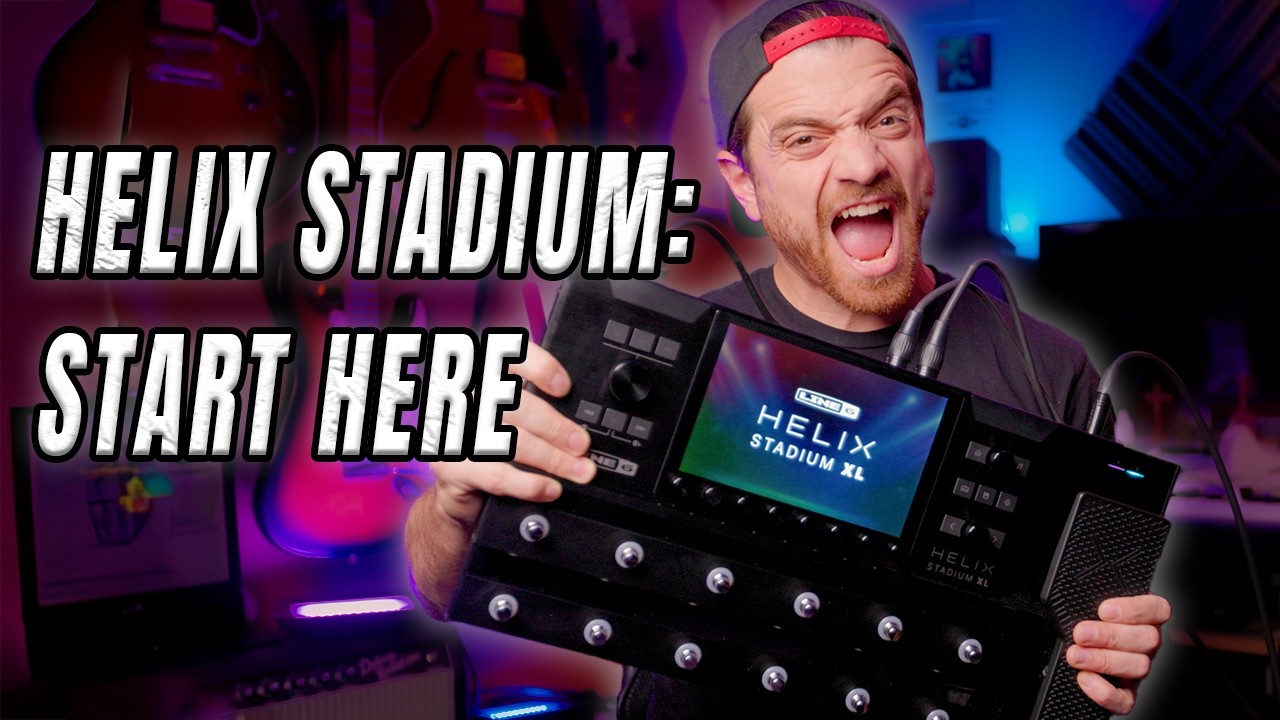
MusicRadar Verdict
While the stock tones may not be quite enough to take the lead in the modeller race, the Helix Stadium XL is certainly the easiest to use and the most enjoyable. It’s also got some unique features you won’t find anywhere else, and has the potential to become an indispensable foundation for you and your band’s shows. In sheer muscle power, this is the standout candidate for me.
Reasons to buy
- +
Agoura amp modelling is a noticeable level up.
- +
Effortless to control with an amazing UI.
- +
Touchscreen performs exceptionally well.
- +
Some powerful and unique features.
- +
Will receive plenty of firmware updates in the future.
Reasons to avoid
- -
Some work is required to dial in tones.
- -
Released before some arguably key features were ready (Proxy).
- -
Does it try to do too much?
MusicRadar's got your back Our team of expert musicians and producers spends hours testing products to help you choose the best music-making gear for you. Find out more about how we test.
What is it?
Few amp modeller lineups have impacted the wider guitar world more than the Line 6 Helix family. First launched in 2015 and subsequently expanded to include pedals of all shapes and sizes – with numerous firmware updates to boot – Line 6’s flagship all-in-one-rig solutions have become some of the most-used and well-loved options on the market to date.
Line 6 has helped pioneer and innovate the space. Lest we forget the POD, which spurned on an entire genre and helped catapult the modeller movement into the stratosphere? In fact, if you had to pick, it’d probably be Line 6 and Neural DSP who are the biggest players in the game today.
However, when Neural DSP brought its touchscreen-equipped Quad Cortex to market in 2020 – and with more competition from the likes of the Fender Tone Master Pro and IK Multimedia coming out of the woodwork – the onus seemed to be on Line 6 to keep up to date with emerging trends and technological developments. Sure, the firmware updates were nice, but a top-to-bottom refresh seemed necessary to stay in the race.

The rollout has been a bit of a shaky one in terms of features, but now the Stadium XL is out in the wild – and it even has a few firmware updates under its belt already. The original is a tough act to follow, but Line 6 has pulled no punches with its follow-up.
There's new Agoura modelling tech, an 8” touchscreen, overhauled UI, a new ‘Hype’ control, intuitive new ways to interact with digital tones, a mountain of DSP, plenty of connectivity options, a built-in expression pedal… the list goes on. But what does all of that mean in practice, and is the Helix Stadium really that much of a step up from what was already an exceptional platform?
Specs

- Launch price: $2,199 | £1,980 | €2,299
- Type: Amp modeller multi-effects floorboard
- Features: 12 footswitches, built-in expression pedal, 8” touchscreen, customizable scribble strips, Agoura amp modelling, Helix effects, Stomp/Snapshot/Preset modes, Showcase.
- Connectivity: Bluetooth, MIDI, WiFi, 2x ¼” control outputs, 2x ¼” instrument inputs, XLR input, four effects loops (or two stereo effects loops), stereo XLR output, stereo ¼” output, ¼” headphone output, Nexus link, S/PDIF in and out, Micro SD slot, MIDI in and out, USB C, USB A
- Power: IEC, 9V DC, 3A
- Dimensions: 19.4”x10.1”x3.6”/493x257x92mm
- Weight: 11.5lbs/5.25kg
- Contact: Line 6
Build quality

Build quality rating: ★★★★★
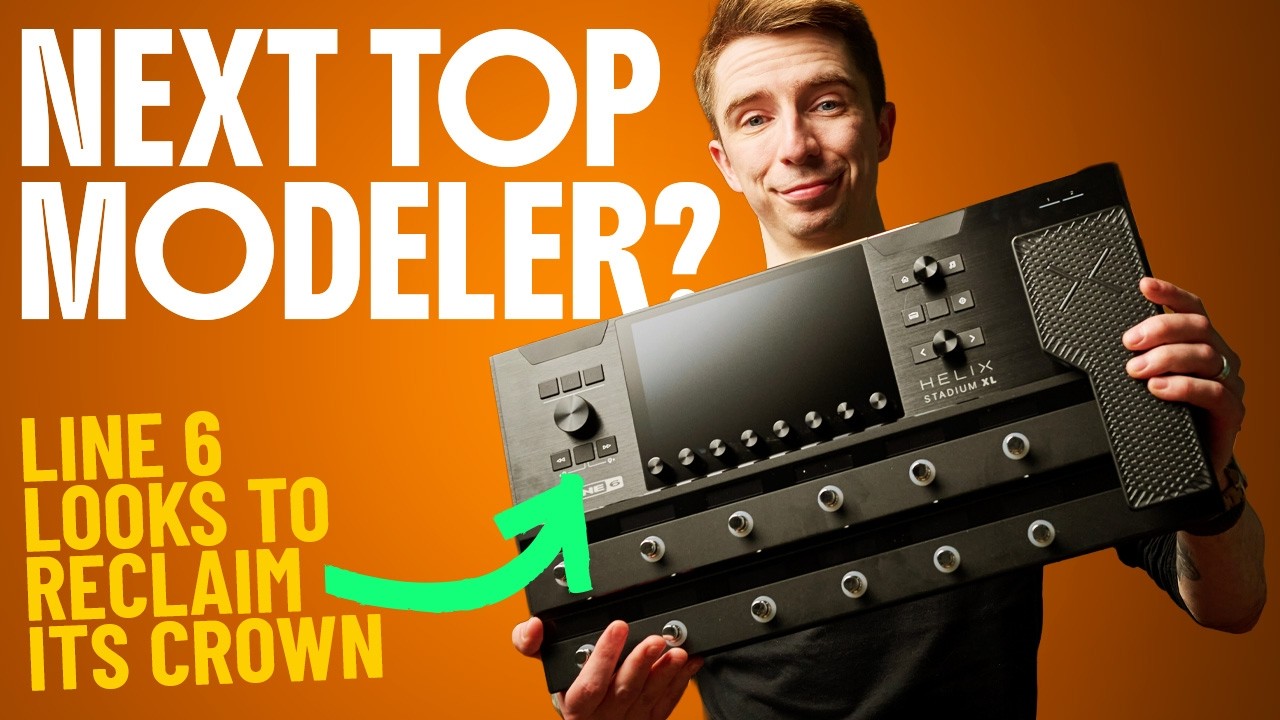
This thing just screams ‘robust’, and having come straight in from reviewing the glass-heavy Neural DSP Quad Cortex mini, it feels reassuring to come to something that’s a bit more industrial in its design. The black brushed chassis looks impervious to any on-stage mishaps that might come its way.
I’ve never gigged a larger Helix myself, just the HX Stomp, but I’ve shared stages with those who have and am constantly crossing paths with them in a live environment. And there’s a reason for that - they are proper workhorses that are tried, tested and trusted. The Helix Stadium XL, unsurprisingly, looks equally so, and while it’s not overly heavy per se, it does have a nice heft that makes it feel even more reliable.

An improved footswitch count finds 12 capacitive touch footswitches lined up next to a sturdy expression pedal that will take plenty of testing rocks, while the 8” touchscreen feels remarkably shatterproof.
The raised edges to separate the rows of footswitches – which all have their own scribble strips – is a nice touch, as is the allen key nut used to tighten or loosen the expression pedal resistance. In that regard, there are no loose switches or wobbly controls. Everything is rock solid – the least you'd expect from a nearly-£2k pedal, of course.
On the back, there are plenty of well-appointed I/Os, including four mono effects loops (two stereo), XLR and ¼” stereo out. MIDI in and out, and both USB-C and USB-A, as well as a ¼” headphone out and a Micro SD slot. It’s powered via a rugged IEC socket, which adds to the sturdy and industrial vibe this pedal gives off.
Usability

Usability rating: ★★★★★
This is the most user-friendly modeller I’ve experienced
I could waste plenty of words talking about the ins and outs of the Helix Stadium XL’s usability (don’t worry, I’ll drill into the details in a minute) but the long and short of it is quite simple: this is the most user-friendly modeller I’ve experienced.
A lot of that is down to the 8” touchscreen – which, it should be pointed out, is larger than the screens found on the Tone Master Pro and Quad Cortex. But it’s not just the size that counts; it’s what it offers and how it feels under the fingers.

The screen is incredibly responsive and accurately calibrated – no unnecessarily heavy-handed taps are needed to scroll or select – and it has a premium satin-y sheen that ultimately feels more robust than the sleek screens of the QC or TMP. It makes it really easy to drag and drop amp and effects blocks, and the almost-matte-like effect means even the sweatiest of fingers won’t grip, smudge or stick to the screen. It’s a small design choice, but one I’d wager was wholly deliberate – and it definitely adds to the usability.
That seems to be the theme here: lots of small, extremely well thought-out design choices that all add up to deliver a really intuitive experience. I’ve plugged into a few modellers that have left me at sea with their functionality, but I had no such issues with the Helix Stadium XL. Part of that might have been down to my familiarity with the HX Stomp, but I think it’s mostly because of the impressive UI utilized here.
Those small functions include having a full-on keyboard view when naming scribble strips, presets or snapshots. Elsewhere, when selecting amps and effects, you get visual renders of each model while scrolling through the banks (similar to the Tone Master Pro). Assigning these using the capacitive footswitches speeds the preset-making process up. The ability to fully customise footswitch functions is great, and easy to do. The tiered layout means you don’t have to worry about accidental switch stomps. There's no real learning curve here. I reckon a monkey could operate this.
But the thing I’m most interested in with the Helix Stadium XL is the potentially game-changing Showcase feature. Along with the overhauled Agoura amp modelling and fancy new UI, this was by far the biggest selling point of the new unit. It wasn’t available at launch despite Line 6 making a big deal about it (the roll-out for this thing is another conversation altogether) but it was later introduced as part of one of the company’s many Helix updates.

Effectively, Showcase can control your entire live set – like, literally, the whole thing – directly from the unit itself. It can run up to eight stereo track stems with a multi-track mixer for levels, sync effect changes to tempo and tracks, and control MIDI commands to trigger an array of any changes your live show might require. That means sound, lighting, slideshows, synths… you name it.
The ability to control your live show from your amp modeller is a huge deal, and while I was worried this was simply ‘features for features’ sake’ in a bid to outmuscle Neural DSP and Fender on the spec sheet, I have since become something of a Showcase convert.
The applications are exciting and the potential is impressive, not just for live performing guitarists but for those looking to level up at-home playing, solo jamming and rehearsals. What’s more, it's easy to operate, and while the thought of controlling a live show from your modeller sounds daunting, it’s anything but.

Tracks can be dropped-and-dragged into your modeller through HX Edit – which can now be linked wirelessly over a shared WiFi connection – and saved through the MicroSD card slot on the rear. Then, you can organise whole songs – heck, even sets – with a multi-track monitor for sorting levels.
It’s a ‘best of all worlds’-style approach that has been refined into Line 6’s own style
Of course, there is a limit to Showcase, and for more expansive, complex sets that require more tracks, the Helix Stadium XL won’t quite cut it (side note: realistically, how often would you need more than eight tracks?). Would I try to control a live show myself? Yes, I would.
But even in the comfort of the testing room, the Helix Stadium XL is still the most usable modeller I’ve gotten my hands on to date. It’s a ‘best of all worlds’-style approach that has been refined into Line 6’s own style.

Sounds

Sounds rating: ★★★★☆
I have to give Line 6 credit here. It could have easily updated its existing HX amp modelling tech and focussed solely on improving the UI of the older Helix family, but it didn’t do that – instead, it built a new software from the ground up, which it’s anointed ‘Agoura’.
I have to say the new US Luxe Black and US Double Black models are the amps I’ve always wanted in a Helix
On paper, Agoura promises more dynamic, more authentic, more tangible playing, and in the conversations I’ve had with Line 6 over the past few months, the emphasis has been on ‘connection’. In other words, Agoura helps you feel the note better. It’s meant to respond to your playing, and your touch, better than old HX amps would.
So, does it? Well, yes, it does. Quite noticeably. There’s a lot to like here about Agoura. My usual litmus test with modellers usually involves trying to dial in a responsive clean amp that pushes and bites like a valve amp would (it’s easier to feel convinced when there are layers of gain and dirt involved) and I have to say the new US Luxe Black and US Double Black models are the amps I’ve always wanted in a Helix.

They are excellent clean amps that (when tailored appropriately) largely don’t fizz or poke out when you dig in with your pick. They are both bouncy and responsive and a notable upgrade to the edge-of-break-up, clean amps of the old Helix pedals.
The Princeton model I used to use in the HX Stomp has been drastically upgraded, with the whole cohort of Fender-style amps capable of some really nice tones that do the ‘edge of break up’ thing very well. The Plexi-style Marshall-y amps are also great, with a satisfying, springy depth that feels really nice under the fingers.
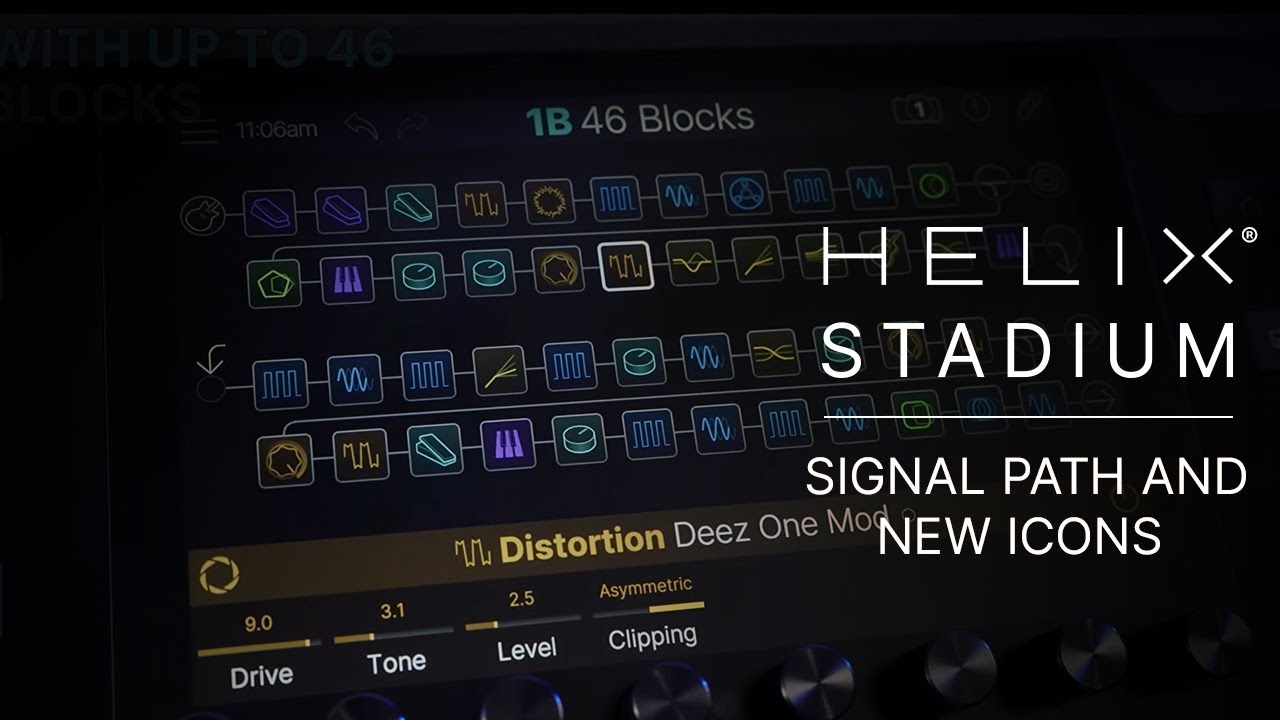
Effects stack really well, too, and thanks to the sheer processing power of this thing you can get creative with your signal chains far easier than before. Re-routing for stereo or multiple signal paths is a doddle, and the sound quality never really falters, regardless of how many blocks you’ve thrown in. Of course, there is a DSP limit, but for most use cases the Helix Stadium XL will serve you fine.
But that doesn’t mean Agoura is the best amp modeling tech I’ve played and it’s by no means perfect straight out of the box. The stock presets are by and large all really good, naturally, but when it comes to starting from scratch it takes a bit of effort to find a sweet spot.
Fortunately, Line 6 has added some tools to help speed up the process. With Focus mode, the visuals of the touchscreen – which displays a render of the selected amp and effects models – can be used to ‘drag’ your tone across five tonal reference points.
This changes a multitude of parameters simultaneously in real time, and saves the tedious effort of going through one by one. To that end, all the parameters responded nicely to each other, giving it a more holistic ‘traditional’ feel.
There's also a new 'Hype' control, which looks to bridge the gap between 'authentic' tube amp emulations and more processed, ultra-refined digital recreations. Is this feature needed? I'm not sure. There will probably be plenty out there who use it, but I didn't find it particularly inspiring, nor did I feel it had an overly significant impact on tone.

Also, I still found myself erring towards putting in my JHS Morning Glory V4 into the effects loop and using that as an ‘always on’ analogue softener to give the Agoura amps even more of an authentic feel. Not a deal breaker by any means (I do this with the Nano Cortex I’ve been gigging for two years) but something to be wary of.
As for effects... well, as the old saying goes, ‘If it ain't broke, don't fix it’ and there certainly wasn’t anything broken with Line 6 Helix effects, which have been transported from the old unit into the Helix Stadium XL wholesale. That means all the delays, reverb, modulations and drives that made my HX Stomp such a huge part of my pedalboard are all here.
The Line 6 drives sometimes get a bad rap, but I’m fond of them, especially the Klon-aping Minotaur, OCD-style Compulsive Drive, and King of Tone-inspired Tone Sovereign. The fuzz models leave a little to be desired, but I find most digital emulations do, so the Arbitrator Fuzz and Bighorn Fuzz models – while nothing to write home about – do the job just fine.
It seems a shame in retrospect not to pair the new amps with new effects,
However, when Proxy (Line 6’s answer to Neural DSP Capture) arrives, the first thing I’d be doing is Proxy-ing my analogue gain stages and putting them into the Stadium. Depending on how effective the tech is, of course, but I’d have more faith in the models I’ve done myself of my go-to drive and compression pedals in getting the job done.
The real MVPs of the Helix effects lineup though are the reverbs, delays and modulations. Currently, I run an HX Stomp that uses a bunch of these, including Reverse Delay, Glitz, Adriatic Swell, Optical Trem, 70s Chorus and more. These, paired with the improved Agoura amp models, are all very pleasing on the ear.
Are new and improved effects on the cards for the Helix Stadium family? It seems a shame in retrospect not to pair the new amps with new effects, but, again, the Helix effects are held in high regard. It will be interesting to see how the sonic palette expands in the future, though...
Verdict

Is this the best amp modeller/ multi-effects pedal out there on the market? It’s hard to say, because there are a number of elements to the answer. While the stock tones may not be quite enough to take the lead in the race, it certainly is the easiest to use and, dare I say, the most enjoyable. It’s also got some unique features you won’t find anywhere else, and has the potential to become an indispensable foundation for you and your band’s shows.
It might not be a ‘plug and play’ world beater straight out of the box that perhaps I was expecting it to be, but with a little time it quickly becomes a formidable and outstandingly powerful foundation for your rig. Agoura is definitely a step up and Line 6 has crafted a modeler experience that is a notable and worthy upgrade to the widely acclaimed and hugely beloved Helix family.
Do you sacrifice perhaps the immediate and accessible tones of the Quad Cortex or Tone Master Pro for a functionality that blows the competition out the water?
Not only that, it will be a regular recipient of Line 6’s free firmware updates, which, if history has taught us anything, are a huge reason to enter the Line 6 ranks. Proxy is coming. Who knows what else will come in the future?
Do you sacrifice perhaps the immediate and accessible tones of the Quad Cortex or Tone Master Pro for a functionality that blows the competition out the water? Ultimately, it all comes down to player preference. I’ve played at an actual stadium and would feel fairly confident with using the Stadium XL there.
MusicRadar verdict: While the stock tones may not be quite enough to take the lead in the race, it certainly is the easiest to use and, dare I say, the most enjoyable. It’s also got some unique features you won’t find anywhere else, and has the potential to become an indispensable foundation for you and your band’s shows. In sheer muscle power, the Helix Stadium is the standout candidate for me.
Test |
Results |
Score |
|---|---|---|
Build quality |
Sleek yet robust, it looks like it could stand up to any stage |
★★★★★ |
Usability |
A dream to operate with a huge and powerful touchscreen at its hear. |
★★★★★ |
Sounds |
Agoura amp modelling tech is a step up, but not quite the best out there. |
★★★★☆ |
Overall |
A worthy successor to the Helix name with plenty of unique features and solid tones on tap. |
★★★★½ |
Also try
Hands-on videos
Guitar World
Line 6
Steve Sterlacci