
MusicRadar Verdict
Once you get your head around the concept, the 814 is a joy to use, offers some interesting opportunities for patching and can grow with your rig too. All in all, another hit from ADDAC.
Reasons to buy
- +
Excellent build quality.
- +
Lots of potential for experimenting with new patch ideas.
- +
DC coupled for audio and CV.
Reasons to avoid
- -
Large footprint.
MusicRadar's got your back Our team of expert musicians and producers spends hours testing products to help you choose the best music-making gear for you. Find out more about how we test.
What is it?
The ADDAC 814 is, at its heart, a mixer but one that is based around a matrix, rather than straight channels, giving it a whole lot more opportunity for creativity and experimentation. A matrix is far more flexible, as any input can be routed to any output and looped back on itself for some interesting feedback options.
In typical ADDAC style, the unit is very cleanly laid out, clearly labelled and easy to use; although getting your head around a matrix can take a little time but it's very rewarding once you do.
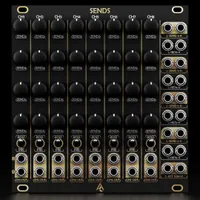
The module comes in two parts, with the first being the larger control portion, while the second houses all the patch points. This allows for two things. To start with, you can link multiple 814s together to form larger matrices, ideal for larger rigs and complex patches. Secondly, and of immediate use to all, it means you can separate the patch points from the controls. Some modules can almost get in the way of themselves, especially when there are many patch points. The 814 allows you to place these more conveniently and stay on top of organisation. Being able to easily see and adjust controls can make or break a patch, especially in a live performance situation.
Build quality is excellent, as you’d expect from ADDAC – solid and confidence-inspiring. It may take up a good amount of HP, but it’s skiff-friendly at just 45mm deep and we can see where even minimal rigs could take advantage of what the 814 offers.
The two parts of the module are connected on the rear by ribbon cables, with extra sockets for expanding into multi-matrix setups.

Performance
So, what’s it like in use and what can actually be done with the 814? The physical use is as easy as you can imagine. It's really as basic as plugging signals in and signals out and routing them wherever you want them to go, but there’s so much more to it than that. Yes, you could use it as a stereo mixer (yes, it’s a stereo module) and it’s great for that, but the matrix allows for far more flexible patching.
You can create feedback for a start, routing an output back into itself, or another channel, which can create some wonderful textures. A little modulation at various parts of the chain can lead to some interesting results too.
What’s particularly useful is that the 814 is DC coupled, meaning it works not just for audio but also CV, so you can create and ‘play’ some really creative patches. A simple example could be to feed a single LFO in, send that to two outputs and have them loop back in to different channels, then blend between them and, depending on how you’ve patched this, you can feed back into the original LFO, at the same time as sending the result off to a different destination. Very clever. We found that subtle tweaks are the best course of action here, as things can get wild fast.
After some initial tinkering, it’s easy to set up complex patches and, for ease of keeping on top of things, ADDAC has handily added scribble strips to each in and out.
The left side of each channel is normalled to the right too, which can be beneficial for certain situations, especially audio uses, or where you want to duplicate a CV mix.

Verdict
Explaining patch examples is tricky for a matrix, as it soon becomes a mess of A3 to C7 and is much harder to read than it is to use. But that’s the joy of the 814. It’s simple to navigate and use, but it can be used to generate some complex results, if that’s what you require.
We're looking forward to using it in more patches and will absolutely be trying two together for even more possibilities down the line.
What’s more, there are switches on the underside, allowing you to swap channels between synth level and line level, making it really easy to integrate guitar effects pedals and the like.
Simply note down what’s connected on the scribble strips and you can turn this into a master mixer for adding outboard gear to any patch, which is enormous fun. That negates any worry about the space taken by the 814, too, as you can use the room you might have dedicated to a reverb or delay unit.
Alternatives
Specifications

Price |
£340 |
Key features |
25HP + 8HP (33HP total) 4.5cm deep 140mA +12V 140mA -12V |
Contact |