


PLUGIN WEEEK 2026: Heartthrob, crooner and fashion renegade - is there anything Harry Styles can’t do? Apparently not. As demonstrated with his recent hit, Aperture, Styles has become a keen embracer of the sonics of minimal electronic music.
It’s a track that is moody and atmospheric, yet driving and bouncy, all while leaving enough room for Harry’s vocals to shine.
Eschewing traditional instrumentation, Styles' Aperture has more in common texturally with something like Nathan Fake - The Sky Was Pink (James Holden Remix), combining sculpted white noise, atmospheric chords, lofi synthesised beats and heavyweight bass.
One might also compare it to the experimental electronic work of performance artist Laurie Anderson with its processed vocals and repeated voice nuggets.
It’s certainly a far cry from Harry’s more traditional work as part of pop icons One Direction, yet crucially, its electronic elements sit tastefully in the mix with Styles’ vocal remaining at the center.
The combination of Harry’s familiar voice and unusual electronic backing saw the song become a huge hit with fans, who no doubt appreciate the track’s unorthodox production even if they’re not fans of the minimal classics that seemingly inspired it
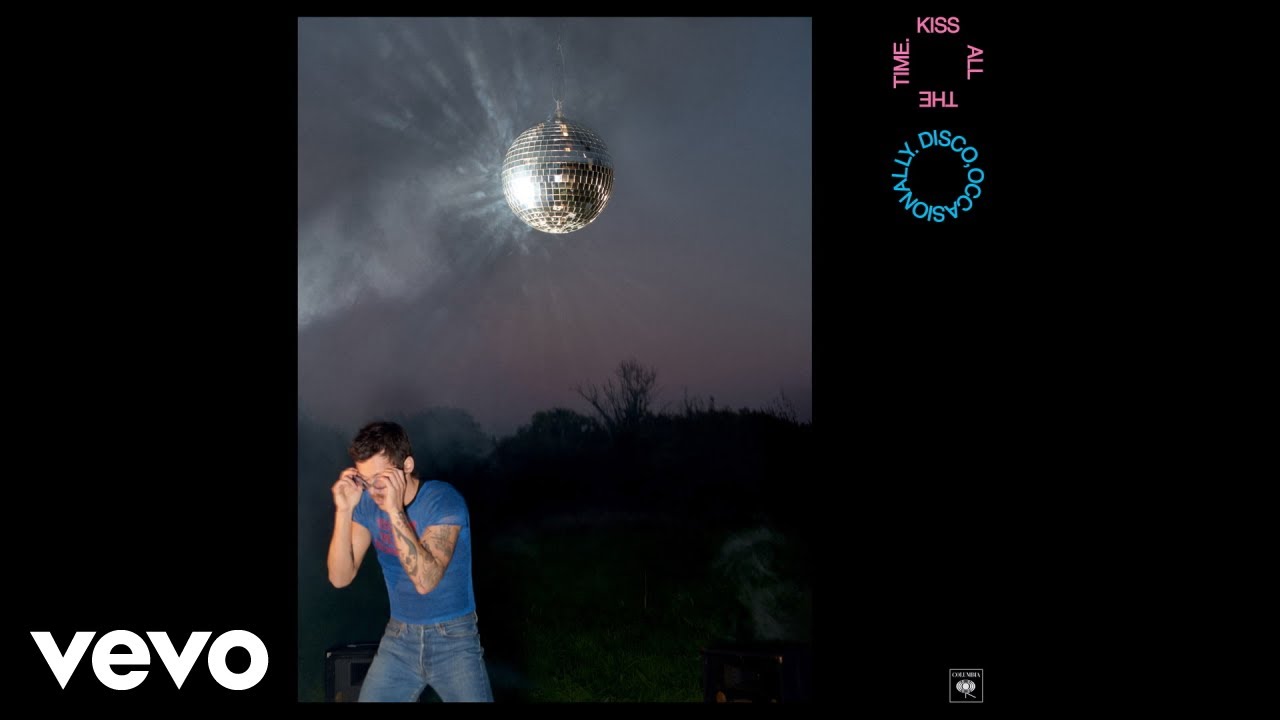
If you’d like to join Harry in this minimal madness you’re in luck - the effects heard in Aperture can be achieved easily with even straightforward soft synths. So let’s break down the track to find out how it weaves its synthetic magic.
1. Pumping organ chords
The foundation of Aperture is its synth-based, organ-like chord progression, which ducks in volume on each beat much like Eric Prydz’ Call On Me.
To create something similar, we can begin with the Arturia Jup-8 V’s Combo Organ preset. Here’s how it sounds playing a I - V - ii chord progression.
This organ preset doesn’t have the smeared, dreamy quality of the Aperture synth, so let’s smooth it out a bit by changing VCO-2 to a sawtooth, dropping it down an octave, reducing the LFO speed and VCO modulation amount, and also turning down the Envelope 2 to filter cutoff.

This gives us a more atmospheric, wistful sound that’s closer to Aperture.
Next we need to add that sidechain-style pump. We can be sure that this isn’t actually sidechain compression, because the ducking doesn’t match the non-4x4 pattern of the kick drum, so let’s use a volume modulating plugin (in this case Ableton Live’s Auto Pan) to duck the volume on quarter notes.

With the effect applied, we get that driving ducking effect that gives the song part of its propulsive energy.
2. Techno kicks
Aperture’s kicks have a techno feel. However, they don’t follow techno’s standard 4x4 rhythm, instead opting for a pattern reminiscent of another early 21st century dance anthem, M.V.P. - Roc Ya Body (Mic Check 1 2).
Creating a kick pattern like this is straightforward: starting with a Roland TR-909 kick drum sample, we sequence it on the first three beats of the bar, then add kicks on the 12th and fifteenth 1/16th notes.

Because the 16th notes don’t perfectly align with the pure 4x4 of the sidechain-esque pump, it creates an interesting rhythmic interplay with the ducking synth.
3. Evolving plucks
Another element that helps drive the track are rapid 16th-note synth plucks. These have a noise element a little like Kelis’ Acapella, with filter modulation opening and closing the sound to create a sense of development.
We can make a version of this sound by starting out with a PWM-style envelope with multiple unison voices, and a low amount of Detune. A noise oscillator provides the aforementioned noise element.

This sounds kind of messy as-is, but we can make it tighter and more energetic by turning down the decay and sustain on the amplitude envelope. We’re going for a really tight decay time here, which helps give the part a propulsive feel.

The final touch is a band-pass filter that’s modulated by two free-running LFOs, one with a period of a quarter note, the other with a period of 8 bars.
Again, this ducks on quarter notes, so let’s add another Auto Pan effect to get that pumping feel.
4. Bouncy Bass
Big, round and bouncy, a little reminiscent of San Soda’s Juno Love, Aperture’s bassline is a great example of 'less is more' in action. In fact, it’s just the tonic note playing on one octave, then the octave above. Simple, yet extremely effective!
The sound design of this bass is simple too. All you need is a square oscillator with a low-pass filter closing over it with a medium length decay time, and just a little portamento glide.

5. Lo-fi percussion
Taking influence from minimal techno masterpieces like Richie Hawtin AKA Plastiman’s Spastik, Aperture continues to make use of white noise in its percussion department.
Making the lowest of lo-fi hi-hats is a breeze: simply use a single white noise oscillator, and turn down the amplitude envelope’s sustain and decay so that you just get a little burst of noise on each note.

Now, let’s hear how all these elements sound together.
So there you have it, five production techniques employed by Harry Styles when he took the sounds of minimal techno pop-ward.
If you’d like to hear more of the original minimal sound, check out The Sound of Minimal Techno on Spotify.