


SYNTH WEEK 2026: The wonderful thing about the emergence of synthesizer technology in the '70s and early '80s is that it gave rise to many fantastically engaging stories, which have since entered the folklore of the synthesist’s almanac.
One of the most often recounted moments could be described as ground zero for Gary Numan.
So the story goes, he walked into a studio with his band, Tubeway Army, with the intention of making a punk album. Unfortunately for punk, there was a Minimoog sitting in the corner of the studio, set up with a patch that literally made the room shake - and the rest (as they say) is history!
In 1979, Numan released The Pleasure Principle, the first album under his own name and away from his band. While there were clearly band-driven elements scattered throughout the album, its reliance on synthesizers was groundbreaking in pop culture - with no track exemplifying this more clearly than its lead single, the (UK) chart-topping Cars.
Surprisingly, according to Numan, the iconic riff of Cars was actually first written on bass guitar.
“I just wanted to do pop music, and thought Cars was here today, gone tomorrow,” Numan told Chaos Control. “I don’t know what happened with that, the fact that it’s done so well over the years - I never quite figured it out, really. It was the quickest song I ever wrote. I wrote it on bass guitar, I didn’t even write it on the keyboard, and it took about 10 minutes, the tune and the lyrics. The keyboard part came later, I mean the main melody and arrangement of the song and lyrics. It was about 10 minutes, beginning to end.

It’s the distinctive sound of that iconic main riff that we’re digging into today, which also forms part of the melody for Numan’s vocal.
When we focus on this element of the song, it's actually quite difficult to hear exactly what's going on because, despite the overall simplicity, it's tricky to filter out the additional elements, such as the bass and drums, but we can certainly derive some useful detail.
First of all, the main riff has been recorded twice, once for the left channel and once for the right. The two sounds used for this riff are both generated by the Minimoog (a Polymoog with the ‘Vox Humana’ patch, was deployed to create the additional swirling lead sounds which enter the mix later).
The twin-Minimoog-driven main riff provides a solid musical foundation, whilst also providing a feeling of movement in the sound. Both sounds are quite ‘reedy’ in harmonic makeup, suggesting that they are predominantly formed from a pulse wave.

The Cars riff patch is a sound that could be recreated using any synth that offers subtractive synthesis, armed with two or three oscillators. For this exploration, we are going to create a soundalike patch using Cherry Audio’s cost-effective Miniverse plugin, which is a hugely exacting software emulation.
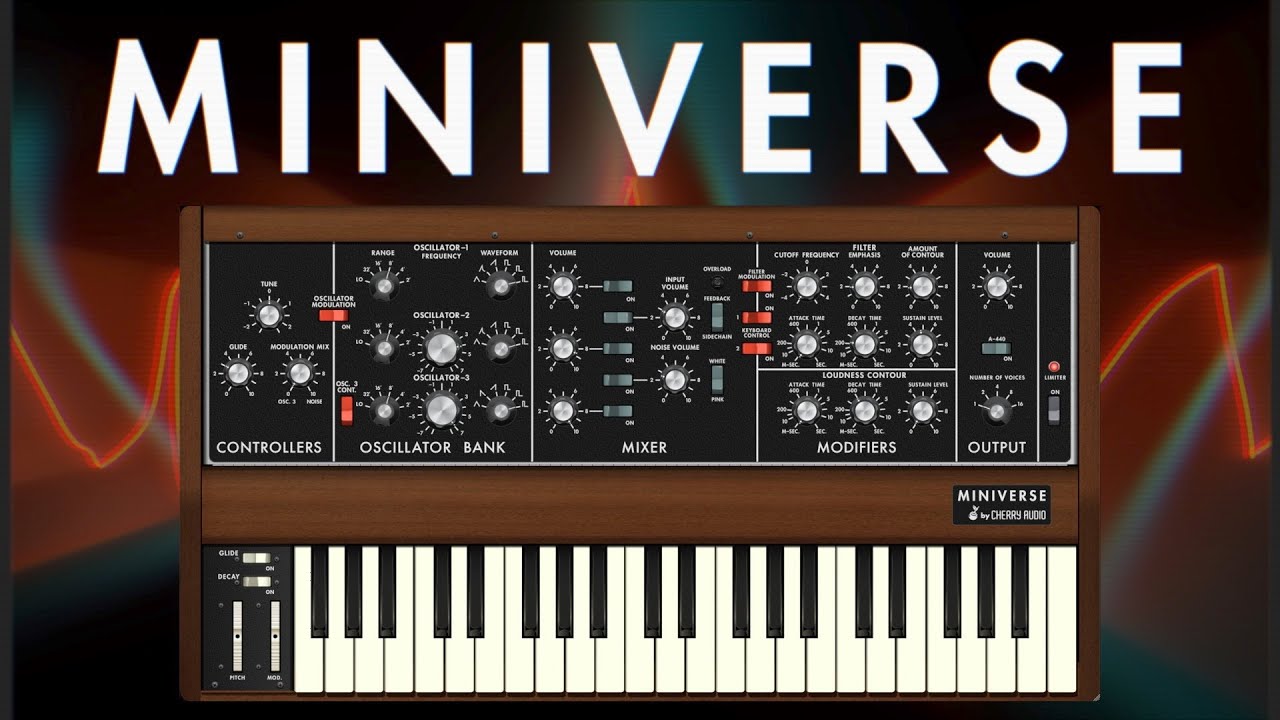
One of the unique features of the original Minimoog is that it did not offer pulse width modulation (PWM).
There were post-market customisations available to add this, but Moog’s answer to the issue was to provide three different pulse wave shapes, within each oscillator section. It is these wave shapes that are fully exploited for the sound of Cars, with a slight variance between the left and right channel.

If you would like to re-create the sound in your own DAW, then you must start by creating the patch for the left channel. It's important to note that you should load your plugin synth in a mono instance, rather than stereo, as this will allow you to pan the synth fully to your left channel.
How to replicate the Cars main riff sound

Using Oscillators 1 and 2, set these to a middle frequency range, such as 16’.
As a starting point, select the first and second pulse waves respectively, making sure that the volumes are set roughly the same. If your chosen synth offers PWM, alter the pulse width settings so that the two oscillators differ slightly in tone.
Depending on the synth you are using, it will be worthwhile creating a small amount of de-tuning. In the case of a Minimoog-in-software, this will mean changing the tuning of Oscillator 2, as the tuning of Oscillator 1 is fixed.
The other related elements to the sound are fairly simplistic, but will once again be open to variation, according to your chosen synth. The filter Cutoff Frequency should be set very close to fully open. In our experience, software versions of the Minimoog often include a cutoff frequency that opens wider than the original hardware, so you may need to reduce the brightness by a small degree. There is no resonance (aka emphasis) applied to this sound.
The filter envelope doesn't play a part here either, but the Loudness Contour (aka Amplitude Envelope) certainly does.
The patch fully sustains, and adopts a very fast attack time, and a rapid decay/release time. If you haven't done so already, switch your synth to monophonic mode or single voice, which will also limit any release phase time to the end of phrases.
That’s pretty much it for the left channel, but the patch for the right channel adopts very similar sensibilities, in fact, it would be worthwhile copying the L/H patch over to the R/H channel, for ease and speed of setup.

The subtle variation between patches takes place within the oscillator section again, where you need to select different pulse waves, providing a sort of ‘ying-yang’ effect between the two channels.
There is also a thought that a triangle wave is used in the R/H patch, which is something worth trying and applying. If you have a third oscillator available, use this and subtly apply a triangle to the existing sound. Much like our first patch, you will probably need to apply a little detuning, to avoid unwanted beating, caused by precise pitch accuracy.

All the other settings, relating to filter and envelope remain the same, although you could subtly tweak these, to create a slightly different tone and envelope tail.
If you haven’t done so already, pan the first patch hard-left, and the second patch hard-right. This will create a gloriously thick and complex texture.
Bussed for Phaser
Having created the two patches, you can record the riff on one part, and copy it to the other part. However, if you would like to adopt the purist’s approach, play and record the riff for each channel, without using quantize. The subtle timing discrepancies between parts will add to the overall flavour, getting closer to the original.
Like many synthesizers from this era, Minimoogs were very reliant upon external effects, and no other effect was more exploited on this album than a phaser.
As most DAW’s offer phasers in one guise or another, bus both of your synth patches to a single bus channel, and apply phaser to the bus. This is certainly an area for experimentation, as you could try various forms of stereo phaser, with variance of setting to get the perfect effect.
Other Elements
While Gary Numan’s music from this era was intrinsically linked to synths, he still made considerable use of conventional instrumentation.
The drums are provided by an acoustic drum kit, and the bass is provided by a bass guitar, however there would be no issue with using a further Minimoog-style patch, to provide a bass one octave below the riff we have been discussing here.
In fact, in the spirit of experimentation, you could use a third oscillator tuned an octave lower, to provide a thicker texture, all sounding simultaneously.
“I think to this day that Cars remains the most poppy song I’ve ever written” Numan reflected on his unlikely hit in an interview with Billboard, “I do not think I have a talent for pop music. It’s too light for me, for my taste in music. It’s too…happy. I’m just not very good at it! I’m much better if I slow it down a bit, make it a bit menacing, add a hint of mystery or oppression, I’m in my element at that point!”
