


As the decade turned from the 70s to the 80s, the ailing genre known as prog rock had lost much of its widespread popularity. Bands such as Pink Floyd, Emerson, Lake and Palmer, and Yes all still enjoyed critical success, but as the 70s gave way to punk and ultimately synth pop, it was clear that popular tastes had changed.
Yes had certainly been around the musical block a few times, with a revolving roster of band members that included Steve Howe, Bill Bruford and Rick Wakeman, in what felt like the musical equivalent of sliding doors.
In 1981, it was announced by their management that Yes were no more. But the music making didn't stop.
In 1982, Yes guitarist Trevor Rabin was introduced to bassist Chris Squire and drummer Alan White, and they went on to form the combo known as Cinema.
Cinema needed a singer; Trevor Horn was suggested, having been the singer in his own band, The Buggles, but Horn declined the invitation, but did agree to step up as producer for the band instead.
By January 1983, Cinema had recorded several backing tracks for a prospective debut album, but they needed a hit.
While Trevor Rabin popped out to take a comfort break, Horn left a tape of Rabin’s demos running. His ears pricked up when he heard the embryonic rhythmic shell of Owner of a Lonely Heart for the first time. In characteristic fashion, Horn could smell a hit.
After many appeals, Horn finally managed to convince the band to record it, firmly believing that what he’d heard would almost certainly be a success if released as a single.

The Rabin demo adopted a drum sound which was reminiscent of American rock. Trevor Horn wasn't really a fan of the sound, being far more in tune with drummers such as Stewart Copeland from the Police, and his tendency to tune the kit quite high.
After many months of wrangling with the arrangement, Horn expressed his desire to incorporate a drum machine into the song.
This did not go down terribly well with drummer Alan White, but eventually he came round to the idea, with Horn and White programming the drum machine together. Ultimately, the song incorporated both programmed and live drumming, with drum sounds being tuned to the key of the song (A minor).
Various other elements were flown-in over the top of the drum part, such as the open hi-hat sound, which we hear every two bars.
There are also some percussion elements, such as a tuned cowbell and some congas, both of which were very fashionable during the early 80s, along with a great use of heavily EQ’d lo-fi breakbeats.
Owner of a Lonely Heart is a riff-dominated song, which is far more reliant upon its main rising riff and tight drum sound than on lush chords. Although there are occasional moments where we hear more expansive keyboard parts, these are more momentary, or employed to lift the bridge section.
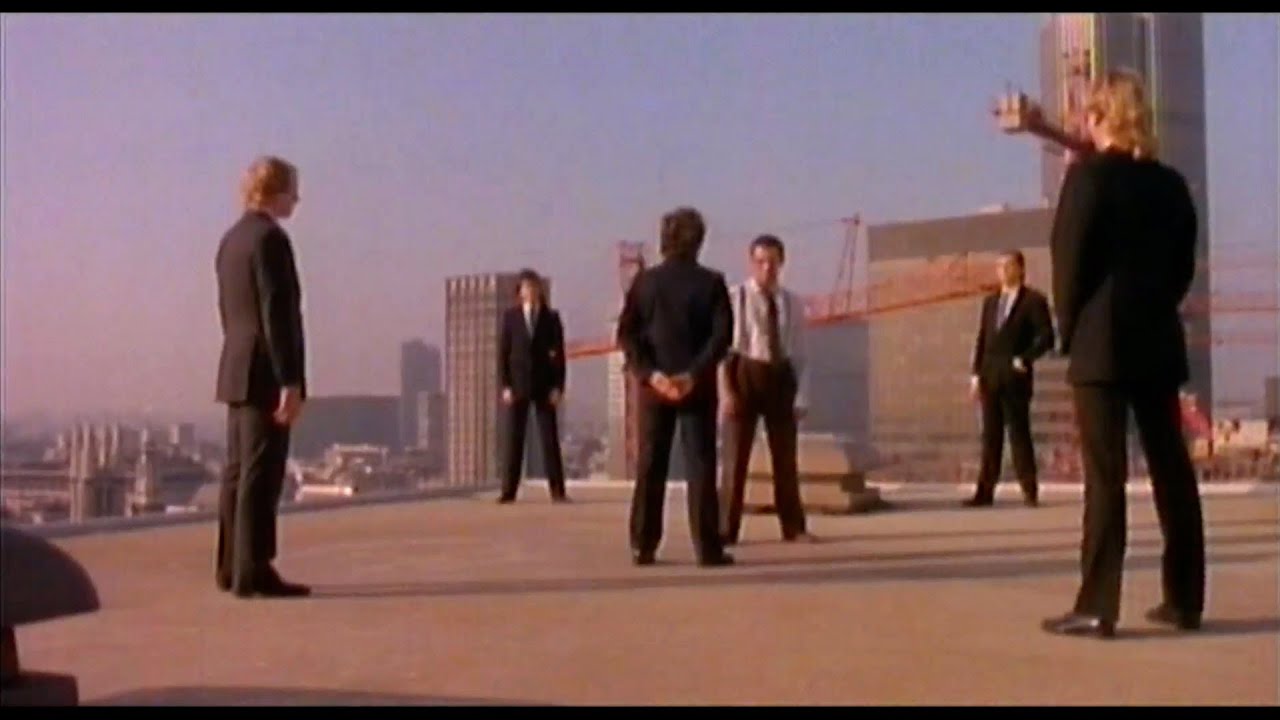
Even so, the main riff itself provides the absolute backbone for the song. We hear it from the outset, in a sustained form, played on a heavily distorted guitar, but it is the combination of bass and guitar, playing this rising riff, which forms the main song construct.
Being based in A minor, the bass rises up the scale - A, B, C, D-D… G-G.
There's nothing more uplifting than a upward step-wise motivic idea, and in the case of this bass part, bass player Chris Squire used a bass which had an inbuilt circuit - adding a ghost sub-octave. It's subtle, but it is there!
Doubling the bass part, we hear the guitar playing in 5ths, dry and muted in the first verse and overdriven in the second.
There is, however, considerable attention paid to the length of notes. According to Trevor Horn, this song was the first time band members had been forced to play to a click track, and the tight timing and unified articulation form the crux of the locked-in arrangement The bass and guitar are literally joined at the hip.
Of course, it's not just the riff itself. There are eighth-note guitar picks, which support the riff by picking out the notes of Asus4, breaking through every time there is a rest in the riff line.

The lyrical and vocal content was responsible for some fairly heated discussion during the making of the track. We have to remember that at the point of initial production, the track was being created under the guise of the band Cinema.
There was a turning point, when former Yes vocalist Jon Anderson was invited to return, initially just to listen to the track. Anderson felt that the vocal needed to be more percussive, and interject itself around the main riff.
“He played me the track, and it was the most amazing sounding track,” Anderson told Songwriter Universe. “It had samples and things like that. I said, ‘Chris, the chorus is such a hit record, but the verses need work. He said, ‘Well, would you like to sing on it?’ I said, ‘Well, if I sing I sing on it, then of course it will sound like Yes.’ And he said, ‘Yeah, that’s what we want.' So I said, ‘Okay,'"

Re-tooling the track from being a Cinema release to being a Yes comeback single was certainly the right move. As borne out by it ascending to the top of the US Billboard Chart upon release on October 24th 1983. But we’re getting ahead of ourselves…
The genius of Owner of a Lonely Heart arguably lies in its simplicity. The main riff runs all the way through the verse and chorus structures, with the occasional extended pause, such as those at the end of the first chorus.
A song like this could get pretty boring, unless there is some ear candy to capture the listener’s imagination. This gave rise to a host of interjecting sounds, which make momentary appearances. Trevor Horn referred to these as ‘whizzbangs’, thanks to their firework-like appearances; they appear unexpectedly, sound fantastic, and disappear just as fast!
The most iconic ‘whizzbang’ is undoubtedly the horn stab, which makes various appearances, interjecting on a 16th note push on each occasion.
The sound was originally sampled using a Fairlight CMI, with the assistance of programmer J. J. Jeczalik, although it is often followed immediately by a triplet figure, which was a combination of Synclavier and live playing. That’s two hugely expensive samplers for the time, typically selling for around $30,000 each.
These interjections were originally demoed by Rabin using a Minimoog, but in a push to bring the track up-to-date, samples and sounds du jour were adopted in the Moog’s place.
It's ironic that each short interjection, cost more in equipment terms than the price of a modest house, at that time. All for the art of music and production.

After the second chorus, we move to the bridge, which is a highly iconic and uplifting section of the song. We have a change in the bass and guitar parts, to a new riff, along with substantial accompaniment from keyboard parts, and a move to A major.
Jon Anderson's vocals fly particularly high at this stage, before shuddering to a halt after 12 bars, to make way for one of the most iconic moments in the track.
The Fairlight horn stab makes a return, interjected by a triggered breakbeat. We hear the stab four times on the note G#, before moving to the note E, and rising up chromatically to the note A, before ripping in to a guitar solo section.
According to Horn, the chromatic horn stab was played live on the Fairlight by Alan White. When auditioning the idea to the rest of the team, they laughed their heads off, probably because it was so different, but ultimately, amazingly creative.
With a large dose of irony, Owner of a Lonely Heart became Yes’s most successful and best-known track, charting in the UK, and going to number one in the US. It also became the first track on the Yes album 90125, which would mark the band’s first reformation.
“All of a sudden we were rock stars,” Anderson told Songwriter Universe. “Then we went on tour, and it was like the movie, Spinal Tap. I didn’t take myself seriously like a rock star, but everybody else did. And for the next five years, I had the best, funniest time of my life.”

It's amazing what you can do with a drum machine, and two of the most expensive sampling and production workstations ever made.
