
The stories of Roland and the drum machine are inextricably linked. Roland Corporation is known for many things: the iconic Juno and Jupiter lines, the influential SH-101 and SP-404, and a deep catalogue of instruments, effects and innovations – but the company’s most enduring impact lies with its groundbreaking contribution towards creating the modern drum machine.
Since 1972, the late founder Ikutaro Kakehashi’s vision has been singular, with each new piece of Roland gear making good on the brand’s effort to design the future through high-quality, boundary-pushing kit. This year, Kakeshi’s legacy has been once again rejuvenated with the release of Roland’s TR-1000, the company’s first drum machine in 40 years to feature a true analogue sound engine.
More than just a carefully crafted analogue dispatch in a modern world, the TR-1000 features faithful recreations of 16 of Roland’s revolutionary TR-808 and TR-909 circuit paths resting within a stacked list of modern amenities. It is not a revisitation or a rehashing, but a renewal of commitment to the same technology that made Roland great.

Roland’s innovations in drum machines have always been unique. Tracing Kakehashi’s output from his very first rhythm modules in 1964 under his previous company Ace Tone to the TR-1000 outlines a calculated trajectory which places creativity at the top of the brand’s pyramid of needs.

The TR-1000’s charisma lies in its fusion of classic analogue spirit with modern digital technology. Alongside its recreations of the TR-808 and TR-909’s analogue circuits, bolstered with expanded pitch and decay ranges and dynamic control, Roland has employed its ACB (Analogue Circuit Behaviour) technology to create digital models of circuit-bent X0X sounds. These are joined by a versatile FM engine and hundreds of PCM- and sample-based sounds.

Matching the machine’s extensive sonic arsenal with stereo sampling and resampling capabilities, an expressive clutch of effects and full-featured I/O, this newest offering from Roland is an achievement which celebrates the company’s history and future in a single take, topping off a long-standing track record of cutting-edge tech and artist-forward design.
To truly appreciate Roland’s place as a world-class electronic instrument-maker and understand the tech that brought the TR-1000 to life, nothing is more important than the story of Ikutaro Kakehashi and his company’s output of market-transforming drum machines.

Cast your mind back to a time before the TR-808 changed the face of pop music and helped launch hip-hop, showing up on records from everyone from Marvin Gaye to Afrika Bambaataa's Kraftwerkian Planet Rock and quite literally inspiring 808 State. Before the 909 could spark Daft Punk’s genius, choreograph Blondie and play a decisive role in launching house and techno.
Before the world knew the name Roland, founder Ikutaro Kakehashi set out on a mission: to create an accessible route for creativity through quality electronic instruments. To this end, Kakehashi founded Ace Tone in 1960. Ace Tone produced all manner of electronic musical instruments and gear, but the company’s expansive product catalogue also included something unique: analogue drum machines.

Drum machines were brand new technology in a burgeoning scene and complemented home and performance organs alike with their rhythmic accompaniment. Kakehashi’s Ace Tone Rhythm Ace drum machines would become the first ever circuit-based drum machines, unlike the rhythm boxes that came before, which relied on spinning discs and tape loops to create sound.
Thanks to retail partnerships with Hammond and Multivox, Ace Tone units made their way around the world. However, the company’s crown jewel would be the Rhythm Ace FR-8L. This was a robust analogue beat box with 16 preset rhythms and a unique analogue circuit-based sound. While the machine only offered preset patterns, the front panel featured very straightforward, fader-based mixing for a selection of percussion busses, as well as tempo and master level control.
In 1972, Kakehashi would begin the next chapter in his mission to change the world of modern music tech by founding Roland Corporation. Roland picked up Kakehashi’s work right where he left off by upgrading the Rhythm Ace FR-8L to the Roland TR-77. Building on the foundations of its predecessor, the TR-77 took the concept to a new level in ways that made it feel less like an accessory for a home organ and something closer to an independent instrument.
Roland’s TR series, which is widely believed to stand for Transistor Rhythm, would produce six unique drum machines throughout the 1970s, all of which relied on the era’s preset-forward design. Over time, the units became increasingly agile with enhanced mute, volume and balance controls on each subsequent drum machine.

In 1978 Roland released the next major upgrade in its catalogue: the CR Series or CompuRhythm drum machines. The original CR line featured three drum machines, but the most successful of the trio would be the CR-78. The CR-78’s programmability made it ideal for artists across all genres – a groundbreaking instrument, it was the first commercially available drum machine to use a microprocessor to enable users to program their own sequences, which could be stored in four memory slots.
This Roland box has shown up everywhere: Phil Collins In the Air Tonight, Blondie’s Heart of Glass, and Orchestral Manoeuvres in the Dark’s Enola Gay all heavily featured the CR-78. From Elton John and Gary Numan to Flying Lotus, Mac DeMarco and more, the CR-78 blew up the new wave and electronic scene of the late 1970s and still shows up today.
The 1980s brought a digital revolution which permeated all corners of the audio world. From digital rack effects, the advent of MIDI, digital recording advances, and a boom in digital synths, digital drum machines, and hybrid releases all around, the turnaround from the first transistor-based drum machines to digitally-voiced drum machines like the Linn LM-1 was quick.
While many studios were transitioning to digital technology – and paying handsomely for it – Roland still had work to do in the analogue realm. The TR-808 would be Roland’s answer for musicians priced out of the new digital wave, and for its efforts Roland would become a major player in the birth of genres like hip-hop, house and more over time.
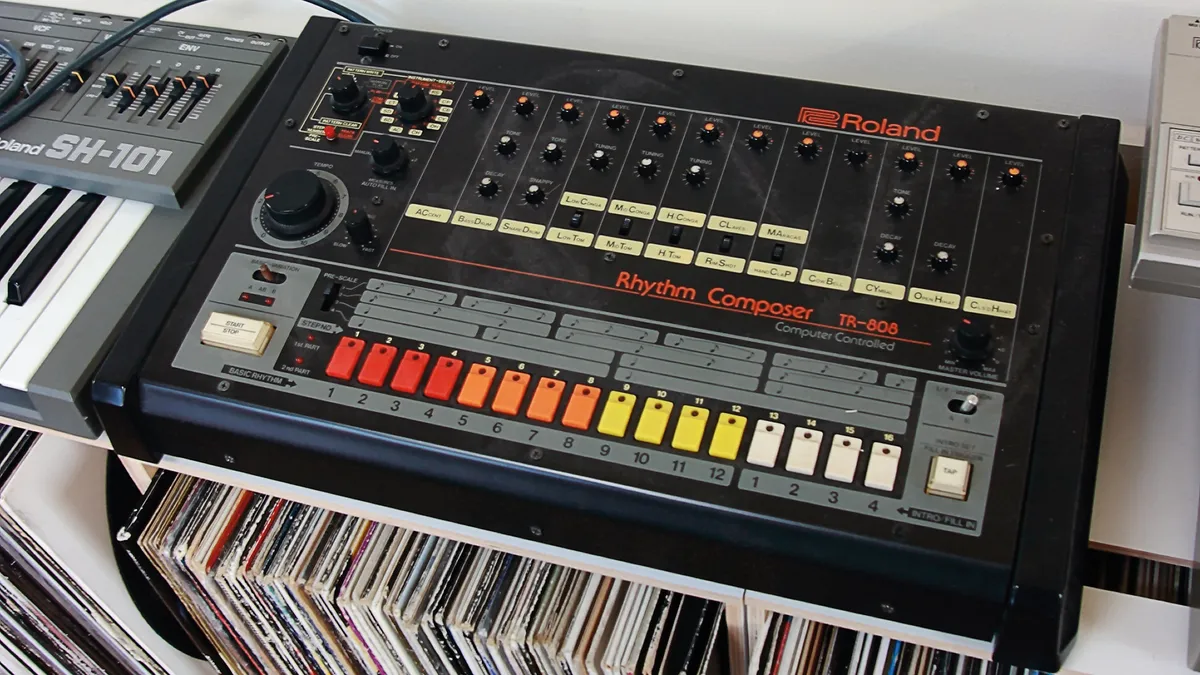
The TR-808 is the most influential drum machine ever created, and has likely featured on more records than any other. Known for its low-end response, the 808’s unique kick drum circuit comes with a long release, which, matched with pitch control, has become the most valuable feature of the machine. The kick circuit is fairly simple – a sine wave, a low-pass filter and a dedicated VCA – but with simplicity comes a sharpened focus, and at the 808’s pricepoint, the unit became notorious as an accessible instrument that could easily surpass its digital competitors.
Released the following year, the TR-606 Drumatix redefined the Roland’s signature form factor with a smaller footprint without losing reach, going on to be a favorite in IDM, industrial rock and pop music, boasting seamless playback and record functions that allowed for unparalleled performability. It has become a go-to for artists like Aphex Twin, Squarepusher, Autechre, Orbital and more over the years.

In 1983, Roland released the TR-909, pumping out yet another scene-stealing TR machine in just three years. The 909 was ahead of the game for a few reasons, but most notable would be its MIDI capabilities and its hybrid design.
Utilizing both analogue and digital signal paths, the 909 would combine the best of Roland in a single unit. Building on the 808, the 909 depended on analogue paths for the drum voicing and digitized sounds for the cymbals and hi-hats, with a punchy, synthetic sound palette. The 909’s crisp and crunchy clap and forceful kick drum would go on to play a starring role in the genesis of house and techno, echoing through the following decades to remain as influential as ever in 2025.

The completely digital TR-707 would be the final major upgrade to the TR line of the 20th century, followed only by the TR-505 and TR-626. On top of the device’s extensive I/O capabilities and 8-bit sample based sound, the 707 also featured mixer faders per voice, which, though it would become a standard feature on modern Roland drum machines, was not common in its time.
Roland continued putting out high-quality, affordable drum machines throughout the end of the ‘80s and into the ‘90s. Introducing 16-bit sampling, nuanced controls, expandable libraries with sound cards, and more Roland’s drum machine output – including that of guitar products division BOSS – was prolific and industry-leading.
In 1996 Roland released its first groovebox – and the first groovebox – the MC-303, which brought a level of performability and customization yet unseen in the Roland line. The Roland groovebox design, which merged a synthesizer, drum machine, sequencer, and (later on) sampling capabilities, paved the way for celebrated instruments like the Akai MPC series, modern day Elektron boxes, and much more.

Over the next decade, Roland would continue to develop its standout line of grooveboxes featuring some of the most adventurous modulation options that Roland had to offer, including the proprietary D-Beam technology, futuristic hands-free modulation through a light sensor, and market-savvy mixer add-ons like turntable emulation.
While Roland’s drum machine output slowed down after 2010, the company shifted focus towards affordable drum machines with accessibility and legacy as their backbone. Joining other manufacturers in a new wave of competitively priced digital drum machines, Roland launched the Aira line in 2014, harking back to the magic of vintage Roland tech using ACB.
Roland’s TR-S series and MC-707 and MC-101 would revive the classic Roland groovebox format with newer digital upgrades and deep sound capabilities. Roland even has options for players interested in ultra-small footprint devices with its Boutique series, inspired by classic Roland synths and drum machines.

More than fifty years have passed since Roland released its first drum machine, and the spirit of Kakehashi’s founding vision remains stronger than ever. With the release of the TR-1000, Roland brought almost every major leap the company has made together in a single device, an instrument that's as much a blueprint for its future as it is a nod to its past.
From the TR-77 to the TR-1000, Kakehashi’s legacy has been immortalized not only in the instruments that he designed, but perhaps most importantly, the music that’s been made with them.