
As 2025 draws to a close, we look back on another exciting year of new music technology gear, packed with characterful synths, hard-hitting drum machines and cutting-edge software.
In our two-part gear of the year video round-up, MusicRadar’s Managing Editor Si Truss and Reviews Editor Simon Arblaster each select their three favourite hardware and three favourite software releases from the past twelve months.
You’ll find the full list below. Watch the videos to hear us explain our choices and highlight a few wild cards and honourable mentions.
These are our personal highlights of 2025, but there's so much other great gear we've not had time to mention. Tell us what you've been loving and using in the comments below.
The best music tech hardware of 2025
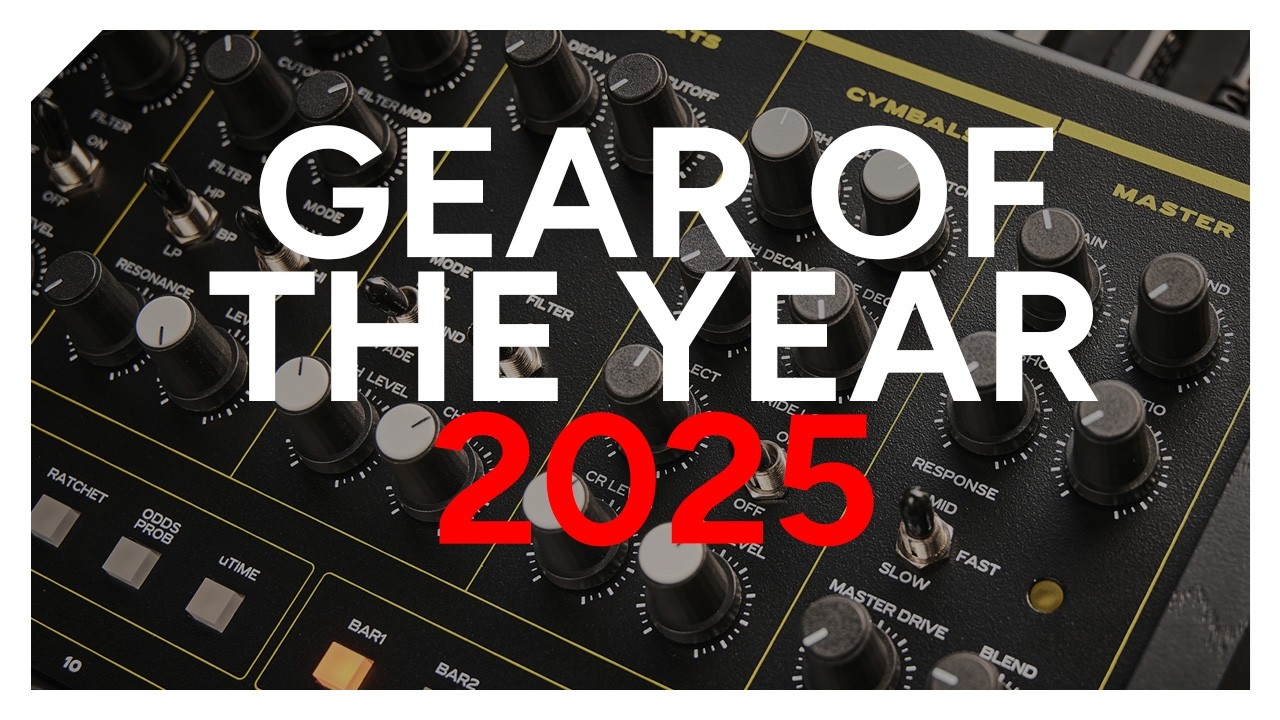
Sequential Fourm (Chosen by SA)

What is it?:
Despite a slightly clunky name, Sequential’s latest polysynth is its most accessible instrument in years, thanks to a sub-$/£1000 price point and compact form factor.
Why we love it:
It might be at the cheaper end of the Sequential range, but Fourm sounds just as top-quality as any of the brand’s other instruments. The big winning feature here is poly aftertouch, which is brilliantly implemented and leads to some wonderfully expressive chord and arp patches.
Any downsides?:
The slim keys are likely to upset some users, and there’s a lack of onboard effects.
Read the full Sequential Fourm review
Akai MPC Live III (Chosen by ST)

What is it?:
The third iteration of Akai’s most portable and self-contained MPC doubles down on the standalone DAW-in-a-box capabilities by vastly increasing the power of the CPU, improving the pads and adding a host of new features to the hardware.
Why we love it:
The new multi-zone MPCe pads are great, and feel brilliantly responsive for finger drumming and playing software instruments. The addition of a more X0X-like step sequencer is a really nice touch too, particularly for those working with modular gear and external hardware. The real highlight here is the additional power though, meaning there’s far less of a reason to hook up to a laptop to get projects over the line.
Any downsides?:
Some might argue that the extra features make the interface feel cluttered.
Read the full Akai MPC Live III review
Arturia AstroLab 37 (SA)

What is it?:
The third, and smallest, addition to Arturia’s AstroLab range, which draws on the company’s Analog Lab software to offer, essentially, the much-loved V Collection as a standalone instrument.
Why we love it:
We really enjoyed using AstroLab and the AstroLab 88, but both are big commitments in terms of price and space. For studio users that don’t need the full stage keyboard playability of the bigger units, this offers a convenient route into the expansive and slickly designed AstroLab system.
Any downsides?:
Again, some will bemoan the slim keys. It also lacks the flexible sound layering of the larger units.
Roland TR-1000 (ST)

What is it?:
Undoubtedly the most high profile hardware release of the year, the TR-1000 is Roland’s new flagship drum machine, combining virtual analogue, digital percussion, flexible sampling and – yes – fully analogue recreations of the classic TR-808 and TR-909.
Why we love it:
The analogue drums are nice to have, but the real highlight of the TR-1000 is how flexible it is in terms of connectivity and sequencing, particularly thanks to the inclusion of a fair few ideas ‘borrowed’ from Elektron machines.
Any downsides?:
Yes. It’s very expensive and as much as the analogue sounds good, honestly, we kind of wish it was all digital and £1000 cheaper. There were a fair few bugs at launch too, particularly when it comes to syncing to external clocks – although Roland is working on ironing these out.
Novation Launch Control XL 3 (SA)

What is it?:
The third gen iteration of Novation’s knob and fader-equipped controller. As with other devices in the ‘Launch’ range, while this was originally launched as an Ableton Live controller, this latest generation is much broader and more versatile in its uses.
Why we love it:
The general look and design is a big improvement on v2, but our highlight here is the inclusion of full-sized MIDI ports, allowing the Launch Control XL to be hooked up to your studio hardware without the need for a computer.
Any downsides?:
The OLED screen is a little small, meaning some functionality requires slightly confusing use of the shift button.
Read the full Launch Control XL 3 review
Erica Synths Hexdrums (ST)

What is it?:
After Canadian modular brand Hexinverter Électronique went out of business in early 2023, Erica Synths stepped in to ‘rescue’ some of its best loved designs. This means that Hexinverter modules like the Mindphaser are back in production. The two outfits also collaborated on a standalone drum machine, Hexdrums, which converts the sounds of Hex’s Mutant Drum series into a desktop, mostly-analogue beatmaking beast.
Why we love it:
Where the analogue drums of the TR-1000 are refined iterations of vintage sounds, Hexdrums’ generators are fresher, more modern and hit like a frying pan to the face. This is a wonderfully hands-on, intuitive machine that sounds massive right out the box.
Any downsides?:
For the price, there are considerably more capable options out there. Hexdrums’ raw and gritty sound is likely to suit some users more than others.
The best music tech software of 2025
Xfer Serum 2 (Chosen by ST)
What is it?:
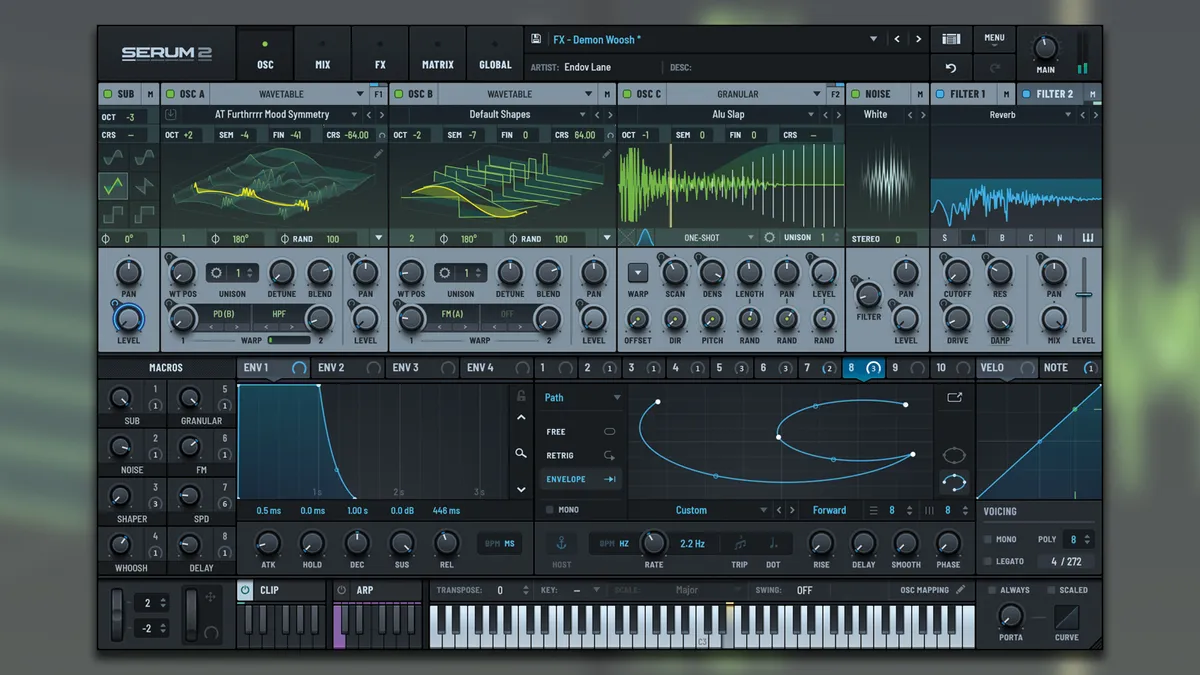
One of the most widely-used and well-loved software synths of all time returns for a full v2 refresh. New additions include a host of new sample-based oscillator modes, including sample, granular and spectral synthesis.
Why we love it:
Serum has always been a fantastically deep and rock-solid synthesizer, making it a real workhorse for modern bass, lead and pad sounds. This update only doubles down on that, adding a wealth of new sound design capabilities. What we really love, however, is the fact that Serum 2 is a free update for existing owners, meaning that even if you bought v1 in the early 2010s, you’re still getting everything for free – a great bargain.
Any downsides?:
Arguably if you don’t already own Serum and you do own, say, a power synth like Pigments or Phase Plant, there’s not a lot you can’t achieve in those other synths. Other than that, there’s little bad to say about it.
Acon Digital Remix:Drums (Chosen by SA)

What is it?:
Acon Digital's AI-powered Remix:Drums separates drum recordings into individual stems in real-time, giving you precise control over each percussive element in a mix. It allows users to apply targeted processing to each component of an existing recording, rebalance their levels or simply remove them altogether.
Why we love it:
There are a lot of AI-powered stem separation tools out there, most of which work in a broadly similar manner. Remix:Drums stands out by focusing on a specific track element – percussion – which allows it to be a deeper, more powerful studio tool.
Any downsides?:
Although the technology and usability really impressed us, there are still occasional imperfections and artifacts in the extracted audio.
ValhallaDSP FutureVerb (ST)

What is it?:
The latest plugin from reverb and delay specialists ValhallaDSP, FutureVerb is said to be based on eight years of research and development. The result is a plugin that combines reverb and echo modules, each with an array of new algorithms that run the gamut from clean, modern sounds to wonky, ethereal effects.
Why we love it:
As with other Valhalla plugins, FutureVerb is neatly designed and incredibly easy to use. It’s versatile too, capable of both realism and extreme effects. The ‘80s-style nonlinear reverbs are a particular highlight. At $50, it’s a bargain too.
Any downsides?:
Although it has its own character, there’s a fair amount of crossover between what FutureVerb does and other ValhallaDSP plugins – including the free SuperMassive – meaning it’s not quite a must-buy for those who own the rest of the range.
Arturia Mix Drums (SA)

What is it?:
The latest addition to Arturia’s rapidly-expanding effects line, Mix Drums is pitched as an ‘all-in-one’ drum processing plugin combining dynamics, reverb, distortion, tone-shaping and much more.
Why we love it:
Mix Drums lives up to its promise of quick and easy drum mixing by providing all our usual go-to percussive processors in one place. It’s packed with genuinely useful presets and comes contained in a stylish and easily navigable interface. Easily the most day-to-day useful plugin we’ve tried this year.
Any downsides?:
Although Mix Drums ties up a lot of functionality in a single package, arguably much of what it does could be reconstructed using stock tools in your DAW.
Native Instruments Absynth 6 (ST)

What is it?:
Absynth is another bonafide classic softsynth. Combining elements of granular, FM, spectral and subtractive synthesis with sound-shifting effect modules, Absynth has long been a go-to for creating soundscapes and textural synth patches. Version 5 was discontinued by NI a few years ago, but Absynth has now returned, re-built to run on modern architecture and with original designer Brian Clevinger back in the fold.
Why we love it:
Everything we used to love about Absynth is still present and correct, but version 6 has given its dated UI a lovely modern refresh. It’s not all about looks though, the new interface adds a neat preset map that makes it quicker and easier to browse similar sounds. The best new feature is MPE compatibility, which really suits a texturally-minded synth such as this.
Any downsides?:
Beyond the improved UI and a few new sound design tools, Absynth 6 isn’t a huge leap forward from version 5. It’s great to have it back on our hard drives nonetheless.
Spectrasonics Omnisphere 3 (SA)

What is it?:
The return of another synth icon. Omnisphere is a sample-powered behemoth beloved by countless pro producers. Omnisphere 3 arrives with thousands of new sounds, a new global control system, an expanded effects engine, patch mutation, MPE support and more.
Why we love it:
Omnisphere sounds exceptional and in this latest iteration it really is stuffed with a mind-boggling amount of creative sounds. The new MPE support and hardware control features are excellent too.
Any downsides?:
Omnisphere is massive in both sound and size – it requires a download of more than 60GB to install.
