
NAMM 2026 was absolutely dominated by AI-discourse. There were many eager music tech companies looking for new ways to incorporate the alleged world-changing potential of it. Then, there were those generative AI-oriented outfits trepidatiously floating around the show, subtly attempting to integrate themselves within a cautious industry.
While AI is, of course, a broad topic, a widespread perception for many in the music-making sphere is that AI is an existentially damaging force. What's more, is a pervading feeling that this disruptive new power should not be engaged with in any capacity.
It’s a view largely fostered by the rejection of copyright-infringing, generative AI-platforms, evolving into a mass lumping-in of anything labelled with those two little letters as aspects of the same malevolent entity. Even the stuff that may actually be pretty useful, is frequently tarred with the brush.
We were intrigued then, when we were personally invited at the show to check out a markedly different kind of AI-driven product. Allegedly designed to help human users become better musicians, this new product sought to arm piano and keyboard-leaners, and not replace any part of the human-instrument relationship.
In fact, this new tool - designed by Seaboard and Equator-maker ROLI, is entirely built around tightening that bond.
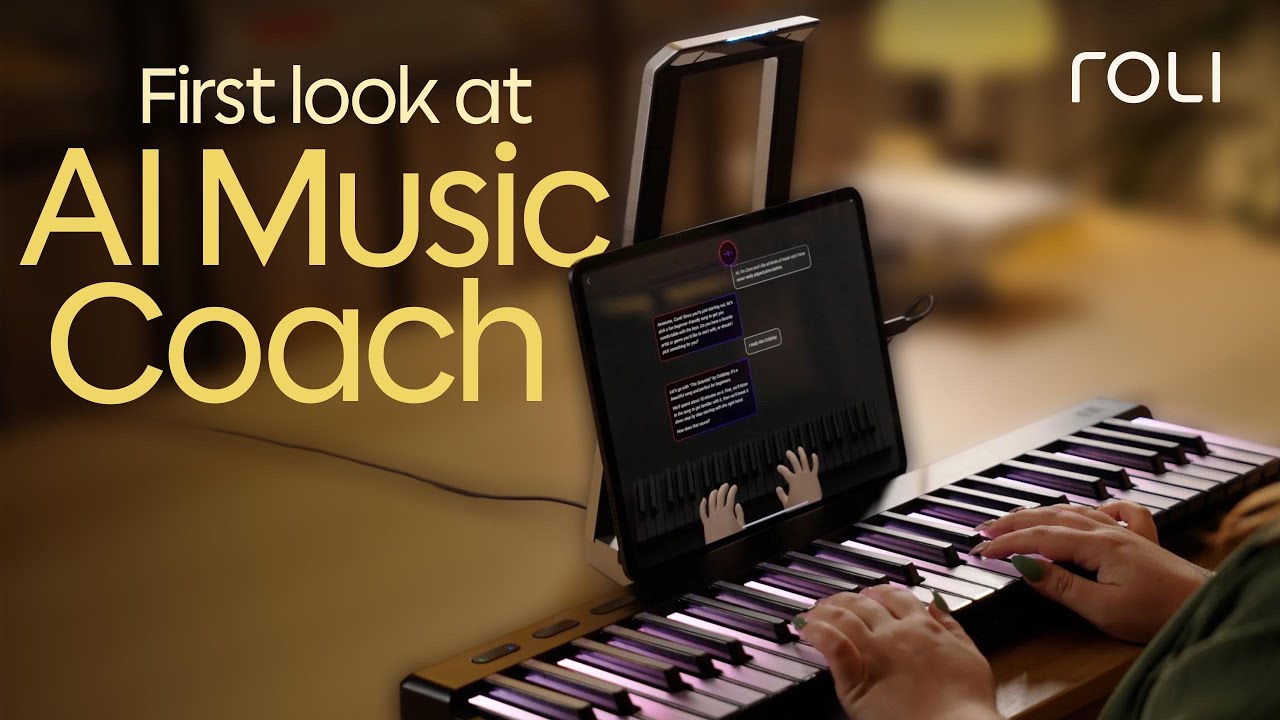
Ostensibly a smart AI piano teacher with a difference, we were told that this intelligent educational software monitors every nuance of the user’s playing, and verbally guides with smart, tailored feedback, angled at improving playing ability over time.
ROLI's AI Music Coach works in tandem with ROLI’s Airwave hand-tracking device to monitor all 27 joints in each hand, which are visualised on-screen at 90 frames per second.
It also works particularly well with ROLI’s vividly-coloured Piano to guide users through a range of colour-labelled exercises and challenges. Hand placement on the keybed is depicted on the screen in realtime, while the interface is entirely speech-based.

As we sat down in ROLI’s refreshingly quiet, dimly-lit (but aesthetically on-point) demo room, CEO Roland Lamb positioned this writer in front of the software, and willed me to explain to the new software who I was, my piano ability-level, and to choose a genre to angle the lessons around.
After communicating that I was more of a 17-takes kind of guy, my first test was to try and match the vocal melody of Billie Eilish’s Bad Guy, depicted on screen as a series of coloured blocks falling down into place over the respective piano keys, with my jittery hands visualised in real-time by Airwave, illuminating which finger should be on which key.
A few quite surprisingly stern responses were issued my way when the concept of an index finger mysteriously vanished from my head - but as Roland explained, this software replicates a real teacher - and evenly balances the fun with the firm.
“The sweet spot is a place where it's not too easy, it's not too hard.” Lamb told me. “You're being challenged in the right way and you're being encouraged, and it's like if you're being challenged too much and not encouraged enough, it doesn't work. In the same way, [it doesn't work] if you're being encouraged too much and not challenged enough.”
A polite way of saying my own playing needed a fair bit of challenging…

Once I managed to snap into gear with the required rhythm, I realised that this particular song-learning aspect was starting to rekindle dim memories of the era of Guitar Hero, albeit with a discerning brain behind the scenes keeping a watchful eye on what I was doing (and I'm not talking about Roland…)
Eventually expanding into chords and more nuanced polyphonic melodies felt like a dopamine-triggering challenge.
As Roland explained, this ‘gamification’ of the learning process has been carefully designed by ROLI to help those who are practicing on their own to improve their technique on a daily basis, merging discipline and play to alleviate the feeling of it becoming a tedious slog. A particular concern for young people just starting out in their journey.
“Lots of people have a certain amount of fear of piano lessons - a fear of failure,” Roland explained. “This kind of takes it away because it's friendly and you can do it on demand. And so there's a lot of ways in which the usability and convenience of a system like this will just help people get started.”
As Lamb continued, he explained how AI Music Coach can generate a personalised lesson plan, as it gathers data on your approach. “It can instantly generate new lessons and new feedback based on what you're learning or your level.”
That’s certainly something I noticed during my initial test as the piano speed smartly slowed down before gradually increasing as I got the hang of it.
Beyond learning particular popular songs, and leaning futher into the ‘gamification’ concept, we were shown one of the the platform’s on-board games, Superluminal - an Asteroids-style video game spin on piano teaching. It began by firing increasingly rapid single notes - which could only be ‘shot down’ by hitting the matching coloured key.
Ultimately, this became dual notes and chords. If the basic song-learning approach got the dopamine trickling then this was akin to a tidal wave. Built with the addictive ethos of a classic arcade game, the instantly absorbing nature of the experience was gradually achieving that age-old trick; teaching without the student even realising they're being taught.
The clear objective here is to facilitate the brain-mapping of the piano keyboard (and the linked notes of a key) via this atypical, addictively fun context, and not through hours of joyless repetition.
“You chose to play that game in C major,” Roland points out. “Maybe if you were working on [learning] a song, you know, in G flat, [AI Music Coach] would be like, ‘Why don't you play that in G flat’, so that you're learning more.”

“Or it might notice that you often make mistakes when it comes to your ring finger,” Roland continued. “A lot of people do, [it’s] the hardest finger to control. So, it might suggest an exercise to build strength or dexterity in your ring finger. It’s going to become incredibly targeted, and it will have insights that real human teachers can't have because they don't see.”
Roland went on to show us another facet of AI Music Coach, a more classically-angled view which guides the player through virtual sheet music.

“I’m a jazz musician, and I'm learning how to read music,” said Lamb. “This is really helpful for learning; I can choose different sections, it can help me adjust to the speed. We think that that is a really nice thing, because it can just work at so many different levels of the music-learning journey. There's a lot of conversations about AI, and particularly sort of [generative] AI for music. but we think this is the sort of best and first example of using AI for human interaction, teaching and learning in music.”
That leads us onto the potentially provocative elephant in the room; the fact that in 2026, the denial of AI-infused products as a matter of principle might scare away potential customers. Did Roland and ROLI contend with that concern when developing AI Music Coach?
“I'm not worried about it,” replied Roland. “But, I totally understand it. Here at ROLI, my philosophy is that AI and technology can be powerful as long as you use it in the right way, and our mission is to use AI to enhance the humanity of humanity. AI can actually help us to be more human by doing things like teaching us the piano and giving access to people who either don't live near a teacher, can't find one or can't afford one.”
Roland stressed that this product is not just for people who can't access a teacher. It's also for people who already have a teacher and want extra tuition between lessons.
“Often practicing is lonely and you're not sure if you're doing it right. I like to think that when you're practicing, you kind of are the teacher and the student at the same time. You have to impose discipline on yourself which is very difficult, because you don't necessarily even have enough information. It’s actually that relationship between being the teacher and the student at the same time that makes a lot of people give up. What [AI Music Coach] is doing is delegating the teaching or coaching function to the AI, and then you can just focus on learning, which is where you should be when you're learning. I think it's a much more efficient model.”

While our time with AI Music Coach was somewhat brief, it was pretty apparent that this hyper-engaging way of getting to grips with a keyboard certainly feels like it could be a satisfying antidote to the often daunting formality of traditional piano lessons.
However, the software - slated for release in the Spring - isn’t quite fully ready-to-go yet…
In our demo there were a handful of technical gremlins - including a slight crash requiring a restart, a mis-hearing of my name and the voice recognition software interpreting my Northern English accent as being Welsh-language (although to be fair, it later made up for this in having no problem swiftly adjusting to Lamb’s pivot from English to Japanese).
These hiccups aside, ROLI’s attempt to redefine AI and re-contextualise it is an educational aid is certainly refreshing. A proudly AI-labelled product that is centred around empowering newcomers to improve their own abilities is an ambition that’s hard to sniff at.
In a more formal statement, released via ROLI’s press team, Lamb was quoted as saying, “We are so excited about this breakthrough in music learning. The combination of hand tracking, advanced voice capabilities, deep musical knowledge, and a range of engaging experiences results in an entirely new type of practice. It’s more fun, but also more effective, because the AI Coach can give you feedback on your technique. And anyone can use it. You don’t need to be able to read music to learn, you don’t even need to be able to read. We think this is an important human-first use of AI. No AI slop.”
ROLI told us that the closed beta of the AI Music Coach opens today, with current Airwave learners eligible to sign up, along with Airwave preorders as they are activated.
A public beta will open by the end of March 2026, with usage limits still to be determined. The company is keen to emphasise that the AI Music Coach will be a cornerstone of its ongoing learning-angled experience. We’ll report back with more info when we have it. Find out more info here
