


Note: This opinion-based, long-read format allows a range of writers a platform to speak about the topics that are important to them. Their views are their own and do not necessarily reflect the views of MusicRadar as a whole.

Andy has been writing about music production and technology for 30 years having started out on Music Technology magazine back in 1992. He has edited the magazines Future Music, Keyboard Review, MusicTech and Computer Music, which he helped launch back in 1998. He owns way too many synthesizers.
The use of AI in music-making is now more widespread than ever, and it's getting better and better at a frightening rate. But do consumers really care how their music is made as long as it sounds good? And where does this state of affairs leave us as 'traditional' music producers? Is the future of music creation really just a text prompt?
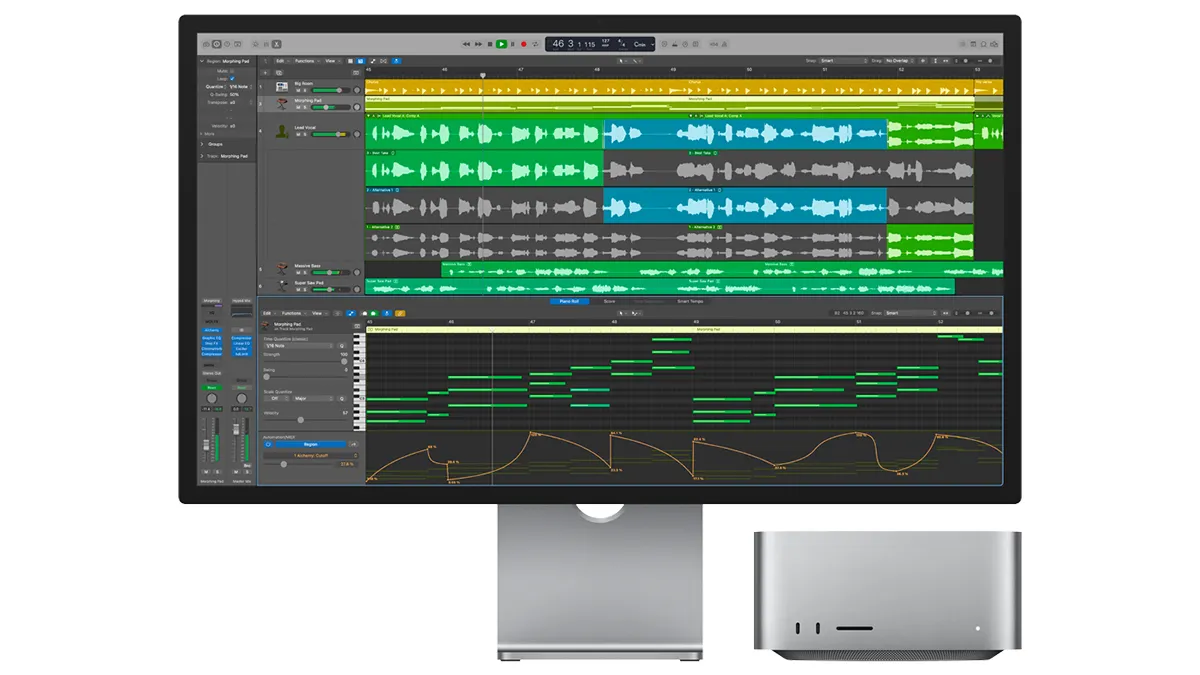
When we first launched Computer Music magazine way back at the end of the 20th century, we jumped on a sequencer-based bandwagon that would end up ploughing through the traffic and leading the way as the de-facto bedrock of modern music creation. As the years went on, ever more sophisticated iterations of the DAW (Digital Audio Workstation) made more and more previously laborious production tasks that much easier to do at the click of a mouse.
DAWs have now not only become the recording and arranging weapon of choice for the bulk of music producers and performers, but also the easiest jumping-on route for a vast number of people not gifted in traditional musical techniques, mixing knowledge, nor recording polish.
In short, anyone with a fairly basic understanding of track creation, mixing and arranging can build out complex pieces of music, very quickly.

A very brief DAW history
DAWs gave power to the people, allowing home music-makers to create release-quality music without having to get signed to a label, and/or fork out money for studio time. The mainstream adoption of the DAW was a not inconsiderable shift, and a relatively recent one at that.
What could be construed as the first DAW was the 1978 Soundstream Digital Editing System that used a late ‘70s computer, an audio interface, and basic digital editing of waveforms using an oscilloscope as a display.
Cubase it was not, but it did lead the way. Digidesign’s 1989 Sound Tools owes at least some of its digital editing prowess to this foundational system.
On the MIDI side of things, Steinberg forged a path with its Commodore 64-based MIDI Multitrack Sequencer (1984) and Pro-16 (1985) sequencers, before developing Pro-24 for the Atari ST and Cubase for the ST, Mac and PC.
Fellow German developers C-Lab followed a similar route with its mid-80s C64 MIDI sequencers (SoftTrack, SuperTrack and ScoreTrack) before likewise jumping to the ST with Notator and Creator. From C-Lab came Emagic and Notator Logic for the ST, Mac and PC.
Audio and MIDI would become partners in DAWs throughout the 1990s, while more loop-based and intuitive products like Ableton Live would join the fray from 2000-onwards.
Yet those early Cubase and Digidesign wares would set a template that is still very recognisable in modern DAWs.
That copy of Cubase v1 for the Atari I stumbled across at college in 1989 used the same(ish) MIDI technology and design as many DAWs of today: tracks going top to bottom, mixing and arranging left to right.
The only difference is that now there are many companies offering extremely similar DAW packages with as many virtual instruments as you could wish for, all bundled together for your virtual studio.
The end of the DAW?
It seemed then, that this DAW-based approach was here to stay.
But little did we foresee the twist in the tale - the rise of generative AI. This low-barrier technology can create tunes by text or spoken prompts alone.
Entire albums can be created by just describing what you want. This not only takes the legwork out of music production, but a great deal (ok, all) of the fun.
AI has numerous other applications of course, it can be deployed in a less do-it-all solution and more of a co-pilot. As the 2020s have rolled on, DAWs (and plugins) have been relying on an increasing number of AI elements to assist in the creation of everything from chord progressions to complex beats, aiding those lacking the prerequisite knowledge.
Like DAWs before it, this new technology is understandably worrying not only to the music software industry but music producers. Those who relied on regular work creating music for advertisements for example (not to mention the videos themselves), will already have been looking over their shoulders (if not in front of them) at the likes of Suno and Udio, as AI peruses their work and sketches up an indistinguishable facsimile.
These generative algorithms are powered by years of studying a colossal archive of previously released, human-made music, arming it with the power to rustle up a decent sounding-response to pretty much any prompt you throw its way.

Musicians were already struggling to make a living from their passion, and the ability to monetize your music looks set to get even harder as AI gets better at impersonating human creators, which it undoubtedly has and will continue to do.
Leaving aside the ethical issues of releasing AI-created music under your name (although there is quite clearly a debate needed over what exactly ‘music-making’ now actually means) it does feel like we should at least try to harness the benefits of this new tech and apply it however we wish.
Having more tools at our disposal has to be a good thing, right?
But is AI music creation actually 'creation'?

And this is the question at the heart of it all, the centre of any debate about AI impacting on our creative industries, whether it be in filmmaking, special effects, video game development or music. Is giving an AI platform a prompt and passing off the results as our own really a fulfilling and creative process?
I haven't got the time or space to wrestle with that big question in full - it’s one of the core debates of the mid-2020s after all.
So, I’ll just get to the point. In my view, no it isn't.
Even as an advocate of embracing music technology over the last 35 years and using whatever tools at your disposal, I still see AI as removing the fun part of music production, its creation.
As an example of this, I recently made some AI videos to use with some recent (non AI!) music I'd produced, and while the process was fascinating, thrilling and scary, and the results way better than anything I could have made without AI, the end results were hardly creative.
They were as soulless and by-the-numbers as you might expect. The whole process left me feeling flat and empty. Creative satisfaction it was not.
With little money to be made from music, the joy has to be in its creation and at a human level, and that is why AI doesn't have a place in my particular set-up.

Who gives a monkeys?
Which would be a great way to end this piece - “two fingers up to AI, and keep music making human!”
A rebellious approach, perhaps, but the truth is, who gives a damn how music is being created these days, as long as it is enjoyed?
There's a good chance that you are already consuming a lot more AI music than you realize, and it's probably not making your life any worse. And who can forget (actually everyone) the very first successful AI band, Velvet Sundown, who got enough clicks and streams to make the headlines.
If more evidence were required, AI has already achieved its first number one with Xania Monet hitting top of the Billboard chart in November 2025.
Unfortunately then, this means that while we might endeavour to push back and carry on our individual human/DAW-based approaches as creatives, it's not really up to us if the listening public doesn't care either way.
So we can either put up or shut up - or start a cause to 'keep music human', but that sounds a bit like when the Musician's Union tried to ban synthesizers back in the 1980s - and it didn't work out well for anyone.
From mods to rockers
'Keeping music human' is still an option, although it's going to be an increasingly difficult one as the join between the two becomes less noticeable.
So where exactly does this leave the (now) traditional use of the DAW? As AI-made music becomes more 'human', perhaps our only option is to make our music more machine-like. Sounds crazy? Let me explain.
When we started Computer Music in 1998 we focussed on traditional sequencing much to the then annoyance of the mod-tracking scene, a network of creators who employed cheap or free trackers to create music based on events; it’s a bit more techie than sequencing, so we took the easier DAW route, with an eye on a large contingent of our readership that consisted of novices to computer music-making.
That tracker scene, however, carried on regardless, and we even got to see it updated in hardware like the Polyend Tracker. So, I do wonder if this is the way the DAW will go, turning into its own underground 'scene'.
Just look how the nostalgia of vinyl has captured people's imaginations, so maybe we'll soon be saying, “wasn't it great in the olden days when we made music on computers and with software?” The good old days of loops and samples.
Maybe us DAW-users will become very much a subculture in music creation which ironically, given its repetitive and machine-like nature, becomes more human than artificial.
It's a difficult future to predict, and we're at that fork in the road sooner than we anticipated. A more strident solution might be to take up arms, learn an instrument and get-up and play it live in front of other people (and get your kids to do it too while you're at it!)
That's something AI will never be able to replicate, which sounds like a prediction just waiting to be broken…

Let us know your thoughts on the future of the DAW, gloomy or otherwise, in the comments below.
