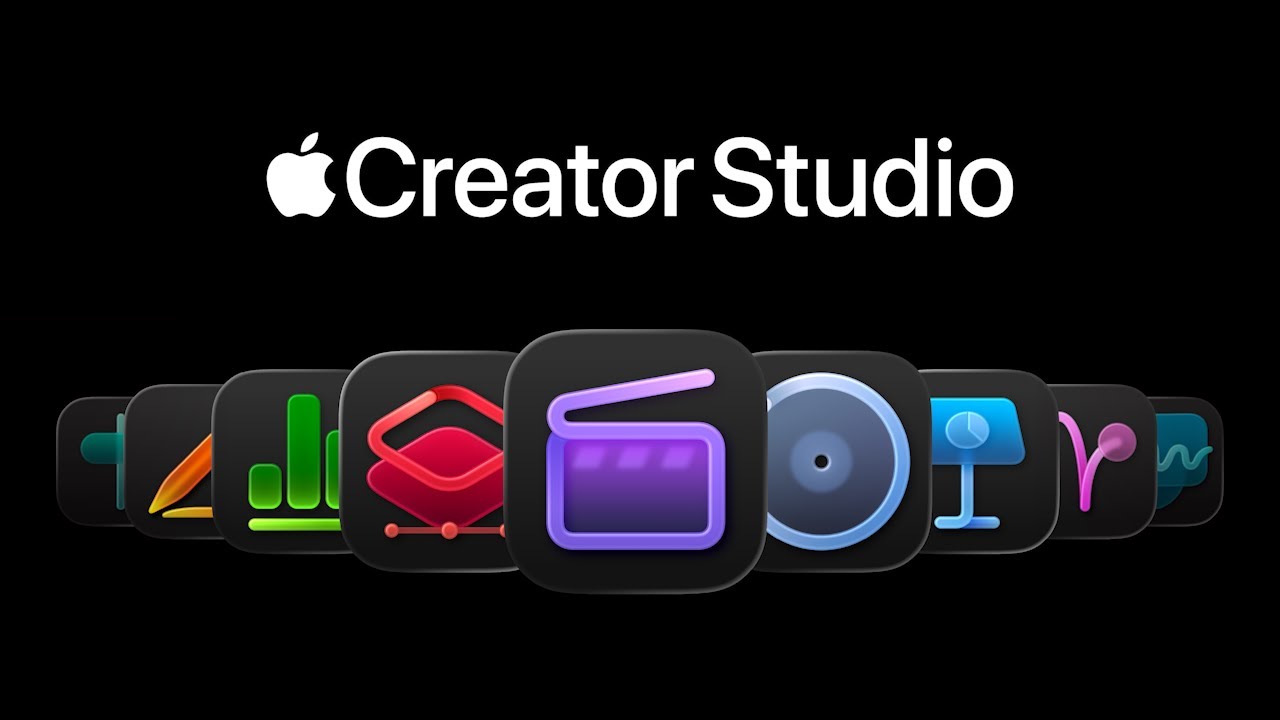
For Apple, the launch of its Creator Studio bundle earlier this week was a pretty big deal. This new subscription package brings together Final Cut Pro, Logic Pro, Pixelmator Pro, Motion, Compressor, and MainStage - plus new AI features and premium content in Keynote, Pages, and Numbers - for a relatively low monthly fee: $/£12.99 per month or $/£129 per year.
For university students and educators, the deal is even better: $/£2.99 per month or $?£30 per year.
This price gives you access to all the apps on both Mac and iPad, so if you use a lot of them, it looks like a no-brainer. That said, it’s worth noting that Final Cut Pro, Logic Pro, Pixelmator Pro, Motion, Compressor and MainStage will remain available as standalone purchases, and both new and existing customers will continue to receive updates.
All of which is interesting enough but, if, as a musician, your only concern is Logic Pro, the bigger news is that both the Mac and iPad versions are getting updates (to versions 12 and 3 respectively) and, as in the previous versions, the focus is on new features that are powered at least in part by AI.
These include the new Synth Player, which is capable of creating both chords and bass parts and joins the existing drum, bass and keyboard Players, and Chord ID, a promising sounding “personal music theory expert” that’s designed to turn any audio or MIDI recording into a ready-to-use chord progression.
Obviously, the idea of using AI in music production is a controversial subject - only this week, Bandcamp announced that it plans to ban music that is “generated wholly” or in “substantial part” by AI from its platform - so we jumped at the chance to quiz Apple’s Bryan O’Neil Hughes and John Danty, who both work in Apps product marketing, on not only the company’s stance on this, but also how Logic Pro’s Player instruments were developed and the future of GarageBand, Apple’s beginner-focused DAW.

So, what is Apple’s philosophy when it comes to incorporating AI into Logic Pro? With products like Suno, which enable you to create complete tracks just by inputting a text prompt, threatening to disrupt the entire industry, how does Apple compete without alienating its users by going against their principles?
“I think it's still early days,” says John Danty. “A lot of these technologies are still maturing and artists and creatives in the community have been pretty clear about how they don't want this type of technology to replace their creativity. They love the notion of it helping them when they need it.
“So that's really kind of where we've been thinking as well. And these technologies, they are spread throughout the app in really interesting ways. The Mastering Assistant comes in at the very end. Our Session Player technology can step in when you may not play a specific instrument or even give you a hint on a part you might want to suggest to a real player.
“So we see [users] really engaging and as part of an interactive experience more than a replacement.”
How did Logic Pro’s ‘Players’ learn to play, though? As anyone who’s used them will tell you, they can sound extremely realistic, so how were those ‘skills’ acquired?
“Our entire session player technology is built working with real musicians,” says Danty. “And so the focusing around the model is really, ‘how does a musician play?’, as opposed to taking a song that they've been working on and then trying to dissect the performance out of it.
“So it's backwards. That's why it took us an extraordinarily long time to build the instruments that we have. And now our news is Synth Player; it's built on that same philosophy, but the underlying technology, as you've probably seen, is MIDI. So that allows us to go in and speak directly to the audio plugins that we have.
“But then of course you can change them out for a third-party plug-in, which is great. And something we're excited about with Synth Player, too, is that you can, of course, connect that to a hardware synth, which I know many of your readers have in their studios. You can have Synth Player control that as well with a tremendous amount of control.”

Danty says that some of the Players took years to develop (“that's why they sound so realistic,” he adds), but let’s not forget that the first one, Drummer, was released way back in 2013 as part of Logic Pro X, when no one was even putting AI and music in the same sentence. Surely, then, the way a new Player is developed now is entirely different?
“It definitely has advanced since those early days of Drummer, you're right,” says Danty. “That’s correct to assume.”
By way of example, he explains that, although the newer Players are built on the same foundation as Drummer, Apple’s developers had to take it a lot further.
“When you have melodic instruments and harmony and all these different aspects, that really makes things much more difficult. Not that drumming isn't difficult, but we actually had to invent an entirely new way to sample within Logic, a microsampling form of technology.
“In the case of the upright bass, you can have hundreds of thousands of individual nuanced sounds that our AI Session Player can play. And so you can play it on a keyboard, but the highest amount of realism is actually to guide the Session Player to play for you.”
Looking beyond AI, Danty confirms that long-time Logic Pro users who scan the version 12/3 release notes will find other “enhancements, bug fixes and those types of things,” but we don’t yet know what these are.
And then there’s GarageBand, Apple’s much-loved entry-level DAW for Mac, iPad and iPhone. It remains extremely popular, but we haven’t had a ‘full’ new version since 2013, so does this mean that it’s quietly being sidelined?
“We love GarageBand a lot,” replies Danty. “It still remains this incredible on-ramp to, you know, a greater understanding of music. I don't think I've met an artist yet that doesn't have a GarageBand story of their journey so we're especially proud of it.”
Time will tell what that means in terms of future updates, but one thing to note is that, after 28 January, when the Creator Studio bundle is released, a subscription to that will be the only way to get your hands on Logic Pro for iPad unless you’re an existing subscriber. This being the case, if you want to have it for the current price of $/£5 a month or $/£49 a year, you’ll have to sign up before then.
We’ll bring you our review of the new versions of Logic Pro in due course. They'll be released on 28 January.