


The idea that you can make music using nothing but a computer, keyboard, and mouse is so commonplace that it’s barely worth a mention. At least it is now.
There was a time when home computers were a novelty, graphical user interfaces were rudimentary, and the prospect of transforming what was then seen as a functional piece of tech into a fully-fledged musical instrument was mind-blowing. That time was the mid-1980s, and the person pushing the boundaries of what computers could do with music was Laurie Spiegel.
Music Mouse, Spiegel’s most famous and enduring contribution to the world of software has long been a source of fascination for music tech enthusiasts. Originally released in 1986 for the Macintosh and later ported to Atari and Amiga systems, it’s widely considered to be one of the very first software instruments.
Its underlying premise is deceptively straightforward: three vertical lines represent a chord, and a horizontal line denotes a single note. As you move your cursor across the X and Y axes you simultaneously shift both harmony and melody to create a cascade of clattering tones or percussive thwacks. It was a radically different way to use computers to make music – hell, it was a radically different way to make music, full stop.
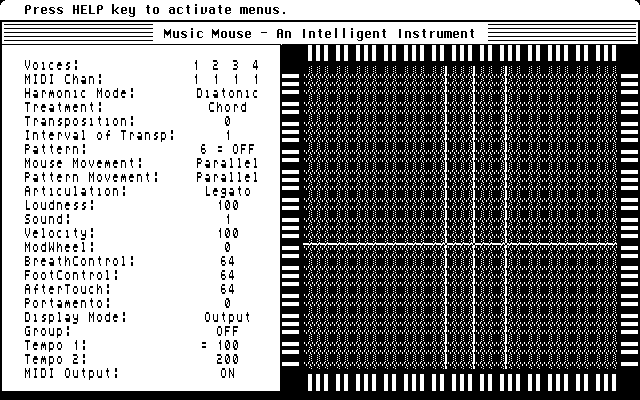
Despite being historic in every sense of the word, in recent times the software fell out of active development and, for a time, it seemed as if this sonic oddity had squeaked its last squeak. So when news unexpectedly dropped that music tech institution Eventide was partnering with Spiegel to resurrect and modernise Music Mouse, furry ears pricked up.
Priced at $29, at Eventide’s release is a fully faithful rendition that retains all the idiosyncrasies of the original while making it fit for modern hardware – but to fully appreciate what makes this instrument special, you also need to understand the time in which it was created, and by whom.
Composer, performer, programmer, educator and all-round pioneer, Spiegel blazed a magnificent trail for female composers working with technology. Her ambient album The Expanding Universe is a classic of the genre, and her music has even slipped the surly bonds of earth, having been included on the Voyager spacecraft’s Sounds of Earth record, which set sail across the galaxy in 1977. (In her own telling, Spiegel was actually stoned when she got a call from NASA asking whether they could send her music into space to reach extraterrestrial life.)
Spiegel also spent years working at one of the most important research institutes in history, Bell Labs, while it was leading a technological revolution in computing. If you want to get a flavour of her ability to combine performance and compositional skills with technical knowhow, you need look no further than this example of Spiegel playing what was arguably the first digital additive synthesiser, colloquially known as Alles Machine, with the aid of interactive software that she coded herself.
“Laurie is not your average composer – she’s brilliant,” states Tony Agnello, Managing Director at Eventide. “She has studied and taught music theory. She’s a scientist and has a grasp of the concepts and mathematics involved in composition. She’s also a programmer. At Bell Labs, Laurie was able to use computers to create music and affect sound a decade before personal computers became available.”
It was during her time at Bell Labs that Spiegel first met Agnello, as he was pushing his own digital frontiers at Eventide—his efforts would eventually culminate in the first commercial digital effects unit, the iconic H910 Harmonizer—and the pair forged an intellectual connection that continues to this day.
“I met Laurie in the mid-‘70s and we became friends with shared dreams of the emerging possibilities for sound design and music creation,” Agnello recalls. “When I was conceiving the design of the world’s first general-purpose audio processor, the SP2016, Laurie and I had conversations about what would be possible: reverbs, band delays, vocoders, granular, and so much more.”
Agnello recalls that over a ten-year span from 1974 to 1984, rapid advancements in digital audio made it possible to create and change sound in revolutionary new ways. But while the dominant design paradigm focused on sound synthesis or effects modules, Spiegel's approach was radically different.

“Music Mouse stood apart from creating new sounds or modifying existing ones,” he says. “Laurie described using the computer’s intelligence and logic to enhance performance: she envisioned the computer as a trainable accompanist. When she first mentioned it to me, it may have seemed ‘obvious’, yet no one in the field that I was aware of was imagining this new path. Laurie is a pioneer.”
The desire to create an “intelligent instrument” was visionary, and while that intelligence may look rudimentary compared to current conversations around AI, at the time it marked a fundamental shift in the role that computers played in the creative process. As Spiegel wrote in the preface to Music Mouse’s original software manual: “Logic, the computer’s ability to learn and to simulate aspects of our own human intelligence, lets the computer grow into an actively participating extension of a musical person, rather than just another tape recorder or piece of erasable paper.”
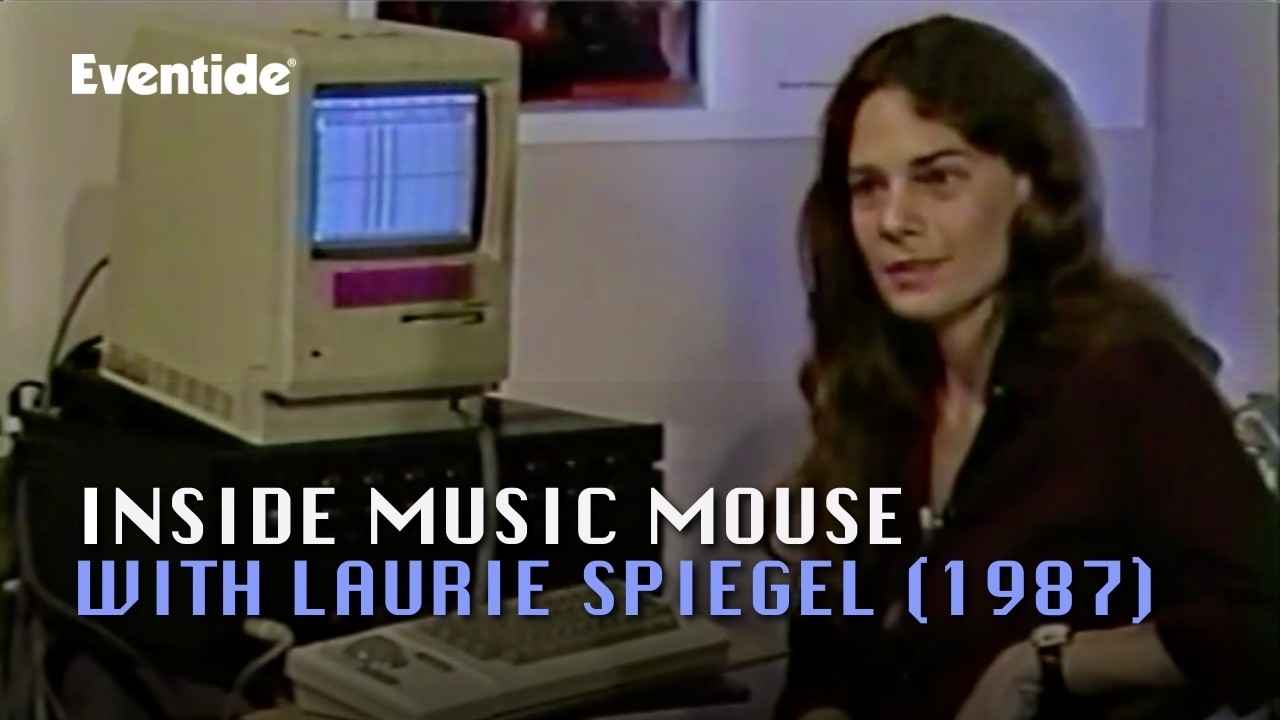
Therein lies the magic of Music Mouse: the algorithmic structures that underpin the software give it a musically coherent context, but it’s the nuanced gestural input from the user that gives it its emotive power. And, rather than use the computer to mimic performance paradigms from the analogue world—such as using the QWERTY keyboard as a piano—Spiegel ultimately created a method of music-making that had never existed before in either domain. To get a sense of just how different Music Mouse was from other music software of the time, just watch this classic interview Spiegel gave not long after its initial release.
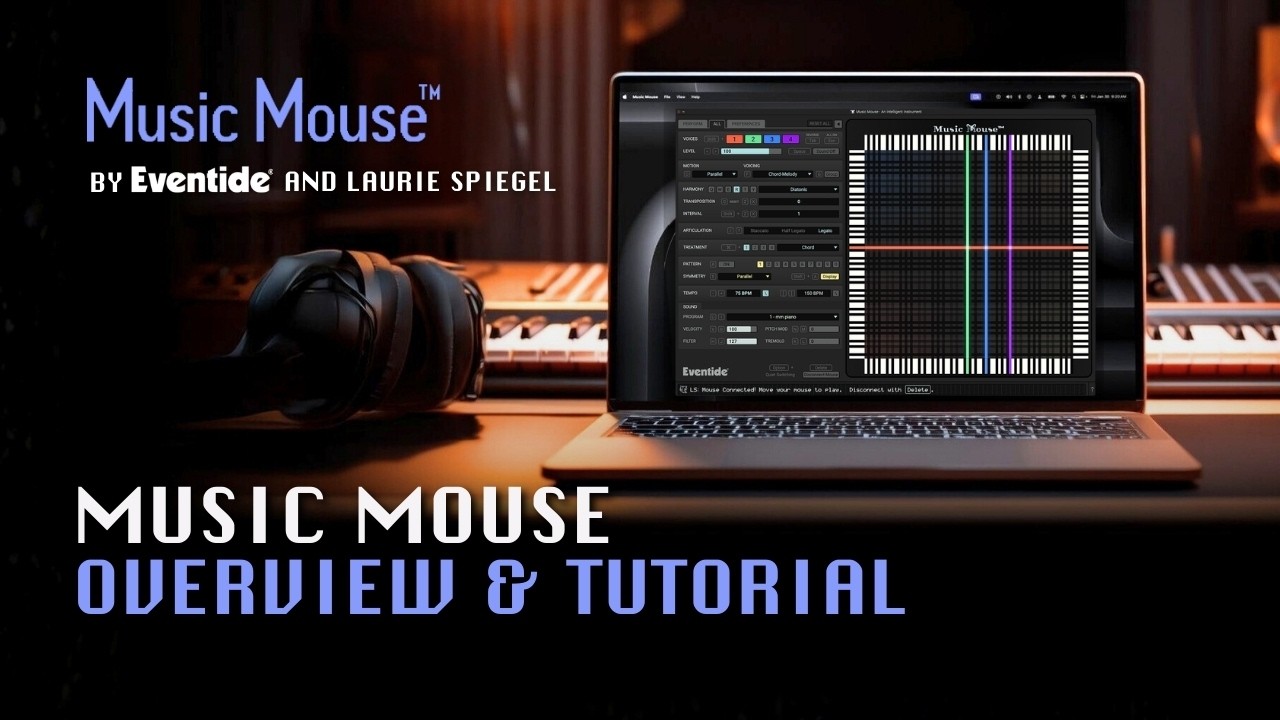
On first blush, Eventide’s re-release of Music Mouse offers a heady dose of nostalgia. The image of a friendly rodent lovingly rendered in 16-bit greets you on arrival, warm neon tones criss-cross the iconic four-sided keyboard matrix, and the sound presets – derived from Spiegel's own Yamaha DX7 and TX7 – are unabashedly vintage in timbre.
Once you get stuck in, however, it becomes clear that there is nothing dated about this instrument. Whether working on ambient music or straight-down-the-line songwriting, its gestural paradigm for note generation provides plenty of happy accidents and musically useful material straight out of the box.
In truth, the novelty of wiggling your cursor like a madman can persist for quite some time, but the real power of Music Mouse lies in its performance-focused settings menu. Here is where you can select between a range of harmonic modes—including diatonic, pentatonic, and Middle Eastern—tweak the transposition of notes, trigger rhythmic patterns, switch between parallel and contrary movement, and much more.
Crucially, all of these controls are mapped to hotkeys on the alphanumeric keyboard—there’s even a downloadable keyboard map which can be used as a quick reference guide—and this means you can jam out with your mouse hand while your keyboard hand shepherds the output towards a musically satisfying destination. Add in the ability to sync to an external clock and to route MIDI out to your favourite hardware synth or DAW and you have a robust performance tool.
This mouse has also been given a much-needed grooming – specifically a UI overhaul that brings a darker colour scheme, resizable interface, the ability to switch between a left- and right-handed layout, a contextual hint bar, and visual indicators for hotkeys. Aside from these unobtrusive quality-of-life upgrades, long-time fans will be pleased to know that everything else is just as it was in Spiegel’s last official version.
However, while this initial release stays true to its roots, Spiegel and Agnello hint that future iterations will take Music Mouse in a new direction. In a recent interview, Spiegel told The Verge that while the team “decided to keep 1.0 of this new version of Music Mouse functionally the same as the 1980s original”, there is a growing feature list to be added in version 2.0.
“There are several improvements but the goal was to keep true to the original design, control, and features, because there are performers worldwide that rely on it and how it behaves,” affirms Agnello. While he doesn’t get into specifics when asked how the team might improve Music Mouse further, he does let slip that during the design phase “our imagination ran wild... but we’ll save those thoughts for another day.”
Resurrecting Music Mouse was clearly a labour of love for Agnello and Eventide – but it didn’t come out of nowhere. Despite not being maintained since 1999, when it was updated for macOS 9, and being unavailable to purchase since 2021, the usefulness of this instrument motivated a dedicated group of users to keep it alive through software emulations and legacy hardware. Asked why the instrument has enjoyed such sustained appeal, Agnello’s answer is simple and to the point: “Because it’s a wonderful musical instrument and there is nothing quite like it.”
“That fact is that it was the first instance of a new category of instrument,” Agnello emphasises. “Something truly new, truly groundbreaking, becomes practical, when an individual, a pioneer, has a vision. For example, Les Paul and the electric guitar. Of course, if the invention is truly groundbreaking, new models based on the same concept will be developed, but they don’t replace the original. There are lots of electric guitars, and new models will continue to be created, but the truly successful ones will always be relevant; they don’t disappear. Because Music Mouse requires a computer, it needs to be ported to current computers to remain relevant.”
"It’s both a serious instrument for high-minded composers and a space for intuitive improvisation with no musical training required"
With the architecture of operating systems evolving at an unrelenting pace, the burden of keeping Music Mouse alive was no small burden for Spiegel. “Laurie did her best to keep it current until several years ago,” Agnello points out. “At this point in her career, she found that it was no longer something she could continue to take on personally.” Rather than let this one-of-a-kind instrument fade, Spiegel turned to Agnello to refresh things for contemporary hardware – a challenge that Agnello and the Eventide team were “honoured” to be able to take on.
Even in 2026, with a software market exponentially more saturated than that of the mid-1980s, Music Mouse manages to still feel surprising, intuitive, and creatively potent decades after its debut. Its idiosyncratic approach somehow manages to blend the esoteric and the accessible; it’s both a serious instrument for high-minded composers and a space for intuitive improvisation with no musical training required. In Agnello’s opinion, that creative prowess is the result of the singular vision that guided its development.
“It is quite unusual for the same person to conceive the idea, create a specification, write the code and use the new instrument in live performance,” Agnello says. “Laurie did it all and, as a result, her Music Mouse is holistic. It doesn’t suffer from the ‘too many cooks’ process that afflicts many software products. It’s most important to keep in mind that Laurie created her Music Mouse as her own personal instrument.”
What started as a Spiegel’s personal project grew, initially through word-of-mouth, into one of the most important and enduring software instruments in history. Now future-proofed for a new generation, Music Mouse is back – or perhaps it’s more accurate to say that it never really left. “For forty years and counting, Music Mouse has continued to be used in performance,” Agnello says. “It’s a living instrument.”
