
MusicRadar Verdict
Cherry Audio’s Mercury-8 could easily be the next-gen Jupiter in software. Built upon the strengths of the original, it takes this vintage classic to contemporary heights, through a series of exceptional enhancements.
Pros
- +
Stunningly good recreation of the Roland Jupiter-8, from the early-to-mid ’80s.
- +
It’s brimming with contemporary content, but can be perfectly vintage too.
- +
Extends the Jupiter’s usability, with a significant number of enhancements over the original hardware.
- +
Compared to hardware, it’s a total bargain, even at many times the price!
Cons
- -
You might be tempted to try and locate an original, which might be a tad pricier!
MusicRadar's got your back Our team of expert musicians and producers spends hours testing products to help you choose the best music-making gear for you. Find out more about how we test.
What is it?
Some people feel a little indifferent about the ’80s. The political landscape was very different to the preceding decade, as was the music. The get-up-and-have-a-go mentality of ’70s punk gave way to the synthesizer, with a plethora of synth-pop bands and increasing number of synth and vocalist duos.
The significance of this period of musical history went hand-in-hand with the influence of the technology of the era. In the ’70s, amazing synthesizers were produced, but many models had their shortcomings. Issues with tuning stability and reliability could make them a challenge to use, particularly when playing live. As the decade turned, Japan picked up synthetic momentum, delivering a golden age of classic synthesizers, almost as though they had been delivered by the Gods themselves!

The myth, the legend…
By the early ’80s, Roland had already produced a significant number of highly-praised machines, although some, like the TR-808 and TB-303, weren’t highly praised at the time. But in 1981, they produced a polysynth which built upon the popularity of their Jupiter 4, and the competing synth from Sequential Circuits: the Prophet-5. The Jupiter-8 was an 8-note polyphonic synthesizer, offering two VCOs per voice, 64 patch memories, 2 & 4-pole filters, two envelopes, and more programming and playing possibilities than you could shake a stick at. It was built like a tank, with a full metal chassis, provided incredibly stable oscillators, and could be re-tuned at the press of a button, in just a couple of seconds. Compare this to the Prophet-5, which could take about a minute to drag its oscillators back into tune, and this was significant progress. Suddenly, the Jupiter-8 was everywhere, becoming a must-have for synthetic and rock artistes alike.
Back in the present, Jupiters remain highly desirable machines, but they have never really been cheap, other than during a brief lull, when analogue fell out of fashion. Even when they were released, they were £3,995, with current secondhand pricing well in excess of £10,000, that’s if you can find a model that hasn’t been around the block a few too many times!
Roland has toyed around with the Jupiter legacy a few times now, through a number of hardware devices and their own software, but now Cherry Audio brings us their iteration of the analogue behemoth, building on the success of their stupendously good Mercury-4 and 6.

Mercury rising
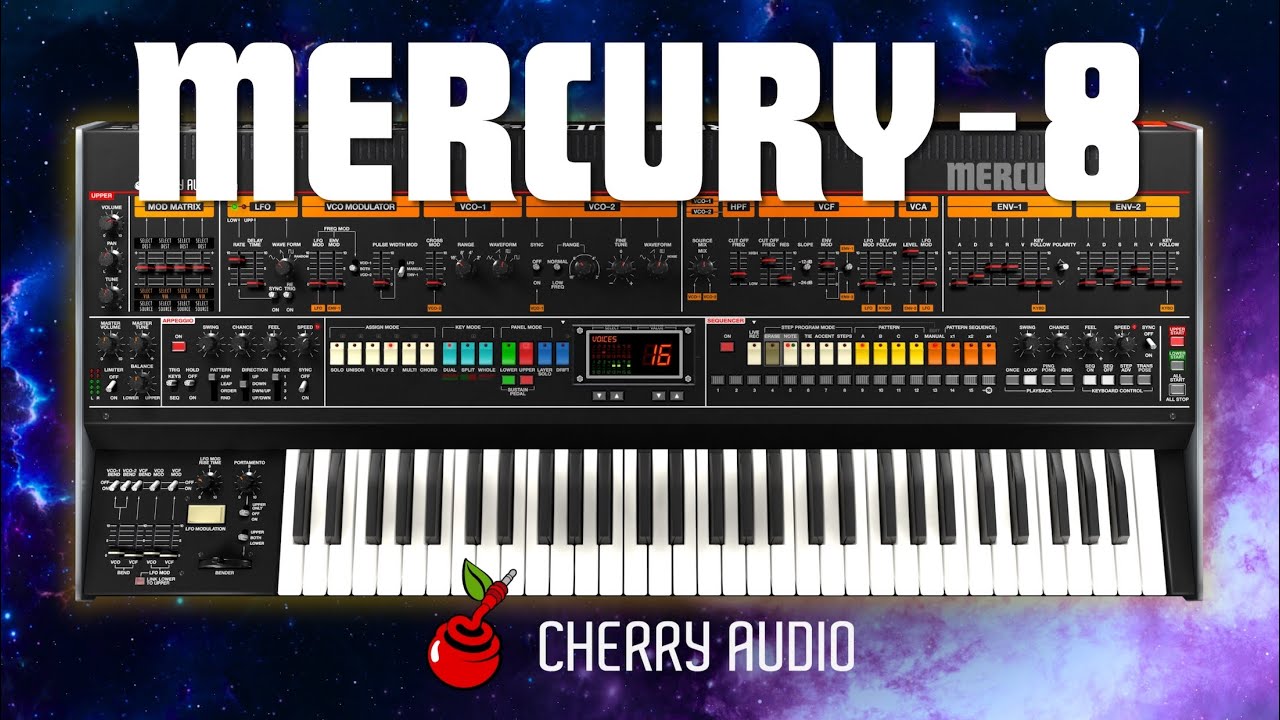
It won’t come as a huge shock to hear that Cherry has called its Jupiter-8 the Mercury-8, but apart from the name, the software delivers a look which is every bit as beautiful as the original. The resplendent orange bands, wrapped around white lettering on virtual black metal casework, looks very stylish, right down to the slight shading on the classic ’80s Roland buttons.
Now we have to admit that we have skin in the Jupiter-8 game. We are lucky enough to own an original, and it’s been a permanent staple in our rig since 1985. Cherry has been exceptionally faithful to the original JP-8 layout, meaning that we could very quickly and easily reach for the faders and pots, just like the hardware.
There are, however, a considerable number of enhancements, with many additional faders and buttons, providing invaluable new features, which were never available on the original.

Performance
Auditioning a handful of presets is always a good starting point for getting a feel for a new synth in software. This presented a really interesting conundrum, because the opening set of presets didn’t immediately remind us of our Jupiter. Don’t get us wrong, it sounds fantastic, but it underlies the fact that Cherry has brought the Mercury-8 up to date; it’s like JP-8 2.0!
With a little bit of quick investigative reverse engineering, the enormousness of the sound is very much a sum of parts. First and foremost, Cherry has extended the overall polyphony to 16 notes, with two oscillators per voice. Nothing unusual about that, except that the original Jupiter provided split and layer capacity, which would halve the voice count. No such issues here, as Cherry provides full layering, in Dual mode, keeping the voice count at 16 notes. This is a crucial point, as there is no note stealing, particularly for expensive sounds with an extended release phase.
As we have also seen with other products from their product line, Cherry has also implemented its fantastic suite of effects, and some of these feel particularly at home. Their Tape Echo adopts Space Echo-style colours, in both visual design and sound, and is a perfect bedfellow for any classic Jupiter deployment.
There are over 600 presets, many of which make great use of the Jupiter’s classic calling cards. Beautiful string pads? Tick! Huge polysynth brass? Tick! Plucky arpeggiated and sequencer patterns? Hang on, the Jupiter never had a sequencer! Well, it does now, and moreover, it’s accessible from the front panel, as a step and live playback device.
Back to basics
The strength of the preset content is undeniably consistent and excellent, but what if you yearn for an original Jupiter, and you hope that this is the answer, at least in software?
As if to provide validation, Mercury-8 is equipped with all of the original presets from the original Jupiter. In fact, Cherry says that you can swap patches to and from hardware, using System Exclusive data! Regrettably, this is something we couldn’t test, although we are pretty sure we have a data cassette somewhere (which emits a pseudo fax machine's bleeps), for dumping the original presets back into our machine! If only we still had a cassette player!
Accessing the original presets is blissfully easy, thanks to the usual Cherry Audio hierarchic preset menu. Faithfully reproduced, there is no layering applied to these sounds, but they don’t sound flat by comparison. They offer a distinct charm, and underlie an incredible authenticity. A second Factory Plus menu provides the same patches, laden with backend effects. They sounded great to start with, but the effects add another layer of sheen.
There is also another section described as templates, which is an excellent springboard for creativity, if you feel slightly out of your depth with the programming architecture.
We decided to create a new patch and audition individual elements against our hardware, from the ground up. Now we have to insert a caveat here because, as previously stated, our hardware is over 40 years old. Yes, it has been serviced regularly, but that amount of time is obviously going to take its toll on certain components, and ultimately the sound. Purists may argue that this makes the Jupiter hardware all the better, but we have to expect some subtle differences to the software.
The most noticeable element is in the detailing of the sound emanating from the Mercury-8. In its most basic and raw single-saw form, the Mercury sounds a little bit weightier, possibly with a view to making it production ready. This is endorsed across all of the original waveforms (saw, square, triangle and sine), right down to the white noise.
The filter duplicates the original, providing both -12dB and -24dB slopes. Sonically, the modelling is incredibly good, with our only discrepancy being the calibration of the faders on our hardware. It feels like the Mercury offers more ‘play’ in the faders, and of course, there is the accuracy that onscreen graphics can provide, above that of 40-year-old hardware faders. There is a slight extension to the top-end cutoff amount, which is something we have noticed with other Jupiter-8 models. The important point is, it is sonically authentic, but with a tad more extension up-top.
Two areas where we noticed slightly different behaviour, stem from the PWM control of the pulse wave, and the unique Cross Modulation, both located within the VCO section. The hardware has always offered a slightly anarchic response, particularly when sweeping the Cross Modulation fader, which underlies the analogue nature of the original. The software sounds pretty identical, but you cannot help noticing that the response feels more measured, as you move the fader on screen. We have to be fair here, this level of detail is something you would only be aware of, if you knew the original inside out. To the listener and the producer’s ear, it is entirely accurate in playback, and debatably has more to do with the way that it feels, when in use.
On a similar point of calibration, the envelope phases do seem very slightly different, in terms of their timing against our original. By way of example, our full hardware Decay phase delivered 45 seconds of fade time, while the software delivered a full 53 seconds. We're not sure we need to worry about this too much, unless of course you want to have your hardware recalibrated to introduce an additional eight seconds! No? Thought not!

Poly-gliding
The original Jupiter offered the ability to select one of four assign modes, which related to oscillator organisation for performance. Cherry has followed this through, with solo and unison modes, with the latter clearly sounding enormous! But we wanted to explore the polyphonic modes further, particularly Poly 2. The concept here was always that the Jupiter would use the same oscillators first, when shifting from one chord to the next. This would be essential, if you wanted to generate a chord which glides in formation, when using portamento. The behaviour of the Mercury-8 is identical, right down to the shape of the glide itself. The assign modes don’t end there though, as there are two additional modes.
Multi-mode opens a series of small pots, which allows you to dictate pitch, pan, filter and VCA levels, across different voices. It’s a beautiful little feature, which proved to be a little bit of a rabbit hole, during our testing. The final assign mode allows the creation of a chord, which can be played back using a single note.
More of a Jupiter
Like all Cherry Audio products, we took huge delight in using the standalone version of the instrument, and got completely lost in the programming. It was during this phase that we truly appreciated some of the added extras, and there are plenty to mention!
Residing in the envelope section, an additional V fader allows quick and useful dictation of the amount of velocity, which may affect your amps or filter while performing. This is obviously over and above the original, but we found it surprisingly useful and effective!
When employing Layer mode, the instrument adopts a similar format to the original, by offering an upper and lower panel mode. When selecting either of these panel modes, a guiding stripe across the top of the instrument switches colour to red or green, as do all of the fader caps and lights, leaving no ambiguity for exactly which layer you are editing.
The original JP-8 offered a considerable number of fixed modulation routings, but in a further enhancement, the Mercury-8 includes a fully assignable 4-fader mod matrix, allowing user selection of both source and destination. This is immediately accessible from the front panel, as is the ability to immediately assign any of the panel’s controls to a MIDI CC, for control from MIDI hardware or DAW.
We also noticed that the analogue-style behaviour of the instrument was pretty exemplary. The drift control subtly changes the tuning, in much the same way as our original. Those beautiful micro tunings that we have come to accept as part of the original sound, work a treat in this context.
Even though the sequencer is easy to use and excellent with it, there is a certain authenticity and endearing quality to the Arpeggiator, which offers all of the original settings and a host of other elements too, such as swing and ‘chance’, which introduces a degree of randomness. You can synchronise this to your host DAW, or if in standalone mode, run in time with any tempo derivative effects. While we’re talking effects, Cherry offers the usual vast selection of both useful and stylish effect tones. The Chorus and Phaser effects do everything you need, with Jupiter-like aplomb, and what’s not to like about that?
Verdict
We have to admit to being happily surprised by Cherry’s approach to this reinvention of the mightiest of analogue classics. To our minds, it is very much a synth of two halves; on the one hand, it is an enormous sounding, production ready, and truly engaging musical instrument, which offers such huge prospects for production work, it puts it into the category of ‘must-have’.
However, if you are looking for a real facsimile of an original Jupiter-8, you can strip this back to its bare bones, and it sounds engaging and truly authentic. Yes, there are some very subtle differences if you compare the Mercury-8 to an ageing original, but the bottom line is, an analogue synthesizer will change with age, and the Mercury-8 will be far more exacting and consistent, while offering all of the benefits and beauty of the original sound. It’s another beautifully engaging piece of synth history, re-engineered by Cherry Audio in software, and possibly its most comprehensive yet!
Hands-on demos
Cherry Audio and Michael Oakley Official
Specifications
Price |
$69 |
Key features
|
Modelled plugin version of the Jupiter-8 2 VCOs per voice 16-note polyphonic voices -12dB & -24dB filter slopes Over 600 presets, including original JP-8 patches On-board arpeggiator and sequencer (syncable with DAW) 6 assign modes, for extended poly operation Velocity amount control for each envelope 5 simultaneous effects - user assignable and selectable |
System requirements |
macOSX and WindowsPC; AU, VST/3, AAX & Standalone formats |
Contact |
