
MusicRadar Verdict
If you’re looking for a sturdy, interesting and decent-sounding effects unit with tempo syncing and sequencing capabilities, the Polyend Mess is well worth checking out.
Pros
- +
Build quality.
- +
Range of effects.
- +
Works with all types of input sources and audio material.
Cons
- -
The programming system could be enhanced to offer better effects auditioning and smoother integration with the sequencer.
- -
Transition between effects presets and sequencer steps could be improved.
- -
No input level indicator.
MusicRadar's got your back Our team of expert musicians and producers spends hours testing products to help you choose the best music-making gear for you. Find out more about how we test.
What is it?
Polyend is well known for its range of Tracker boxes, plus a strong line-up of synthesizers and grooveboxes all featuring the ubiquitous grid-based button interface that we have all become well accustomed to. However, more recently, it has entered the stomp-box arena with an analog compressor, Press; the drum machine called Step; and the multi-effects Mess, which is reviewed here.
It’s worth stating from the start, however, that whilst all these boxes are floor-based in format, they are clearly aimed at the desk of synthesists and other users as much as the floorboard of devoted shredders.
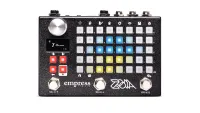
The clue to Mess’s name and primary purpose comes from the acronym of ‘Multi-Effect Step Sequencer’, but delve deeper and you’ll find four independent effect processors, each linked to its own 16-step sequencer featuring a range of step probability options.
A single effect block can employ one of over 120 algorithms (in 11 categories), configured for serial, parallel or dual parallel configurations.


The unit features stereo inputs and outputs and can handle both high-impedance (hi-z) guitar and line-level inputs.
On the back, you’ll also find USB and MIDI connectivity - the latter accessible via 3.5mm socket adapters. There is also a microSD card slot for loading and saving presets, updating firmware, a configurable expression pedal input, and the all-important DC power socket. A power adapter is not provided; however, any polarity and voltage between 9V and 18V will work.
The top panel includes a very nice colour OLED screen, which interacts with the track, sequencer step, and other programming controls.
In physical terms, the Mess feels very well-made and exudes a classy air, both in terms of its appearance and feel.

Performance
Taking the plunge with Mess is pretty straightforward. To ease the process, Polyend provides a nicely laid-out ‘Getting Started’ and effects guide. Between them, it was possible to get straight into a solid session of audio mangling. First impressions were strong, with each twist of the Preset knob introducing another interesting effect.
The one oddity, from our perspective, was the control layout, which allocates the four available parameters on each page to rotary encoders on the far left and right, despite the screen displaying them in a slightly different manner. It’s a small thing, but it threw us off each time we used the unit.
The knobs in the middle are conventional pots for Input level and Mix. Unlike other controls, there is no screen-based visual feedback on their settings. Each effect gets its own (stored) Mix parameter, but not the overall mix balance control here. It would also have been helpful to have some indication of input level, if only to optimise gain through the digital effect and avoid occasional distortion.


There are too many effects to fully describe each one here, but they fall broadly into Panning, Shaper, Filter, Pitch Shifter, ‘Spectralizer’, Micro Looper (time/buffer repeat), Reverb, Delay, Modulation, Granular Burst and Particle Sampler types. They can be used conventionally, but can also be programmed to change in time with the programmed tempo (internal or external), via LFO, tempo sync, or by adjusting parameters for one or more steps.
It was relatively easy to get the hang of the programming system after spending some one-on-one quality time, although sequenced changes can get lost if you switch effect types (on purpose or in error).
The effects themselves are very good. The reverbs are lush and beautiful when required, and there are weird and wonderful modulated, glitched and swarm-like gems scattered throughout the 120+ algorithms. The best bit is remembering that you can have four at the same time!
Verdict

The Mess comes bundled with loads of presets, and covers a wide enough territory that even if you don’t get heavily into the minutiae of per-step programming tweaks, it will conjure up a plentiful supply of sonic joy.
In fact, even without engaging the sequencer, it makes for a very good multi-effects box. If you do delve deeper, though, do expect to get lost (in a creative way) amongst its myriad effects options.
The Mess is not a cheap unit, but its build quality, flexibility and sonic prowess go a long way in justifying its chosen price point. It was great to try out something a bit different and not just another iteration of well-worn effects territory.
Whether you’re a guitarist, synthesist or any other musician or producer looking for something a bit different, and that is just as at home on stage or in the studio, the Mess might be what you’re after.
Hands-on demos
Polyend

Alternatives
Specifications

Price |
$599 |
Key features |
Stereo/Mono In: jack 6.3 mm / L-Out/MONO: jack 6.3 mm + R-Out: jack 6.3 mm / Expression Pedal / MIDI In/Out: mini-jack 3.5 mm / USB-C Power: 9-18 V DC / min. 500 mA (power adapter not included) 4 x effects tracks , each with 16-step sequencer. 125 stereo effects algorithms |
Dimensions |
Height: 5.7cm / Width: 18cm / Depth: 12cm |
Weight |
0.93kg |
Contact |