MusicRadar Verdict
With a slew of controls for adjusting sounds to a fine degree, the Burn is a well-built enclosure packed with superb, vibey organ-esque sounds. It's got plenty of utility for fast and slow modulation, as well as hidden talents for tone colouring and reverb.
Reasons to buy
- +
High-quality form factor.
- +
Plenty of sonic range and adjustability.
- +
Fabulous organ sounds.
Reasons to avoid
- -
The reverb can't be bypassed properly.
- -
The controls might be easy to knock.
MusicRadar's got your back Our team of expert musicians and producers spends hours testing products to help you choose the best music-making gear for you. Find out more about how we test.
What is it?
The rotary speaker has been with us since the 1940s, invented by Donald Leslie as a means of bringing life to the newfangled Hammond electric organ, by making it sound more like the magnificent pipe organs of old.
Harnessing the Doppler effect, by way of amplifying the organ signal through a rotating drum and horn inside a wooden cabinet, the Leslie speaker created a glorious, swirling wash of sound, widely beloved to this day.
Though invented for the organ, the Leslie speaker sound gained a whole new fanbase as the electric guitarists of the 1960s started experimenting with effects – not least when Japanese engineer Fumio Mieda created the Uni-Vibe, a rotary speaker emulator geared specifically toward guitar.
Since then, the difficult job of capturing the vibrant sound of the Leslie speaker, or indeed the idiosyncrasies of the later Uni-Vibe, has occupied the minds of many of the effects industry’s big players.
This is where Italian organ and synth brand Crumar comes in. This pedal, the Burn, is an in-depth Leslie emulation replacing an earlier unit by fellow Italians Genuine Soundware.

The product page for that discontinued pedal still exists, the strapline seeming to confirm that the Burn is named for Deep Purple’s organ-heavy 1974 track.
Rock ’n’ roll credentials, for sure – so of course, we need to find out what it’s like when you pluck it out of the keyboard player's signal chain and plug in a guitar instead.
Specs

- Price: $309 | £227 | €259
- Type: Rotary speaker emulation pedal
- Controls: Balance, Distance, Angle, Speed, Ramp, Reverb, Memphis, Front Stop, Reverb Type. Side-mounted input gain selector.
- Features: Fast/Slow rotary speeds, RGB LEDs, rotary stop mode, Memphis mode (stopping drum rotation for low frequencies), dual-mode reverb.
- Connectivity: 9v DC input, ¼” instrument input, Cat5 connector (for One-Cord connection to compatible Crumar keyboards), 3.5mm headphone output, ¼” Left and Right outputs, USB-C service input, TRS jack for optional footswitch
- Bypass: Buffered
- Power: 9v DC, 300mA
- Dimensions: 118 x 34 x 96 mm
- Weight: 0.4kg
- Contact: Crumar
Build quality

Build quality rating: ★★★★½
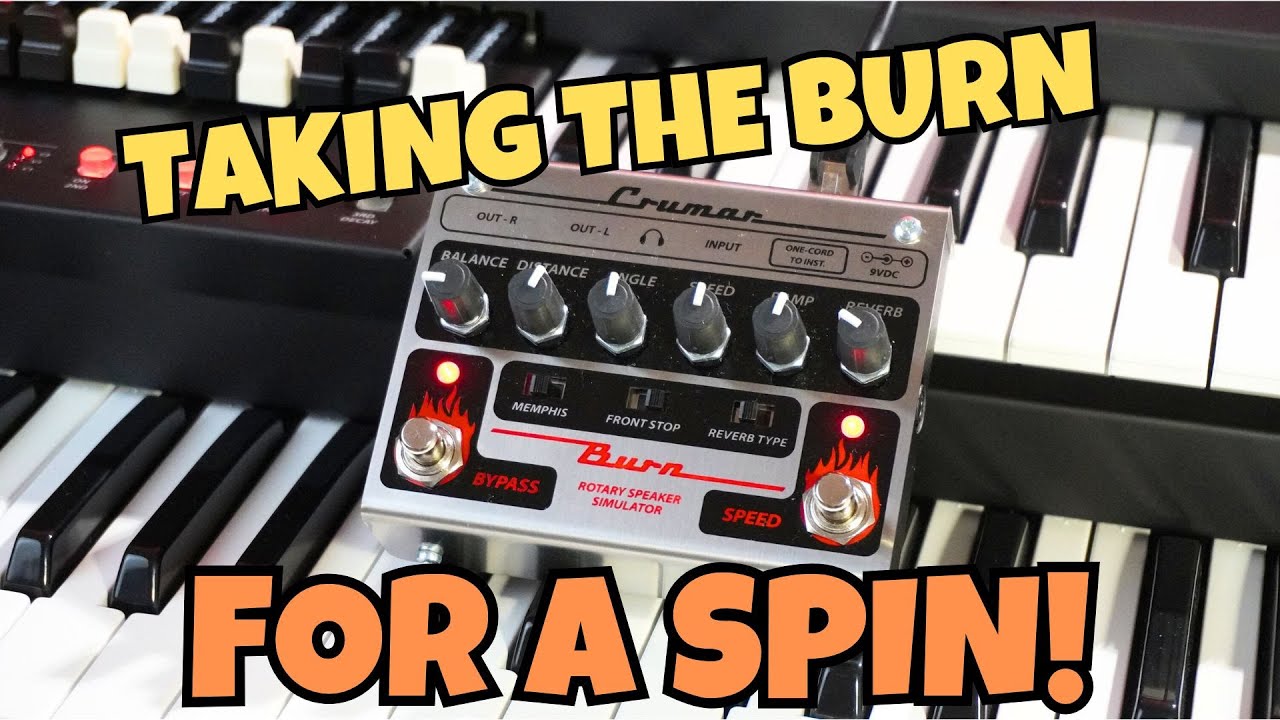
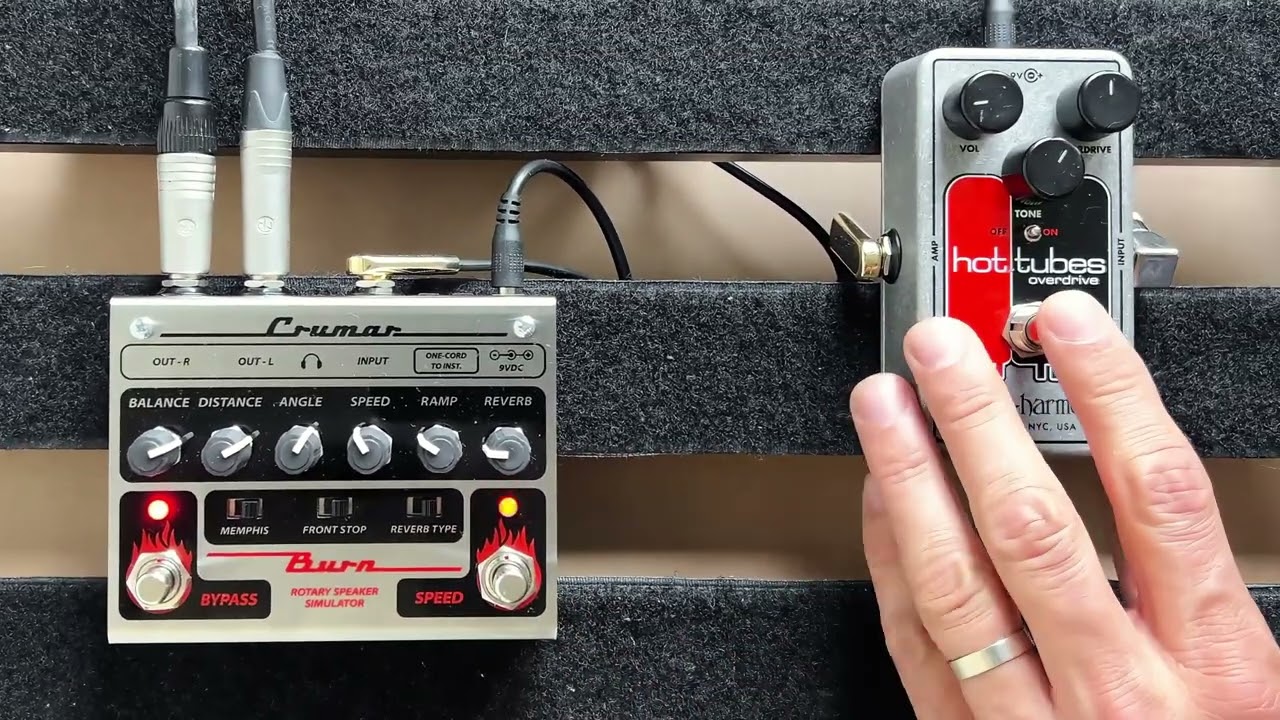
The silver, black and red colour combo looks classy, and the unit is reassuringly sturdy, as you'd expect when spending £200+ on a pedal; a chunky metal case with good hardware and very clear, purposeful printing.
One potential issue: the knobs may fall within nudging distance of your shoes when operating the footswitches. If it's more of a studio tool for you, not such an issue.
Usability

Usability rating: ★★★★½
Unlike its Genuine Soundware predecessor, the Crumar’s layout is refreshingly upfront - no editor required, everything you need is right there.
We’ve a suite of controls for some quite granular tweaking of the modulation’s finer points, an additional knob for the dual-mode onboard reverb, and two footswitches – one to switch the pedal on and off, the other to select Slow or Fast rotary speed.
Stereo outputs allow you to create the width you need from a rotary sound.
Sounds

Sounds rating: ★★★★½
I plugged the Burn into the clean channel of my Laney VH100R, with my old SG/Les Paul Junior, and from the first press of the footswitch, the signal was enveloped in rich, three-dimensional modulation.
The Fast setting is a pitch-perfect, Hammond organ-esque rotary sound, with minimal tweaking required to perfect the settings.

If you hold the footswitch, the spinning stops and you have a subtle, tone-colouring preamp stage without the modulation
The Slow setting is relaxed, but effective - akin to a very slow phaser or flanger. A delightful feature is the adjustable Ramp, which controls the speed at which the slow and fast settings change; you can hear the modulation speeding up and slowing down, rather than sounding as though it is simply latching from one digital algorithm to another.
Then, if you hold the footswitch, the spinning stops and you have a subtle, tone-colouring preamp stage without the modulation - this is nice in itself, providing a warm push to the clean channel.
The reverb is excellent too – a pre-effect spring emulation, and a hall reverb which is a subtler post-modulation setting, with a huge amount of each effect available. Bear in mind, though, that the reverb remains active even when the pedal is switched off - if you want it gone, you have to turn the knob down.

I tried a humbucker-equipped Les Paul and my single-coil James Tyler as well as the P-90 of the Junior, and came away thinking that, for the Hammond-alike sounds the Fast setting conjures up, fatter pickups are the order of the day.
But there’s other useful potential to be found with various guitars and, of course, other effects – although I had less success stacking with overdrive or distortion through the front end of the amp.
Running the Burn in the effects loop may be the ticket for those seeking a more distorted organ-esque tone.
Verdict

The lesson here – if you've been searching for the right Leslie emulation for guitar, keyboard experts may have the answer
There are plenty of Uni-Vibe homages out there, but fewer guitar pedals that really nail the original Leslie rotary speaker sound, so it's to Crumar’s credit that the Burn is aimed at guitarists as well as keyboardists.
And it certainly nails the brief, offering that perfect, evocative organ sound as well as slower, gentler revolutions that enrich clean guitar parts with a distinctive flavour that's not quite like any other modulation effect.
The addition of a couple of vibey reverb settings only adds to the appeal. The lesson here - if you've been searching for the right Leslie emulation for guitar, keyboard experts may have the answer.
MusicRadar verdict: With a slew of controls for adjusting sounds to a fine degree, the Burn is a well-built enclosure packed with superb, vibey organ-esque sounds. It's got plenty of utility for fast and slow modulation, as well as hidden talents for tone colouring and reverb.
Test |
Results |
Score |
|---|---|---|
Build quality |
Very solid enclosure with excellent visual aids for dialling in. |
★★★★★ |
Usability |
The knobs might be vulnerable, and the non-bypassable reverb is an unusual choice, but the Burn is still very easy to use. |
★★★★½ |
Sounds |
It really does make your guitar sound like a Hammond, or gives you a lush slow, phasey swirl, with excellent reverb too. |
★★★★½ |
Overall |
A really capable and useful Leslie emulation that seems to suit guitar just as well as organ. |
★★★★½ |
Also try
Hands-on videos
The Music Alliance
Woody Piano Shack