





MusicRadar Verdict
If you've always loved the idea of wavetable, but previously baulked at the cost of the hardware, this is one wavetable synthesizer that you could fall in love with. It can do subtractive and hard-edged '90s, and still have plenty of new direction to offer a contemporary track or soundscape.
Reasons to buy
- +
Incredibly cost-effective, entry-level Wavetable synthesizer.
- +
Despite its small design, it’s very accessible and well made.
- +
It ships with all the historical wavetables that you want, from PPG and the Microwave 1.
- +
With 4-part layering, global effects and performance tools, it’s an engaging unit!
Reasons to avoid
- -
The screen is teeny-tiny, but once you know your way around, you’ll be less reliant upon it.
- -
Interface requires a degree of intuition and familiarity, but workflow improves considerably with practice.
MusicRadar's got your back Our team of expert musicians and producers spends hours testing products to help you choose the best music-making gear for you. Find out more about how we test.
What is it?
Waldorf is a company with an incredible heritage. Rising from the ashes of PPG, the company that brought wavetable synthesis to the masses, Waldorf has always had an uncanny knack of distilling wavetable technology into a format which is both usable, great-sounding, and also incredibly engaging at a musical level.
Recent years have seen an enormous resurgence of interest in Waldorf, thanks to a run of exceptionally powerful synthesizers with wavetable at their heart. The excitement around the Quantum (released in 2019) was palpable, and Waldorf did not disappoint. The same technology and interfacing were employed throughout its Iridium range, appearing in a number of different sizes and styles to suit your budget. However, even the cheapest Iridium attracted a price tag of just over £1,000. Despite the incredible quality of the unit, that's still a hefty investment when software can be so enticing and comparatively cheap.
The only problem is, when it comes to wavetable, there is an awful lot to be said for hands-on control, and almost on cue, Waldorf has just the solution, in a relatively affordable package.

Performance
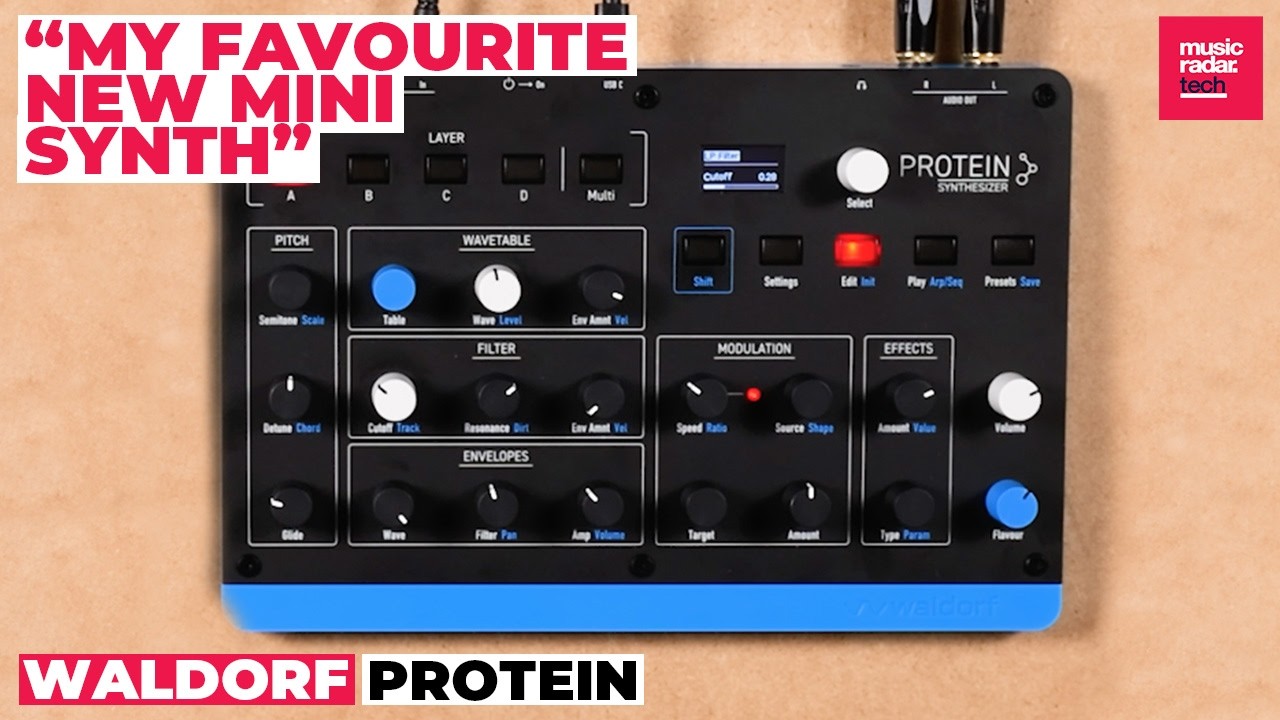
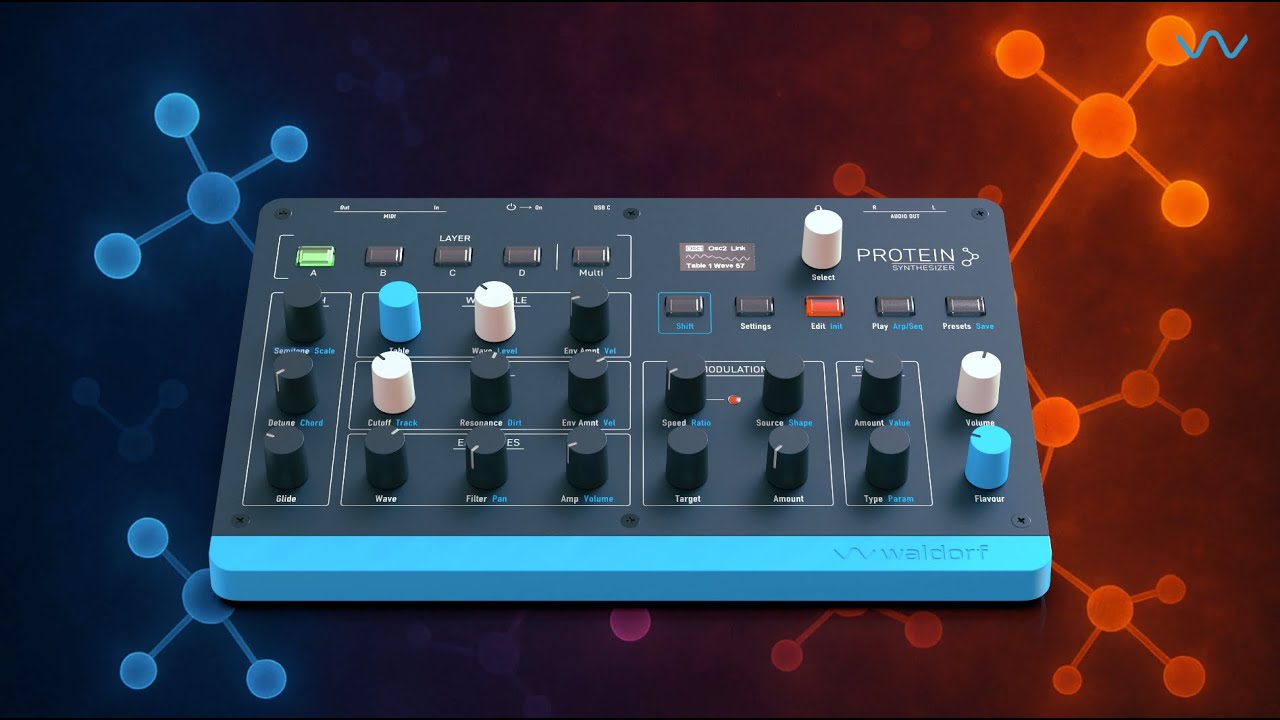
The Waldorf Protein fulfils its brief perfectly; it's a small desktop device, powered directly from your computer via USB-C, providing perfect hands-on control via 21 pots. Most of these pots are of the fixed variety, with a handful of rotary/push pots, in appropriate locations. There’s also a shift function that doubles the functionality of the pots. As you dive into a section for editing, your path is guided by the parameter next to the pot, with confirmation presented on the sharp-but-small display. The shift button can be latched or momentarily depressed, depending on your style of working.
The Protein architecture is an 8-bit, 8-voice synthesizer, which provides two oscillators per voice. However, it also offers up to four layers, so a patch could conceivably consist of eight oscillators per voice. In reality, the number of oscillators can be less important when it comes to wavetable synthesis, as the interest provided by a single wavetable provides a compelling prospect against the more traditional forms of subtractive synthesis. Arguably, all of the interest lies within the wavetable, and Waldorf does not disappoint.
The two oscillators per voice/layer are identical, being based on the original Microwave 1 ASIC oscillator. Waldorf supplies 64 classic PPG and Microwave wavetables, each with 61 cycles per wavetable. If you require something more subtractive, the last three cycles of each wavetable produce a triangle, saw and square wave, which have their uses for bolstering the resonant colours of some of the wavetables.

Filter noise
Where the Protein differs from some other Waldorf designs is through the use of an entirely digital filter. There have been previous examples of digital filter from Waldorf that have been completely indistinguishable from their analogue counterparts, and the supplied filter adopts a faithful model of the CEM Curtis chip design, and it’s very palatable as a consequence. It is switchable between low and high-pass modes, with accompanying resonance and envelope modulation pots contained immediately within the filter section, alongside the ubiquitous cutoff pot. Of course, filter behaviour is influenced considerably by the wavetable(s) being sculpted, but even with full resonance applied, the resulting colours are nuanced and musical. The heritage of this instrument harks back to the '90s, and to our ears, the filter feels more polished and usable than many filter examples from 30 years ago.
There is also a drive component to the filter, with five different variations which include the grittiness of a tube, diode or just plain ‘crunch’, but in each case, it replaces the filter component, so it may not be entirely appropriate for all settings. In fact, referring to our previous point about the wavetable content, the coupling of drive with a particular wavetable timbre can be incredibly effective, particularly when you factor in layering. As up to four layers can be employed, you can simply mix and match filter or drive colours across the layers.
Also buried within the filter section is a noise generator, providing a number of terrific noise timbres. These range from static, which is essentially white noise, through to clicks and even a Geiger counter. The noise sources described as Burst (of which there are three) provide various short lengths of noise, which are perfect for adding colour to the front of a patch.

Get modded
Wavetable synthesis reacts particularly well to modulation, and Waldorf provides potential for creating plenty of movement. Protein is armed with three ADSR envelopes and two LFOs, at the layer level, with the LFOs offering tempo synchronisation and sample & hold. It's possible to engineer basic modulation from the front panel with a degree of immediacy, but going deeper does require the use of the mod matrix, where up to eight slots are available.
One of the beauties of having hardware control is the fact that you can experiment considerably before cementing your modulation. Even the simple process of employing a sweep across a wavetable can be explored hands-on before committing the modulation routing, making the whole process far more appealing for the end user.
Protein also reacts to polyphonic aftertouch and embraces MPE modulation sources comfortably.

Round robin flavour
One of the attributes of wavetable is that it can sound a little sterile in certain settings and scenarios. Waldorf has engineered a couple of ingenious elements to lessen this outcome, beginning with the ‘flavour’ pot. It could easily be described as an organic or analogue pot; increasing this parameter induces elements of detuning or subtle variation to the wavetable or filter. In an intrinsically digital device, it is really effective.
However, if you are working with a multi-layer patch, the round robin feature is particularly cool. As each note is triggered, the round robin feature can be set to trigger the next available layer, either in sequence or randomised, creating a degree of subtle variation, which works particularly well when working with some of the performance elements, such as the arpeggiator.
Despite being a module-only device, there is no lack of performance features, with the arpeggiator leading the charge, with 16 different rhythmic variations available. You do have to keep a close eye on the screen, though, when selecting your arp parameters, but you can get lost for hours in the beauty presented alongside the round robin feature.

Protein power and connections
The Protein is designed to be a small and portable device, and weighing in at under a kilo, it won't add much weight to a laptop backpack. Connection to your computer, via USB-C, is perfect for both powering and acquiring a direct MIDI connection. There is no audio interfacing via this connection, so you will need to use headphones or connect the TRS stereo jacks, but in this context, the connection will be very tidy. This becomes a little messier if you need to use conventional MIDI sockets, as you will need to use the included trailing adapters.
You can also use an external power supply, such as a phone charger. During our testing, we had Protein powered from a USB hub, and we experienced no issues, either with powering or noise. Waldorf freely admits that in certain circumstances, noise can infiltrate the audio path, and it provides a helpful USB adapter, which will eliminate any earthing issues, resulting in unwanted clicks and pops in the audio path.

Verdict
It won't come as a huge shock to learn that we love the sound of Protein. Despite its price, which is considerably less than other Waldorf devices, Protein stands up incredibly well. We have always really enjoyed the PPG/Waldorf wavetable sound, and Protein really delivers on this front. It’s sonically multifaceted, sounding pure and cutting, or soft and endearing, or you can go full-on wavetable and create exceptionally appealing movement from a single wavetable. What's really interesting is that you can get lost in a single layer for ages, creating the perfect sound, such is the nature of wavetable synthesis. You can then copy and paste a layer to a multi-patch, allowing for editing individually or globally.
Despite the resplendent set of pots and buttons, it still takes a little while to truly discover where things are, and how things react. Workflow begins to speed up considerably once you have an acquaintance with it. Wavetable can also feel a little more labour-intensive in its programming ethos, and the Protein certainly falls in line with this level of expectation, but the trade-off is a very unique-sounding set of patches and the total enjoyment of working with hardware in this scenario.
Hands-on demos
Waldorf
Alternatives
Specifications
Price |
£299 / €329 |
Key features |
8 note polyphonic 2 x Oscillators per voice plus noise 4 x Layers 3 x Envelopes 2 x LFOs Low or high-pass filter, with resonance Polyphonic aftertouch and MPE operation 2 x Effects available globally (Chorus, Flanger, Phaser, Tremelo, Drive, EQ & Reverb) MIDI via USB-C or trailing cable sockets Mono or Stereo output via 2 x TRS jacks Over 150 included Factory patches, with 250 patch locations |
Contact |
