


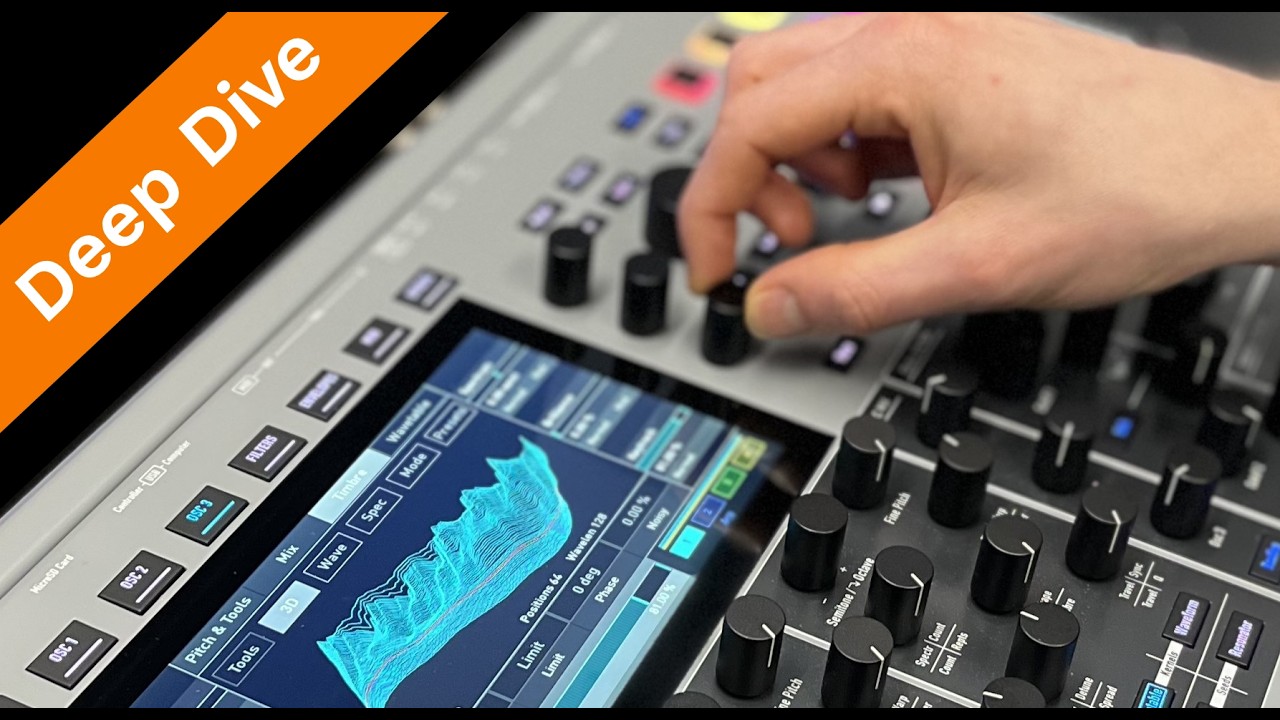
Waldorf has announced a new version of its desktop synth Iridium, which ups the power of the original and adds several new features that have been informed, in part, by a collaboration with Aphex Twin.
First launched in 2020, Iridium is based on the same multi-engine design as Waldorf’s flagship Quantum, which combines various complex digital synthesis approaches including wavetables, granular, physical modelling and modulation synthesis.
Although its specs are trimmed down compared to the behemoth Quantum, Iridium is still a hugely powerful synthesizer, offering dual layers with three oscillators a piece, multi-functional digital filters, a hugely capable effects section and a generous array of modulation tools.
Now Waldorf has launched Iridium Desktop Mk2, which appears to double down on all the most impressive aspects of the original.
Notably, Iridium Mk 2 increases the power of the original, with extra RAM for the sample-based synthesis approaches and an improved CPU. This extra grunt allows the Mk2 to up the multitimbral capabilities, now offering four distinct synth layers, rather than two.

As well as adding extra layers, Iridium Mk 2 offers new ways for these multitimbral elements to interact. Like Waldorf’s recent compact synth Protein, Iridium can now cycle through timbral layers in round robin or randomised patterns.
There’s a new synthesis mode on offer too, named Seed, which Waldorf describes as being “inspired by wavetable synthesis, in which each wavetable represents a timbral journey, Waldorf has found a way to base these timbral journeys not only on static waveforms, but also to dynamically synthesize each waypoint from sub-oscillators we called ‘Seeds’.”
The Seed mode can also make use of modulation approaches including FM and ring mod.
Possibly the most eye-catching of Iridium’s new features is its per-note parameter locks. This allows users to assign up-to 16 different parameter settings for each note, effectively letting every played note have an entirely different sound, even going as far as changing the synthesis approach for individual notes.
What makes this feature particularly interesting is the fact that it is, according to Waldorf, “the result of a collaboration with legendary Aphex Twin, a long-term Iridium Desktop user.”
Parameter locks are input simply by holding the intended note and then adjusting the parameter using the Iridium interface. Per-note parameter locks are saved with each synth patch and can be edited using a dedicated UI menu.
This is hardly the first time Aphex Twin has offered a brand a few instrument design pointers. In recent years, the likes of the Korg Monologue and Novation Bass Station II have also benefited a little input from Richard D James.
Iridium Desktop Mk2 also gains an assortment of other new features compared to its predecessor, including expanded flash memory for samples, additional presets and a ‘flavour’ control – again, inherited from Protein – which introduces subtle variations in pitch and tone.
Along with the new model, Waldorf has also released a firmware update for all Iridium and Quantum users that adds universal features including a Mutator patch randomiser, polyphonic arpeggiator and microtonal features.
Iridium Desktop Mk2 is out now, priced at £2,095/€2,399/$3,699. Head to the Waldorf site for more info.
