
Major musical instruments are a lot like motion pictures. Making them takes a long time and involves a large team of people and usually a heck of a lot of money. Nobody wants to make a bad product; everyone is shooting for the moon. It’s just that, on occasion, the end result falls short of the mark.
Fair enough, and pats on the back all around for giving it the ol’ college try, but sometimes a product polarizes its audience. Think Prometheus or Man of Steel: it’s the same for instruments. No company sets out to light Reddit’s r/synthesizers page on fire with flames of hatred, but that’s what happens when you push out the musical instrument equivalent of The Phantom Menace. Some hate it, others love it, and interestingly, the general consensus often changes over time.
Some products take off, some land with a thud, and some stir up so much controversy they become their own memes. These are the most divisive synths, drum machines, and grooveboxes ever released, the ones you love to hate – or possibly even hate to love – and the ones that armchair warriors love to debate online.
Some made a big splash at first, only to have their reputations tarnished as reports of buggy software made the rounds. Others are split right down the middle, with half falling all over themselves to post artfully arranged Instagram videos of the instrument placed next to a potted plant, and the other half gleefully tearing it a new one in the same video’s comments section.
1. Akai Timbre Wolf

At NAMM 2013, Korg surprised everyone with its MS-20 Mini, a remake of the classic 1970s synth, and a major catalyst for the analogue synth revival. Two years later, Akai Professional received a very different reaction at NAMM to its Timbre Wolf, a four-voice analogue poly that coincidentally borrowed a few ideas from Korg’s Mono/Poly.
While the Timbre Wolf is an unusual synth with some questionable design choices, the crowd that greeted the online reveal were out for blood, having already decided that the Rhythm Wolf follow-up was going to be a howling failure.
Essentially the bass synth from 2014’s Rhythm Wolf drum machine (the one plagued by tuning problems, hence the feeding frenzy) multiplied by four, Timbre Wolf offered four synths in one, each with its own filter and VCA, with round-robin voice allocation recalling the Mono/Poly.
The filter had a bad habit of killing volume at high resonance, the oscillator tuning was limited in range, the envelope was limited to decay, you couldn’t play polyphonically over a single MIDI channel, and people complained of a frustrating lack of response in the knobs. All of this culminated in an avalanche of criticism that found users competing to see who could say the worst things about it online (like calling it ‘Fart Poodle’).
Ten years on, the Timbre Wolf still has its passionate detractors, but many have grown to accept it for what it is: a unique quadruple bassline generator with a sequencer and over-the-top distortion. (That was our take from the very beginning.)
2. Teenage Engineering OP-1

Most music instrument companies have a few polarizing releases under their belt – it's an inevitable result of the strive for innovation. But there aren’t many like Teenage Engineering, whose entire existence is divisive. From the release of its very first product, 2010’s OP-1, the Swedish brand has divided producers into two camps: a devoted fanbase that's fully onboard with its quirky design choices, and those who think it’s overpriced hipster rubbish.
“It's not cheap, but the beautifully designed OP-1 is fun, inspiring and unique-sounding.” This is the summary in our review of the OP-1, which ran in Future Music Magazine in 2011. That’s pretty much TE products in a nutshell: beautifully designed, unique, and expensive. The OP-1 cost $849 at the time of release (and $1399 when discontinued in 2022), and the sequel OP-1 Field is currently $1999. Detractors say that’s a lot of money for not a lot of instrument, while fans will argue that you’re buying a ticket to the TE way of doing things, which inspires creativity through creative limitations and unconventional design.
With the OP-XY continuing the Casio-like design legacy (and costing more than ever), the debate doesn’t appear to be cooling down anytime soon. Now if only the company would release a new version of its $1600 table so that we can all be on the same whinging side again.
3. Yamaha DX7
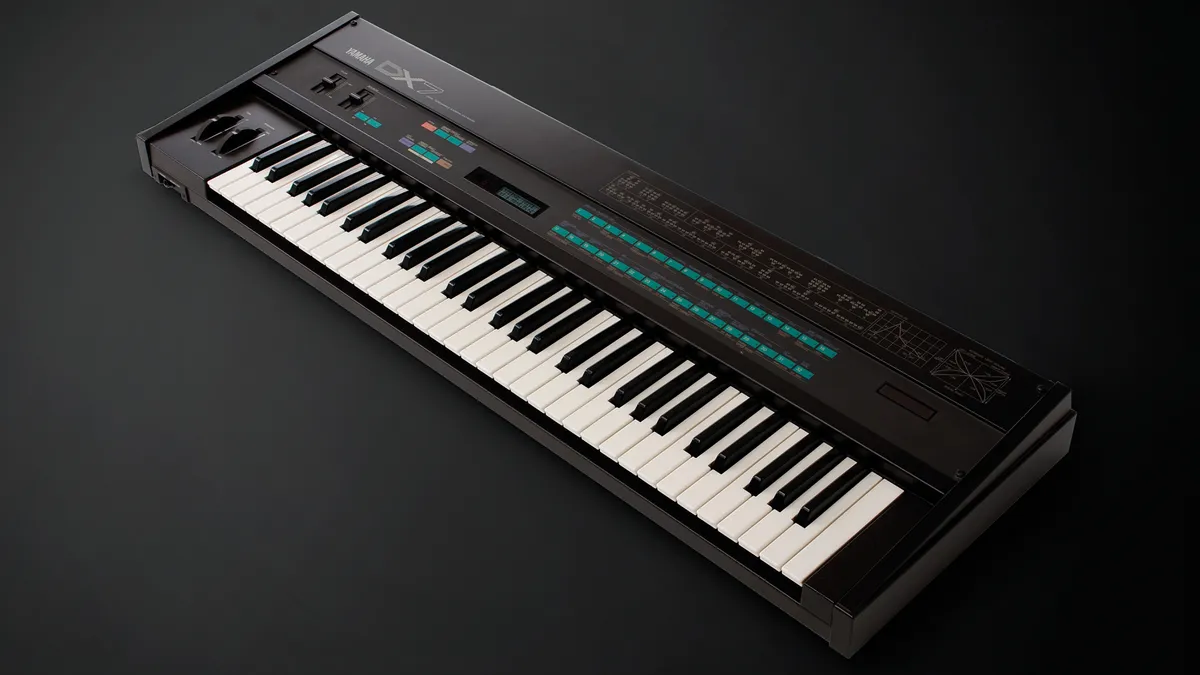
In 1986, something like 60% of songs in the US charts featured the Yamaha DX7's electric piano preset. That is a ridiculous statistic. But at the time, Yamaha’s digital FM synth was the hottest thing going, selling at numbers unheard of in the synthesizer market.
With its unfamiliar modulators and carriers, it was also prohibitively difficult to program - and that was for people who already knew about synths. One of the reasons the DX7 sold so well was that non-synthy keyboard players were buying them, too. They certainly weren’t going to bother learning how to program them, and so they leaned on the presets, rinsing them in all the big hits.
This is largely why the DX7 remains so divisive, even 43 years after its initial 1983 release. Never mind that it came loaded with some pretty amazing sounds capable of more than just pop ballads. It’s hard to imagine industrial music without it, for one. That bass – phwoar. And if you knew your way around an algorithm, you could coax some shockingly beautiful tones out of it. Just ask Brian Eno.
But the E.PIANO 1 damage was done. Even today, there are musicians of a certain age who cringe when they hear a DX7, even though it’s one of - if not the - most important synthesizers of all time.
4. Arturia DrumBrute

Riding high on the analogue revival, in 2016 Arturia released the DrumBrute, a drum machine variant of its popular (and polarizing) Brute line of synths.
The backlash was, sadly, predictable. People seemed to have forgotten that the sounds they’re used to hearing from the most-lauded analog drum machines, Roland’s TR-808 and 909, have been processed and inflated to such a degree that they bear very little resemblance to what you hear straight out of the box. (Not to mention that the cymbals on the 909 are sampled!)
Anyone expecting similarly massive kicks and snares was going to be disappointed. We said as much in our review: “By their nature, synthesized claps and snares can sound a touch thin compared to the multi-layered, sampled drum hits we're used to hearing in modern productions, and you'll probably need to add a bit of drive, reverb or a tight delay to these to get them to cut through a mix.”
However, for those willing to accept the DrumBrute on its own terms, there are plenty of gritty analogue delights to be had. “The trick is to approach it for what it is instead of hating it for what it isn’t,” says Redditor NortheastAttic. “That snare doesn't sound like an 808, which is its strength, really.”
5. Eurorack

When Dieter Doepfer invented the Eurorack system in 1995, he had no idea the beast that he was unleashing upon the world. The Doepfer A-100 system established the 3U size as the height of choice and made modular synthesis far more popular than any other format had before.
Relatively affordable in comparison to systems like Moog or Buchla and with an experimental ethos running throughout, Eurorack introduced music producers to new worlds of synthesis, modulation and sequencing, which then filtered out into the more traditional ‘normalled’ world of hardware synthesizers.
Or so say its fans. For those on the other side of the fence with their fingers in their ears, Eurorack ‘music’ sounds like bleeps and bloops at best, and flatulence at worst (see ‘Fart Poodle’, above). It may be affordable compared to Buchla, but economies of scale and small batch runs ensure that you’re still paying much more for less functionality than a basic synthesizer. And are any Eurorack devotees actually finishing songs, or are they just endlessly patching?
One person’s low-end modulation explorations are inevitably another person’s fart noises – as it should be.
6. Behringer Model D

Like Teenage Engineering, the very mention of Behringer causes producers to pick a side. Mirroring the broader societal culture wars and playing out in the comments across social media platforms, musicians tend to fall into one of two camps: the first agrees that Behringer’s low prices are circumventing gatekeeping and bringing low-cost clones of classic instruments to the masses, while the other bristles at the company’s sometimes heavy-handed marketing techniques.
This all started with the Model D, a budget recreation of Moog’s uber-famous Minimoog Model D. Current pricing has Uli’s take now selling for around $200, 26 times cheaper than Moog’s own 2022 reissue. And it sounds the real deal. “It really does nail that vintage sound and has found a permanent place in our workflow,” we said in our review in 2022. It’s hard to argue with savings like that, and it seems that few are, as half of European retailer Thomann’s 20 best-selling synthesizers of 2025 came out of Behringer factories.
7. PACE Anti-Piracy iLok

This may seem like a strange choice. iLok isn’t a synth, drum machine or groovebox, but it can be a locked door that stops you from purchasing the software version of one. And boy, do people hate iLok. To the extent that if they see that iLok is a requirement, they will refuse to buy the product it's associated with – or even download a piece of freeware. So what gives?
iLok is a DRM (digital rights management) software application from PACE that developers can use to (ostensibly) prevent the product from being pirated. It requires activation through an iLok application and needs to remain installed on your computer to use the software – this is where people's resentment begins.
Requiring internet access at all times can be a dealbreaker for some. And then there’s the dreaded dongle. While the USB stick is no longer necessary for the most part, having been replaced with a cloud option, bad memories of having to shell out extra cash just for the right to run software that you already paid for have left many with a bad taste in their mouth.
So who likes iLok? Developers, obviously. Pirating is a major source of lost revenue, and iLok helps prevent that. But for many, it’s too much of an ask to be worth it.
8. Korg KAOSS Replay

This year at NAMM, Korg announced the KAOSS PAD V, a return to form for the long-running hardware effects series, one that took a serious detour into disappointment with 2023’s KAOSS Replay.
Part KAOSS PAD, part sampler, part DJ tool, it mainly confused people as to what they should do with it. If it’s a KAOSS PAD, why is it so expensive, and why can it only trigger one effect at a time? And if it’s an SP-404 competitor, why is it so limited in terms of sampling?
However, for those who have actually recognized it for what it is - a DJ-style performance tool and not a phrase sampler - it has found firm favour in their live rigs. “I own this and it is so, so sick,” says one Redditor. “Very easy to master and a crapload of fun.” Live techno act Saytek also uses one in his setup alongside his drum machines and synths as a replacement to his older KAOSS PAD KP3.
The fact that the KAOSS Replay has beatmatching and hot cues could make it ideal for someone looking to DJ their own material and process it live. If they can afford it, that is.
9. Roland MC-303 Groovebox

In the late 1990s, dance music reached an apex of popularity, with acts like the Chemical Brothers and Fatboy Slim burning up the charts, even in traditionally rock-oriented America. Roland jumped to meet the opportunity with the MC-303 Groovebox, the first product to be called a groovebox, a divisive term in and of itself.
Although the 303 in the name was a deliberate callback to the TB-303, the MC-303 was not analogue but a glorified ROMpler with a sequencer, something that felt like a cynical cash-grab to dedicated electronic music producers at the time. The fact that it was extremely limited in both editing and sequencing only added to the frustration, and to this day it’s often the butt of jokes. “The best thing I ever did with my MC303 was sell it!” says one Reddit user.
But as these things usually go, 30 years later it’s seen not as an attempt to fool unsophisticated producers into mistaking it for a TB-303, but as a time capsule of late-1990s music production, an era of tech that is very much in vogue at the moment. “The workflow is funky, but I love the sounds inside it,” says another Redditor.
Interestingly, the follow-up MC-505 didn’t receive nearly the same amount of hate, with MIA famously using one on her debut album and the Beastie Boys even curating an entire album (At Home With The Groovebox) of heavy hitters like Beck and Air making tracks exclusively with the machine.
10. Akai MPC 5000

Akai Professional is riding high right now on the accolades being served up for its flagship MPC XL. But an earlier flagship, 2008’s MPC 5000, wasn’t greeted with nearly as rosy a reception. In fact, the device is generally considered to be the worst of all MPC models.
Buggy, unreliable and perhaps overly ambitious, with an internal synth engine that didn’t quite land (but hinted at where the line was heading), it failed to fulfil expectations. It didn’t help that the MPC 5000 was released at a time when DAWs were becoming the music production method of choice. Although later firmware addressed some of the 5000’s early issues, the damage was done, and the patina of failure remains.
However, this is still an MPC we’re talking about. Despite its numerous issues – including that it inexplicably dropped 24-bit sample support from the previous MPC 4000 model – the MPC 5000 still has its supporters. It sounds great, particularly for drums (we said as much in our review) and the sequencer remains popular for controlling external gear. “I used it as a sequencer, and it was awesome,” says OctaneRed392 on Reddit. “[It] has one of the most accurate MIDI clocks you can dream of.”
