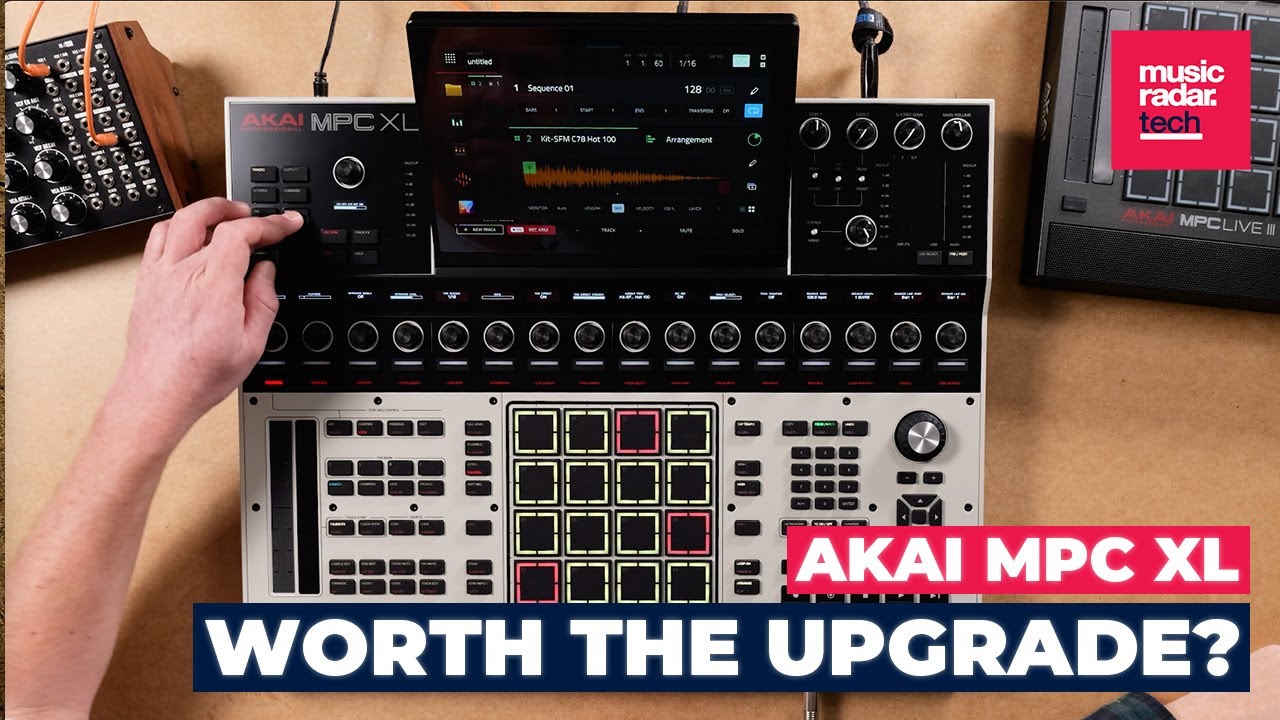
NAMM 2026: Akai has launched its successor to the flagship MPC X, the MPC XL. The XL follows in the footsteps of last year’s excellent MPC Live III upgrade, adding a lot of similar enhancements such as vastly improved CPU power, expressive MPCe pads and a new step sequencing workflow.
The MPC XL maintains the design ethos of the MPC X, which was first released in 2017, and followed by an upgraded Special Edition model in 2023. Broadly speaking, it offers the same workflow as the smaller MPC Live and MPC One models, capable of self-contained beatmaking, recording, sampling, arranging and mixing, but with an increased amount of inputs and outputs and a broader variety of hands-on controls.
There are significant upgrades here compared to previous gen MPCs though. As with last year’s MPC Live III, the XL is now powered by a Gen 2 8-core processor that Akai says offers four times the processing power of previous MPCs. The XL is also packed with 16GB of RAM, which is double the 8GB offered by the MPC Live III and a massive upgrade from the 2GB and 4GB of RAM in the MPC X and X SE respectively.
From a practical perspective, that means the MPC XL can now run up to 32 plugin instruments and 16 audio tracks simultaneously, with support for up to 256 simultaneous voices. The MPC XL also ups the onboard storage to 256GB, with a SATA expansion bay for additional storage.
The central grid of pads is upgraded with the MPCe tech seen on the Live III last year. This brings an expressive functionality broadly inspired by MPE controllers, although functioning a little differently in practice. As well as offering aftertouch expression, the pads can also be configured to modulate parameters by moving a finger across their X/Y axis.

The pads are divided into four quadrants, and the MPC XL also allows for these to be configured to trigger different samples, effects or timing divisions depending on where the pad is pressed, which is fantastic for creative finger drumming.
Another new feature carried across from the Live III is the touchstrip, which can be configured to control pitch, volume levels, trigger samples or introduce performance effects and beat repeats.
The 16 multi-functional Q-Link rotaries of the previous MPC X are still included, but they’re now moved to sit in a row running across the middle of the unit, above a bank of buttons used for step sequencing. Each Q-Link controller has its own OLED screen offering feedback on various parameters within different sequencing and arranging modes.
Thanks to the repositioned Q-Links, the MPC XL has more front panel UI space, which allows it to offer, according to Akai, “one-to-one function buttons for immediate access to every feature.” A particular highlight of this is a pair of buttons for instant access to sample slicing and stem separation.
On this latter front, as with the MPC Live III, the increased CPU allows for the MPC XL to include the higher quality separation algorithms used in the desktop version of the MPC software, as opposed to a more ‘efficient’ variation.
Connectivity-wise, the MPC XL is similar to the MPC X. Its rear panel has two preamp-equipped combo XLR/TRS ports, along with an additional pair of rear inputs switchable between stereo TRS or phono. These are joined by a pair of front panel instrument inputs.
The MPC XL has eight ¼-inch jack outputs arranged in four stereo pairs. As with the MPC Live III, the X can now stream 24 channels of audio I/O and 32 channels of MIDI I/O via its USB-C port.
The MPC XL has six MIDI ports, offering two inputs and four outputs. There are also eight stereo CV outputs, allowing the unit to output up-to 16 CV signals simultaneously. For additional storage and connectivity, the MPC XL also has two rear panel USB ports, along with an additional USB and SD card slot on its front edge.
"The MPC XL represents the evolution of everything we've learned from decades of innovation in music production," said Andy Mac, Creative Global Marketing and Artist Relations Manager at Akai Professional. "We've created a true studio-grade workhorse that delivers DAW-like power in a standalone format. MPC XL removes every barrier between inspiration and creation, giving producers the speed, control, and connectivity to bring their most ambitious musical visions to life."
We got our hands-on the MPC XL ahead of launch. In the video at the top of this page, we explore how it differs from the MPC Live III and MPC X, along what we like and what we’d like to see added.
The MPC XL is out, now priced at €2,899.99, £2,499.99 and $2,899. Head to the Akai Professional site for more.
