
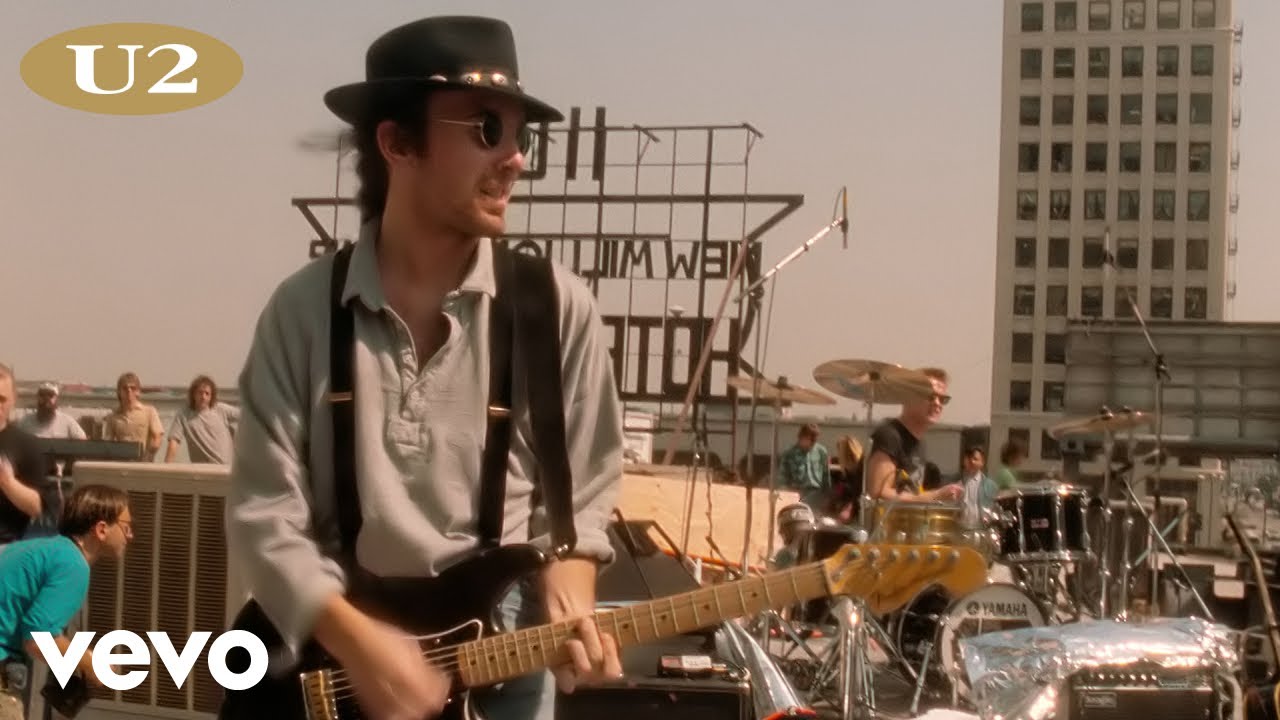
On 27 March 1987 the four members of U2 and their substantial production team took over the first-floor rooftop of a liquor store in downtown Los Angeles.
The plan was to perform a guerilla-style video shoot for Where The Streets Have No Name, the opening song and third single from their recently-released album The Joshua Tree.
The video would become a defining visual moment in the trajectory of the Dublin four-piece and it had a distinct sense of drama and urgency, due to the LAPD threatening to shut the shoot down. This had strong echoes of another iconic rooftop concert back in January 1969, a fact acknowledged by Bono.
“It's not the first time we’ve ripped off The Beatles,” the singer quipped.
In reality, the video for Where The Streets Have No Name was not an impromptu event but an impeccably-planned operation. The video crew reportedly spent a week beforehand shoring up the roof of the liquor store and the police were only galvanised into action after U2 informed the media of the event, which prompted tens of thousands of people to descend on the location of the shoot at the intersection of 7th and Main Street in downtown Los Angeles.
In an interview with Classic Rock in March 2022, the video’s director Meiert Avis said it was always the band’s intention “to be disruptive”, adding that the shoot was planned with the aim of “creating a spontaneous media event that one couldn't help but notice”.
But for all its contrivance and the fact the band were obviously performing to a playback of the studio recording, their performance in the video had real conviction.
Certain moments stand out, such as Bono’s Blakean persona, whirling and teetering precariously at the rooftop’s edge, bassist Adam Clayton’s shirtless cool and the throngs of fans staring up excitedly from below.
It’s no surprise that U2 chose Where The Streets Have No Name as the opening track on The Joshua Tree album and as the opening song of their set on that album’s mammoth tour, which kicked off six days later at the ASU Activity Centre in Tempe, Arizona.
Where The Streets Have No Name is a soaring, euphoric anthem with a frenetic, driving edge. It’s also seeped in atmosphere and evokes all the widescreen emotion for which the band would become known.
The first stirrings of the song that became Where The Streets Have No Name emerged as a demo that The Edge recorded in 1986 before the band resumed the Joshua Tree sessions at Windmill Lane Studios in Dublin.
The guitarist had recently bought Melbeach House in the leafy, coastal suburb of Monkstown, south of Dublin. He was recording an arrangement of keyboards, guitar, bass and a drum machine on a four-track in an upstairs room.
In the band’s official autobiography U2 By U2 (2006), created by the band in collaboration with music critic and author Neil McCormick, the Edge recalled that he wanted to “conjure up the ultimate U2 live song”.
When he finished a rough mix and listened back, he realised he had come up with “the most amazing guitar part and song of [his] life”. There was no-one else in the house at the time to share his elation with, so he simply danced around to the track while punching the air in celebration.
The band were equally enthused. But playing and recording the song was another matter.
“At the time it sounded like a foreign language,” Adam Clayton said in U2 On U2, “whereas now we understand how it works.”
On Where The Streets Have No Name, the Edge used a heavy rhythmic delay effect. This was achieved by playing a fast-picked arpeggio pattern through a digital delay – most likely his favoured TC Electronic 2290 units and/or his Korg SDD-3000s – and then splitting the signal after the effects chain between two vintage Vox AC30s for the signature wide stereo sound that defines the song.
The guitar he reportedly used was his 1973 black Fender Strat with a DiMarzio FS-1 bridge pickup and the effect was a dotted eighth note delay, set to approximately 354-365ms at 128bpm.
Locking in precisely with the Edge’s dual delay set-up was a challenge for bassist Clayton and drummer Larry Mullen Jr. So too was the fact that the song featured two distinct time signatures – 4/4 for the main body of the song and 3/4 for the atmospheric introduction and outro.
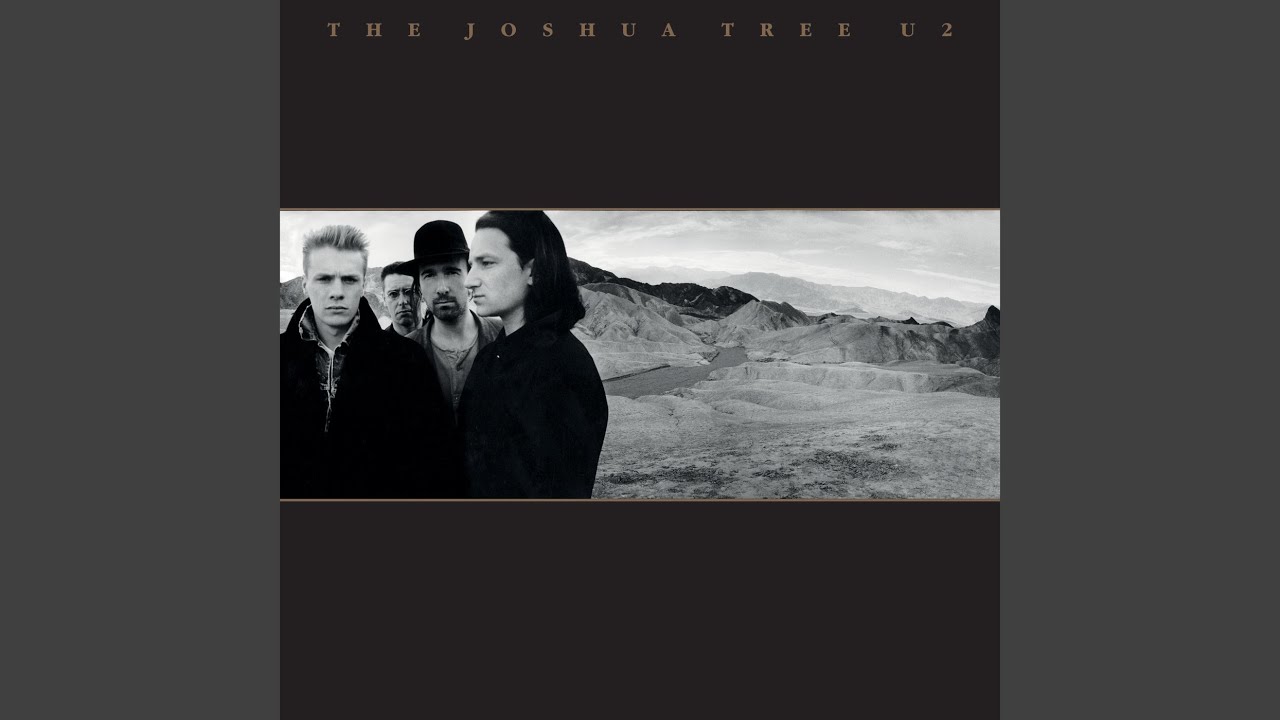
Getting all these elements spot-on in the recording process was a problem for the band, the recording engineers and the co-producers on The Joshua Tree, Daniel Lanois and Brian Eno.
In a feature written by Colm O’Hare of Hot Press magazine in 2007, Lanois recalled the experience.
“That was the science project song,” he said. “I remember having this massive schoolhouse blackboard, as we call them. I was holding a pointer, like a college professor, walking the band through the chord changes like a fucking nerd. It was ridiculous.”
The band, their producers and their engineers spent weeks working on the one song. Eventually, according to the 1998 TV documentary Classic Albums: U2: The Joshua Tree, Eno allegedly decided that the best solution would be to completely erase the song’s tapes and start from scratch with a fresh performance.
At one point, Eno allegedly had the tapes cued up and ready to be recorded over but it never happened. According to the engineer Mark ‘Flood’ Ellis, fellow engineer Pat McCarthy had gone out of the room to make some tea, returned to the control room, saw what Eno was planning and dropped the tray full of tea he was carrying to physically restrain the producer.
“He was completely freaked out as the junior member of the team attacking the senior member of the team and saying, ‘Maybe it’s not a good idea, Brian, to wipe the entire song,’” said Flood in the documentary Classic Albums: U2: The Joshua Tree.
In the same documentary, Eno recounts his own version of events.
“What we kept doing was spending hours and days and weeks actually, probably half the time that the whole album took, on that song, trying to fix up this version on tape,” Eno said. “It was a nightmare of screwdriver work you know. And my feeling was… I’m sure we could get there quicker if we started again.”
“So my idea was to stage an accident, to erase the tape so that we would just have to start again. But I never did.”
The song was eventually compiled from several takes and was one of several songs mixed by Steve Lillywhite in the final months of recording The Joshua Tree.
“It took so long to get that song right, it was difficult for us to make any sense of it,” recalled Larry Mullen in the autobiography U2 On U2, “It only became a truly great song through playing live. On the record, musically, it's not half the song it is live.”
Lyrically, the song is rather obtuse but the initial inspiration seems to stem from a story Bono was told by someone in Belfast about how the street someone lives in reveals so much about them.
In the U2 On U2 autobiography, Bono said he wrote the lyrics on an airsickness bag while staying in a village in Ethiopia, where he and his wife Ali Hewson were staying while on a humanitarian trip as volunteer aid workers.
In December 1987, he told Robert Hilburn of the Chicago Sun-Times that he contrasted the Belfast story with the anonymity he felt in Ethiopia.
“The guy in the song recognises this contrast and thinks about a world where there aren't such divisions, a place where the streets have no name. To me, that's the way a great rock ’n’ roll concert should be: a place where everyone comes together... Maybe that's the dream of all art: to break down the barriers and the divisions between people and touch upon the things that matter the most to us all.”
In a 2017 interview with Rachel West of Entertainment Tonight Canada, Bono said he still felt the song’s lyrics were incomplete. “Lyrically it’s just a sketch and I was going to go back and write it out,” he said.
He also expressed profound regret for rhyming ‘hide’ with ‘inside’ in the opening two lines. But in the same interview The Edge disagreed with his comments: “I love the track, myself. I disagree with Bono. He’s very hard on himself.”
Where The Streets Have No Name was released as the third single from the Joshua Tree in August 1987, and reached No. 1 in Ireland and New Zealand, No. 4 in the UK and No. 13 in the US.
Critics lauded the song. Cash Box called it an “achingly beautiful rocker” with “incredible raw emotion and power”. The NME praised Bono’s impassioned singing and The Edge’s guitar playing and concluded that the “last ten seconds are breathtakingly beautiful”.
As the years have passed, its reputation has grown. In 2002, Q magazine named Where The Streets Have No Name the sixteenth most exciting song ever. In 2020, The Guardian ranked it number one in its list of 40 Greatest U2 songs while in 2022, New York Magazine’s Vulture website placed the song number one in its list of all 234 U2 songs.
Where The Streets Have No Name is still widely regarded as one of the group’s most popular and enduring live songs.
“We can be in the middle of the worst gig in our lives, but when we go into that song, everything changes,” said Bono in Visnja Cogan’s 2008 book U2: An Irish Phenomenon. “The audience is on its feet, singing along with every word. It's like God suddenly walks through the room.”
