


SYNTH WEEK 2026: Just Can't Get Enough is very possibly Depeche Mode's poppiest hit, and arguably their most recognisable song. But it is also the cash-spinning, golden albatross that sticks around the end of every modern Depeche show like your drunken aunt at a wedding. You know she's going to get up and dance when the DJ sticks it on (probably just after Dancing Queen). She's guaranteed to make an arse of herself, but by the end of it, you're joining in with her like it's the best song ever written. And it is. Or it really isn't.
Whatever you think, you can't argue with the fact that Just Can't Get Enough is the song that launched both Depeche Mode and Vince Clarke's incredible careers, so it's time to look at the story behind arguably the most important synth-pop song of all time.
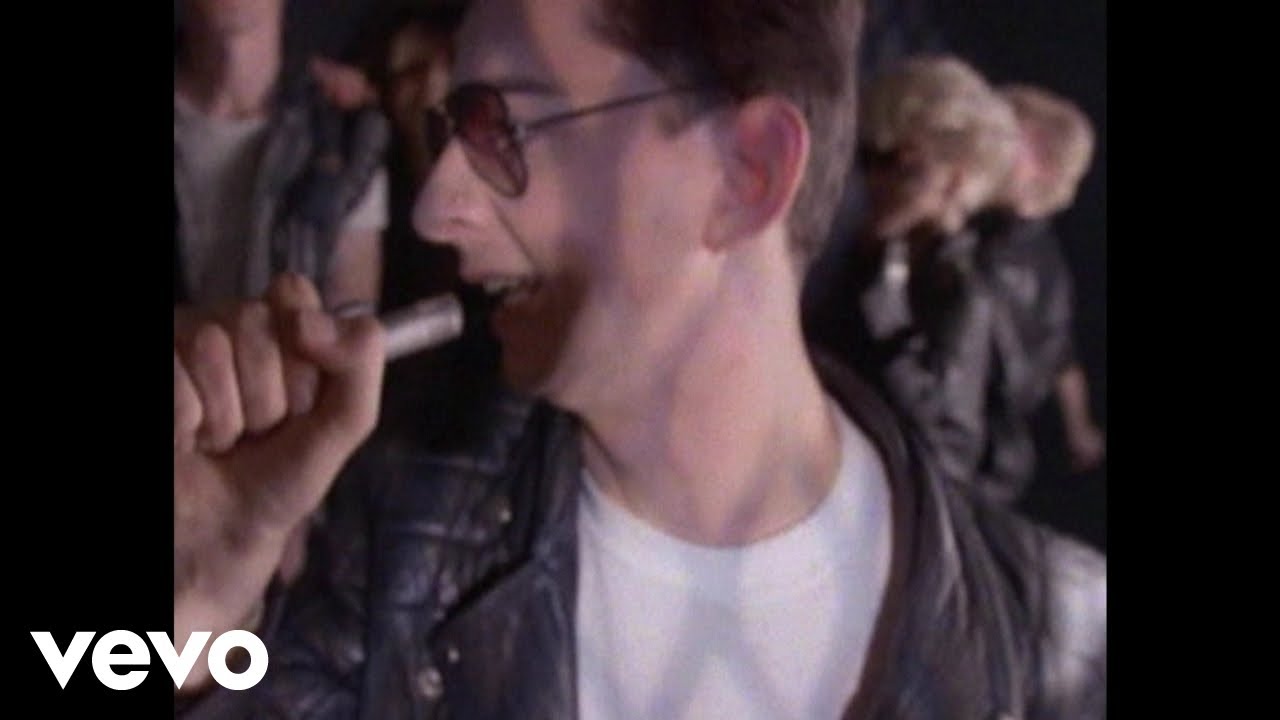
While supporting their sublime album Memento Mori on their last tour, Depeche Mode invariably (actually always) played Just Can’t Get Enough as one of their encores. It was and usually is a Depeche Mode live ‘rule’. Dave camps it up (even more), it sounds perfect - especially after the bleak and black celebration of less, shall we say, happy material, and it’s what the fans want.
Only if you were to ask those fans, it is probably not their favourite DM track by any stretch of the imagination.
But god help Dave Gahan And Martin Gore - the band's remaining founder members - if it’s not played, because the fans might well riot.
You see, Just Can’t Get Enough is as Depeche Mode as the band gets, but also not Depeche Mode as it represents a time at the dawn of the band before they discovered samplers, Martin Gore’s exceptionally dark songwriting, and minor chords.
It’s the perfect pop song, but also the very antithesis of what the band wanted after its songwriter Vince Clarke left the band in 1981.
Maybe the remaining members would have preferred to have never played it again, they certainly would have been justified (as there are about 20 songs in their back catalogue that could easily replace its encore position) but Just Can’t Get Enough won’t go away.
Whether it’s an annoying cover version backing an ad campaign, or an ecstatic inclusion in the horror comedy film Cocaine Bear, this 45-year-old (yes, it really is) synth-pop classic will always help bring the DM curtain down.
So why fight it? Depeche Mode certainly don't.
While acknowledging it might not be their favourite back catalogue track, Gore and Gahan know a good way to end a gig and both recognise its pop supremacy, so they just give the fans what they want and those fans, you knew this was coming, just can't get enough of it.
To understand where Just Can’t Get Enough came from, just imagine it's 1980 in Basildon, Essex. It's the height of the Cold War, you think you're going to be nuked at any second, everything (and I mean everything) is grey, and the only electronic music you've heard so far has been sombre sci-fi from Numan, terrifying JG Ballardian dystopia from John Foxx, university lecturer electronics from the early Human League, and a bunch of albums about transport from Germany…

Vince Clarke was about to throw some sheer happiness into the pot, with a focussed, single-finger genius, cheap synths, inspiration from a local girl and (yes) Spandau Ballet's To Cut a Long Story Short.
How could you not write one of the best synth songs in history, with those ingredients?
Initially though, some of these essentials were missing. Before forming Depeche Mode with Andy Fletcher, Vince Clarke didn’t have any synth aspirations.
“I'd always been primarily a guitarist, because originally I wanted to be a folk-singer,” he told Electronics and Music Maker in 1984.
“I used to play acoustic guitar in a gospel duo.” It was all a gazillion miles away from analogue synths and pop, and not something we’d imagine would have tempted a young Andy Fletcher away from his office job, but the two school friends began writing songs together anyway.
“By that time I had an electric guitar and a very cheap PA,” Vince recalled, “plus a dreadful Selmer Auto Rhythm Machine. I managed to persuade Fletcher to get an electric bass, and we used to play the odd gig in each other's bedrooms!”
It would be Martin Gore’s arrival that heralded a rethink on the instrumentation because he had gone out and bought himself a Yamaha CS-5 synth.
“When the others saw the possibilities [the synth] offered they both got one as well,” Mute head-honcho and early Depeche producer Daniel Miller told Electronics & Music Maker in 1982. “Then they started to like bands like Human League and Kraftwerk so they gradually changed their instrumentation.”
“When Martin joined the band,” Vince added, “he was the first musician I'd met who had a synth, and it seemed obvious to me that he didn't need any special effects or amplification, because his instrument was really just like a big effects box with a keyboard on it; he didn't need anything else outside it.
“So Andrew and I decided to get a synth each. I got the Kawai (100F), and Andrew borrowed a Korg 700, though just after that he bought a Moog Prodigy instead.

"We had a lot of cheap drum-machines. I remember an Electro-Harmonix machine that was really terrible, and quite honestly I don't know why we bought half our stuff. In the end though we bought a Dr Rhythm, which was the first programmable rhythm-machine. And that was pretty much how Depeche Mode started.”
Still without a ‘proper’ singer, the band wrote early tracks that would appear on their debut album, Speak & Spell, which would be fleshed out into a full LP after Dave Gahan joined them in 1980.
Early singles Dreaming of Me and New Life announced the Depeche sound - very much putting the pop in synth - but these were nothing compared to the band’s third single, perhaps the most famous synth pop track of all time, Just Can’t Get Enough.
Released in late 1981, the single would follow New Life into the top 10 but, more importantly, became a hit around the world, and would ultimately follow the band around for the next five decades.
“The keyboards were really simple, monophonic synths which can only play one note," Clarke told Paul Gambaccini in 1987 in an interview on STV. "So, you can’t play chords, which was good for us because we couldn’t play chords anyway! It [Just Can’t Get Enough] was all one liners that went together with a simple drum machine backbeat.”
The band were recording tracks at Blackwing Studios with Daniel Miller and engineer Eric Radcliffe. (Eric himself would become famous as the 'Eric' in Upstairs at Eric's, an album recorded by Clarke's next band Yazoo.) Miller brought his own synths to the recordings including a Roland SH-1 and an ARP 2600, and by this time Clarke was expanding his synth collection, even considering some early polyphonic options.
"I was looking for a synth with memories, and at the time all I could find was the Roland Jupiter-4," he said. "In retrospect I think buying that was one of the biggest mistakes I ever made, because the JP-4 is polyphonic and I only really wanted another mono one!
"We used to have this thing about playing chords, that they were a bit of an easy way out, and in many ways I still think they are. As a band we never really felt the need to play chords as backing, because we had so many melodies layered on top of another, so when I bought the JP-4, I was still playing it monophonically - I didn't use it as a polysynth at all!"

Radcliffe's Blackwing Studios was in All Hallows' Church in London which he'd initially set up around a Teac 8-track recorder, but other gear at the time included a Korg KR55 drum machine and Roland MC-4 sequencer.
"From eight-track I went on to a Soundcraft 16-track machine," he told Electronics & Music Maker in 1984."and shortly after that I acquired a second Soundcraft and locked the two together to give 32 tracks. We did a lot of Yazoo and Depeche Mode recordings using that system."
Like many other producers and engineers, Radcliffe was wresting with recording synths which were very much in their early days and offering just as many issues as they did solutions.
"Although synthesisers should in theory be easier to record than acoustic instruments, they do present their own set of problems," he said at the time. "You're dealing with discreet frequencies from electronic signal generators, as opposed to acoustic instruments where the frequencies are generated naturally over a much broader bandwidth. I think it's for that reason that you've really got to remember the characteristics of the various types of speaker systems the music is likely to be heard through."
At the time Radcliffe had a flexible effects setup too, including a Lexicon 224, a Lexicon 224X, Quantec Room Simulator and an AMS system. Many would find their way onto Depeche's debut, as would the natural reverb of the church.
"We also use quite a bit of natural echo," Radcliffe said in 1984 of the studio, "because there's a long corridor that still has the original church stonework intact, and above Blackwing Studio there is a natural echo chamber which lies under the main roof of the church. When I originally designed Blackwing, I left the area under the roof as a natural echo room, really because it seemed too good to waste.
"I wouldn't say there's much we record that's absolutely dry, but what does tend to happen is that because we have such a large selection of available reverbs, we often leave that selection until the mixing stage, unless we come across a particularly striking effect during composition."
But really, Speak & Spell and JCGI are all about the synths; early, cheap (mostly) and very cheerful. The 2600 provided sequences, basslines and beats, a Roland System 100 generated some of the percussive sounds and effects, and the Yamaha, Kawai monophonics and Jupiter literally filled in the gaps.

On its release in 1981, the band's debut album Speak & Spell was exactly what both Vince and Daniel had in mind - or at least they did at some point in its production.
Daniel wanted to meld the pop and the synths he saw after witnessing Depeche playing in the Bridge House pub for the first time into his visions for a shiny teen synth band. He’d already tried with some success with his own outfit Silicon Teens.
Vince, meanwhile, must also have been happy with the results, as he wrote the bulk of the tunes and had loaded the album with simple, catchy and direct pop songs, which would become his trademark with a series of collaborators post Depeche Mode.
But as successful a debut as the album was (it spawned a couple of hits, made a splash and did its job of announcing the band to the world) it would become something of an oddity in the Mode back catalogue, arguably more a Vince solo album with Daniel's gear supplying much of the sounds.
After discovering how much of an impact sequencing could have on his life (as in he wouldn't need a band anymore) Vince left Depeche Mode to pursue his own musical vision, and pretty much knocking out magnificent synth pop hits on demand for The Assembly, Yazoo and Erasure.
Depeche Mode turned to the dark side, of course, with Gore proving himself as a master songwriter, especially when the subjects veered away from sugary love songs to death, religion and sex.
Miller would carry on producing, along with engineer Gareth Jones, and the band would conquer the world after being joined by the sonic master craftsman Alan Wilder.
But while Speak & Spell might not be in your list of top DM albums (which is a shame as a couple of tracks are great, as are some of the B-sides), Vince, the band, Miller, Eric, and those early monophonics (and a poly!) did give us Just Can't Get Enough, a song which the fans never will get enough of.
And without it, you can be pretty sure that the Depeche Mode of today might well have been a different proposition. Or not even a proposition at all.

The song itself took on its own life, and has been covered by more than 50 artists since its release, most notably The Saturdays who introduced it to a new generation of listeners.
And who wouldn't put it in a film about a bear taking cocaine? Seems obvious, right?
Ultimately, Just Can't Get Enough was a fitting way for Clarke and the band to part ways. It was a high point of their success at the time, but sent both parties packing and onto much greater things.
So if you don't like the song, you can at least thank it for the greater musical good that it helped give birth to: four bands, countless hits, and really putting the synth on the pop map.
