The BBC has dipped into its archive once again to give us another fascinating look at how the relationship between computers and music was perceived in the late 20th century.
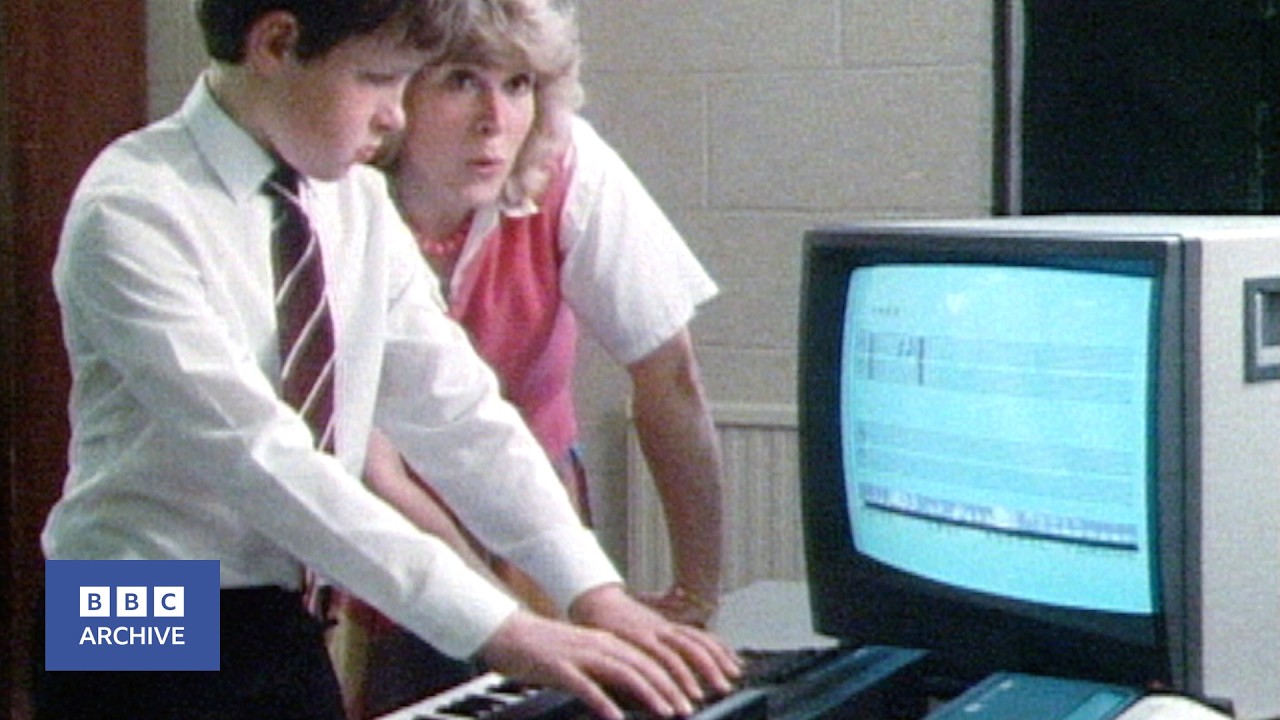
This time, the year is 1986, and we’re at Hugh Faringdon School in Reading to see how a computer – a Yamaha CX5M, unless we’re mistaken – was changing the way that music was being taught. The clip comes from BBC Two computing show Micro Live, which you may well remember if you’re over the age of 45, grew up in the UK, and spent a lot of time trying to learn BASIC in the mid-’80s.
The CX5M was a dedicated music computer that could have its sounds upgraded with cartridges, and could receive note data from a MIDI or QWERTY keyboard. In the video, we learn that Hugh Faringdon School is taking part in a research project in conjunction with Reading University, designed to discover “whether a music playing home computer is fit to join conventional musical instruments” in the classroom.
We get to sit in on a class being taught by music educator Clare Tester, who asks her students to come up with a 1-bar melody using just five notes: E, F, G, B and C. Most of them set to work on the school xylophones, but Mark gets to jam on a synth.
After hearing a few of the melodies, the students are asked to vote for their favourite. Mark’s gets the nod – possibly because it wasn’t played on a xylophone.
Armed with Mark’s melody, Clare shows us how it can be recorded into the CX5M, which is running some simple notation software. “When using the composing program, the computer will take in any number of up to eight parts that you program into it and then it will play it back for you,” she explains. There are 46 sounds, and basic editing facilities.
We see Mark painstakingly choosing his note values and playing his melody, which is layered with others to create a larger arrangement.
What do the students think of this new technology, though? “The computer's better because it can store things longer in its memory than we could,” says one, but not everyone’s convinced of the machine’s potential.
“It's a bit of a shortcut because [when] you're using, like, a guitar or a drum, you're playing it on a keyboard,” points out a different pupil. “I would prefer to learn how to play the instruments. I think it's better than actually playing it on a keyboard.”
Clare Tester also has a criticism or two: she bemoans the fact that the computer can’t display or print all eight of its parts alongside each other so that students can see how they interact. Tasker also suggests that, after a while, the novelty of having the machine started to wear off.
“When we first had the computer, we used it virtually non-stop,” she says. “But interestingly enough, they did begin to miss playing the music for themselves after a while, which meant that we came up with a balance of actually playing the instruments on top of the computer in the background.”
Our narrator, though – who we think is Micro Live presenter Fred Harris – is quick to extol the benefits of music technology, which have become more and more profound as it has developed.
“Until now, creativity has been stifled by the need to acquire playing skills,” he argues. “Now, using the computer, any child can play a piano, organ, trombone, or drums and express creative ideas.”
For the finale, we get to see the students performing their piece using a pioneering hybrid setup of computer, various percussion instruments, brass, woodwind and synthesizer. The big question, though, is if Clare Tester is sold on the idea of having the computer in her classroom going forward?
“I think an excellent way of assessing the success of any new teaching aid is to ask yourself the question, ‘Would I still use it if I had to carry it up three flights of stairs?’” she suggests. “With the music computer, the answer is definitely yes. It's added a completely new dimension to the teaching of music in this school.”
Cue the end-of-day bell. Case closed, class dismissed.