


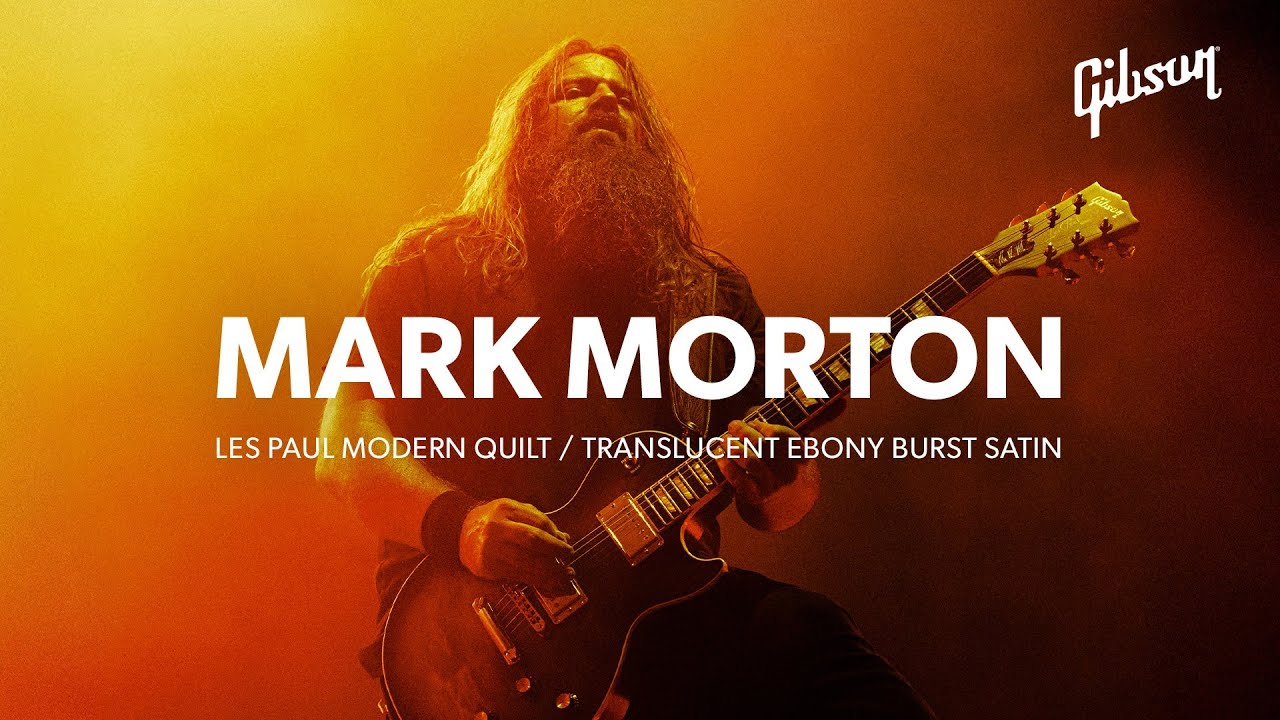
Mark Morton’s signature Les Paul was years in the making, and then when it finally arrived it sold out in a flash, all 350 units gone. The Gibson R&D team and the Lamb Of God guitarist had cooked up a winner.
They had had also played the long game. As far as marketing campaigns go – accidental or otherwise – this one went all the way back to 2022, when Morton, hitherto a Jackson artist, was first announced as joining Gibson, and everyone wondered what kind of guitar they would develop together.
It was not long before Morton was showing up for shows with a mystery Les Paul like nothing from the Gibson catalogue. In September 2023, Gibson CEO Cesar Gueikian gave us a closer look at this guitar, sharing a video on his Instagram account playing a Les Paul with a similar translucent grey finish and quilted maple top to Morton’s. It had black hardware, uncovered humbuckers – and it sounded gnarly.
Months went by with no release but this unidentified electric guitar would regularly turn up onstage with Morton and on social media. It was officially unveiled in February as the Mark Morton Les Paul Modern Quilt (that finish was satin Translucent Ebony Burst), but if you are a Lamb Of God fan, chances are you had probably already heard it when the Richmond, VA metal stalwarts dropped Parasocial Christ on YouTube, the first track from their forthcoming album, Into Oblivion.
Joining MusicRadar from his home, Morton reveals it’s all over the new record.
“And the prototypes!” he adds, relieved that he can actually talk about this guitar after years of putting it through its paces on the road, the Eddie Van Halen way. “There are three prototypes… those are the ones you’ve been seeing me playing and touring with.”

Morton has all kinds of Les Pauls back home. He could have asked for a reproduction of his heavily modded 1975 Les Paul Deluxe. A double for that could be useful right now.
“That guitar, it’s a beater, man! It’s a Deluxe that was routed out [for full-sized humbuckers]. It’s a pancake body,” he says. “That one’s long been retired.”
The Deluxe was one of his old favourites. Nonetheless, Morton wanted something fresh for his Gibson debut. If the Les Paul Modern was ultimately the platform that he gravitated towards, the first prototypes were quite different, with none of the Ultra Weight Relief patterns that take so much of the bulk out of the Les Paul Modern’s body. Initially, Morton’s thinking skewed more vintage.
“That was in the starting point I wanted to be at, because my thinking originally was that I have some older Les Pauls, and I’ve had a number of pretty classic Les Pauls over the years, and I’m used to them being on the weightier side,” says Morton. “Depending on which era, too, as you well know, once you get you get into the ‘70s, they get really heavy – ‘70s and ‘80s. But I wanted to start out without it being weight relieved.”

Les Paul purists will often give short thrift to weight concerns. It’s solid mahogany with a slab of maple on the top, after all. Get a thicker guitar strap is their retort. And yet not many of them have a touring schedule like Morton’s with Lamb Of God, nor are their shows as physically demanding; they’re not playing Redneck and Walk With Me In Hell night after night. The Modern began to make more sense in this context.
“Lamb Of God is a more modern sounding band, and I think for a metal band, the Modern platform of the Les Paul is cool,” says Morton. “It’s got the access up at the higher registers in the neck and, ultimately, we just landed on it being more comfortable weight relieved. I’m playing these guitars on stage for hours at a time, and the weight relief, it just makes it a more comfortable long-session guitar.”
The sample we played weighed in at a relatively svelte 8.4lb. That’s no lunker. The comfort extends to the neck, too. Shaving some of the bulk out of the neck joint, Gibson’s Modern Contoured Heel provides more access to the upper registers, useful for those occasions when Morton’s fretting hand skedaddles on up by the 12th fret, e.g. his ripping Ghost Walking solo. That’s a practical update on the traditional golden era Les Paul blueprint.

The SlimTaper neck of the ‘60s? That is still fit for purpose, and it gives Morton’s Les Paul Modern Quilt a familiar feel in your hand, ditto, the medium jumbo fretwire. As for the ebony fingerboard, the compound radius is subtle enough to almost go unnoticed. This is not the 12” to 16” radius that’s used almost across the board by EVH Gear, Charvel and Jackson.
The most radical – or the most intense – R&D efforts were dedicated to finding a suitable set of electric guitar pickups. Morton didn’t want to just transplant the DiMarzio Dominion humbuckers from his Jackson signature guitar into this. Gibson’s master luthier Jim DeCola was tasked with creating a new humbucker paring.
It was no easy task. At least when DiMarzio was winding the Dominion humbuckers, there was something to work from as they used the Breed humbucker as a starting point and went from there.

DeCola’s custom-wound humbuckers for Morton similarly used a ceramic magnet as the Dominion. They would be high-output, giving the front end of his Mesa/Boogie tube amps something to think about, but there was no question that they were going to be passive.
I find passive pickups to be far more dynamic than any other platform of pickup
“I find passive pickups to be far more dynamic than any other platform of pickup,” he says. “To me, passive pickups respond to touch. They respond to the voicing of your hand in a way that I don’t feel that same response from other types of pickups.”
So many modern metal guitar players are drifting towards active designs. Some prefer to crush those dynamics for a more compressed, almost industrial response. Morton remains partisan on the subject.
“Yeah, I mean, I’m sure there are players that don’t have an interest in playing dynamically and they just want to be on or off.” he says. “And if someone plays like that, that’s cool, and there’s a lot of pickups that do that. But not mine.”

What DeCola came up with was a bridge humbucker that packed a low of heat. As per The Trogly’s Guitar Show on YouTube, it has a DCR reading of 16.38K. And it is smoking. The bridge humbucker is a little more refined, more in keeping with a classic Les Paul voicing.
I don’t want to like compare and contrast too much – they’re different pickups, but I feel like there’s a top-end thing going on on the DiMarzios that is a little bit dialled back on the Gibson
A high-output ceramic pairing, with a real bruiser at the bridge, that’s not a million miles away from what we've got with the Dominion. Morton says his Gibson humbuckers have something else going on in the midrange.
“I mean, in the sense that the bridge pickup is a high-output passive pickup, that’s a similar thing, but EQ’d, I think they are a little more mid-focussed,” he says. “I don’t want to like compare and contrast too much – they’re different pickups, but I feel like there’s a top-end thing going on on the DiMarzios that is a little bit dialled back on the Gibson, so I think they feel a little warmer overall, but still have a really heavy gained response.”

Morton liked DeCola’s humbuckers so much he has modded some of his vintage Les Pauls with them.
“I have a ’69 Les Paul Custom, and I used that quite a bit on the new record,” he says. “I love those. I’ve had a number of them, and I’ve got one in particular that’s a favourite, and it has the Jim DeCola pickups in it, so I pulled out the T-Tops that came in it originally in ’69, and it’s got the the Jim DeCola custom-wound pickups in it.
“And that’s not a pancake body. That is a mid-1969 custom, ebony fretboard, great guitar! And that one is all over the record. Sepsis is almost entirely that guitar. When you listen to Sepsis, you hear that ‘69 Les Paul quite a bit.”
It might have been adapted from the Les Paul Modern but Morton’s LP dispenses with the ancillary switching options. There are no coil-taps, out-of-phase modes, nor is there the pure bypass mode.

It’s kind of a needs-must guitar; the locking tuners speak to that, too. The black ‘Top Hat’ controls with silver inserts are more old-school. The ABR-1 bridge and Tune-O-Matic tailpiece are present and correct.
Aesthetically, Morton is not wrong when he says the Translucent Ebony Burst takes on a bit of a purple hue in certain lights. The satin nitro lacquer quietens the quilted maple top nicely. Morton’s signature is engraved into the truss rod cover but there’s a blank in the case in case you wanted to swap it out.
The chrome trims on the pickup surrounds can also be removed if you prefer a more traditional look. You will also find a set of Morton’s signature Stringjoy electric guitar strings with the custom 9.5/50 gauge inside the guitar case.
But with Gibson reportedly having sold all 350 of Morton’s Les Pauls already, it begs the question whether we will see a wider release sometime soon, or, following similar developments we have seen with other Gibson artists, an Epiphone version?
“I’m not – as we all know! – I’m not the guy to ask,” laughs Morton. “But I can say that they sold out very, very fast, so, clearly, that tells me two things; there was a demand for the guitar, and that Gibson did a really, really bang-up job with these guitars because they went quick.”
Lamb Of God’s 10th studio album, Into Oblivion, is available for pre-order, out 13 March via Century Media.
