MusicRadar Verdict
It’s not a new guitar in any way, but if you want a more manageable squeeze than a full-fat Les Paul, it’s not only comparatively lightweight but really nails some classic Gibson P-90 voices in unshowy style.
Pros
- +
Classic and versatile sounds from the soapbar P-90s.
- +
All-access SlimTaper neck profile.
- +
Light weight.
Cons
- -
Sharp-edge fingerboard binding.
- -
The pickups need firmer cushioning.
- -
Don’t forget P-90s are single coils and can pick up noise and hum.
MusicRadar's got your back Our team of expert musicians and producers spends hours testing products to help you choose the best music-making gear for you. Find out more about how we test.
What is it?
While most of us are very familiar with Gibson’s classic single-cut Les Paul Junior and twin-pickup Special, which were introduced from 1954, with an eye on declining sales as the decade progressed, a new and quite radical double-cut design was ushered in from 1958.
While the DC Junior was a big hit, the original Special, which began leaving the factory the following year, was hampered by an unstable neck join.
Consequently, the neck pickup was moved back towards the bridge, a new pickguard was designed and the Special limped on until what we now know as the SG, with its pointed futuristic shape, took over by 1961.
Today’s USA-made version reminds us of, arguably, an overlooked classic than might have been a short-lived model back in the day but it went on to inspire plenty of players and more contemporary guitar-makers like Hamer and Paul Reed Smith.
Specs

- Launch price: $1,999 / £1,699 / €1,999
- Made: USA
- Type: Double-cutaway, solidbody electric
- Body: Mahogany
- Neck: Mahogany, SlimTaper profile, glued-in
- Fingerboard/Radius: Single-bound Indian rosewood /12”
- Scale length: 24.75” (629mm)
- Nut/width: Graph Tech/43.4mm
- Frets: 22, medium
- Hardware: One-piece wraparound bridge/tailpiece, Kluson-style Gibson Deluxe tuners w/ white buttons – nickel-plated
- Electrics: 2x Gibson Soapbar P-90 single coils, 3-way toggle pickup selector switch, individual volume and tone controls
- Weight (kg/lb): 3.28/7.22
- Left-handed options: No
- Finishes: Ebony, TV Yellow (as reviewed), Vintage Cherry – gloss nitrocellulose
- Case/gig bag: Gibson hard case
- Contact: Gibson
Build quality

Build quality rating: ★★★★☆
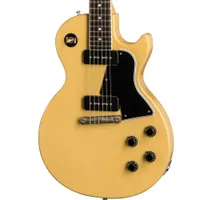
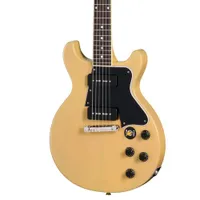
While the Special DC is also offered in Ebony and Vintage Cherry hues, this TV Yellow is the classic option.
Whereas pukka ‘Pauls seem to be getting heavier by the day, at well under 7.5lbs this Special feels gym-toned
The pickup covers, control knobs and the quite unusually-shaped pickguard all add considerable contrast here with the TV Yellow finish. But colour aside, the first thing you notice is the light weight. Whereas pukka ‘Pauls seem to be getting heavier by the day, at well under 7.5lbs this Special feels gym-toned.
Under the gloss opaque finish is of course an all-mahogany construction and checking a translucent Vintage Cherry version it looks like the body is two-piece, the quarter-sawn neck, one-piece. There’s no arched maple cap, of course, and overall the uncontoured ‘slab’ body measures 45mm deep, much like a Telecaster.

Revealed by the double-cutaway outline, the big difference here is the all-access 22-fret neck following on from Gibson’s V, Explorer, and the ES-335 . It was a theme that continued with the SG.
Compared to the more supported-neck single-cut design, there’s slight neck flex here and although there’s a rather sharp top edge to the cream binding, the medium frets are well-polished with a little more height than I encountered meeting Noel Gallagher’s Les Paul a while back.
Like the Junior this new Special goes for individual modern-mount Gibson Deluxe tuners and the polarising wrapover bridge that’s a key part of the Junior/Special DNA.
Pickups are standard Gibson USA P-90 single coils with a four-control layout although the pickup toggle switch moves from the shoulder to close by the two volumes.
The soapbar P-90s are standard Gibson USA fair but the bridge pickup especially needs more cushioning: it’s really loose and audibly ‘clonks’ if you shake the guitar.
Playability

Playability rating: ★★★★☆
There’s a real grab-and-go vibe to this Special. That light weight still means strapped on it has a good balance, obviously less bulky than a LP Standard and it also makes for a great at-home sofa noodler.
The neck, meanwhile follows the SlimTaper protocol, which again really suits the style, and obviously with such full access to all the frets, well, you could even shred here unhindered.
While Gibson’s upper-tier electric guitars had moved over to the tune-o-matic and stud tailpiece by the time the Special originally launched, it stayed with the one-piece wrapover bridge of the initial models.
A little more care with the nut grooves wouldn’t go amiss
Today, it seems impossibly basic with only overall height and intonation adjustment but actually the bridge is correctly placed and it’s pretty close to being bang-on intonation-wise. It’s certainly good enough for rock’n’roll!
That said, a little more care with the nut grooves wouldn’t go amiss: the D string here was sticking and didn’t help with overall stable tuning until it was sorted.
Sounds

Sounds rating: ★★★★½
Part of the on-going appeal of the Junior and Special is quite simply their sound.
My original 1957 Les Paul Junior reference is quite a monster with even, unplugged, a big and ringing response. The Special DC sounds a little lighter, snappier, but it’s a very lively guitar in the hands.
Dial in a bit of crunch and at bridge the P-90, a little more polite than our historical reference, focuses in on that fatter single coil-voicing with quite a midrange push and pretty balanced clarity.

Switch both pickups on and the funky, soulful rhythm voice adds some almost Fender-y cut to the sonic stew
If that ticks the raw-sounding Junior box, the neck pickup (not to mention the four controls) really expand the potential moving from fifties jazz and snappier BB King blues with a little volume reduction and a clean amp channel to really creamy and quite smooth-edged classic rock leads.
But then switch both pickups on and the funky, soulful rhythm voice adds some almost Fender-y cut to the sonic stew. Virtually every sound we conjure recalls a classic player or style: there’s something very special about mahogany and P-90s!
Verdict

While Gibson Custom and indeed Epiphone already offer very credible versions of this guitar, having it back in the mid-price USA line-up makes a lot of sense.
There’s a lot of relevance to the design today not least the light weight, that full access neck and really characterful P-90 sounds
It’s not a reissue but, modern tuners aside, it may as well be, and although it’s now some 65 years since we first saw one, there’s a lot of relevance to the design today not least the light weight, that full access neck and really characterful P-90 sounds.
Aside from a couple of minor points it’s really well-crafted too. But it also adds to the considerable choice around this price-point that Gibson already offers: is it a guitar too far? No, not when it feels, plays and sounds as good as this.
MusicRadar verdict: It’s not a new guitar in any way, but if you want a more manageable squeeze than a full-fat Les Paul, it’s not only comparatively lightweight but really nails some classic Gibson P-90 voices in unshowy style.
Test |
Results |
Score |
|---|---|---|
Build quality |
Tidy build and finishing let down by sharp-edged fingerboard binding, a sticking nut groove and especially the bridge pickup needs more secure cushioning. |
★★★★☆ |
Playability |
Once settled, and with the nut sorted, it’s a very stable guitar. The lack of individual string intonation may bother some but here it’s pretty close to bang-on. The full access neck is a revelation after a single-cut model. |
★★★★☆ |
Sounds |
Big range of classic sounds from the dual pickup/four control set-up. Yes, it’ll do ‘Junior’ but there’s a lot more here. |
★★★★½ |
Overall |
With comfort, fingerboard access and expansive sounds all part of the deal there’s quite an ‘all-round’ workhorse vibe here. It might be of pensionable age but remains hugely valid today.
|
★★★★☆ |
Also try
Hands-on videos
Dirk Witte