





MusicRadar Verdict
The Audient Horizon 8P won't magically improve your recordings, but its ability to expertly join the musical dots might just transform the way you make them.
Reasons to buy
- +
Excellent audio performance.
- +
Outstanding workflow flexibility.
- +
Extensive expansion potential.
Reasons to avoid
- -
Expensive for smaller studios.
- -
No Windows support.
MusicRadar's got your back Our team of expert musicians and producers spends hours testing products to help you choose the best music-making gear for you. Find out more about how we test.
What is it?
My current desktop interface still sounds good. It might be quite long in the tooth, and have the odd dent in it, but it does a job for me.
The problem is that, over time, I’ve accumulated more instruments than it has inputs, so recording often begins with a round of unplugging things and generally annoying faff. A new synth here, another microphone there, perhaps a drum machine or two, and suddenly the trusty desktop audio interface starts looking rather inadequate. It's a familiar problem, and one (of many) that Audient believes it has the answer to with its new Horizon 8P interface.
The Horizon 8P is a professional, 19-inch rackmount Thunderbolt audio interface, offering 24 inputs and 32 outputs, eight of which are Audient's console-derived microphone preamps. There’s 32-bit conversion and extensive analogue and digital connectivity. There's also ADAT expansion, digitally recallable preamp settings and sophisticated monitoring and routing capabilities, all designed to make managing larger recording setups considerably easier.
At £2,199, this is an altogether different proposition to the two and four-input USB interfaces most home producers will be familiar with. Where those smaller devices are designed to capture a handful of instruments or microphones at a time, the Horizon is built to sit at the centre of a much larger recording environment, bringing multiple instruments, microphones and external processors together under one roof.
I've been using the Horizon 8P in my own home studio, where my collection of guitars, synths, drum machines and other electronic instruments has steadily grown over time. On paper, it's probably more interface than I strictly need, although I was intrigued to find out whether its considerable capabilities would translate into tangible benefits.
As it turns out, the biggest revelation wasn't necessarily how good it sounded, but how much easier it made everything else.
Pricing
Launch price: £2,199/$3,499/€2,499

Performance
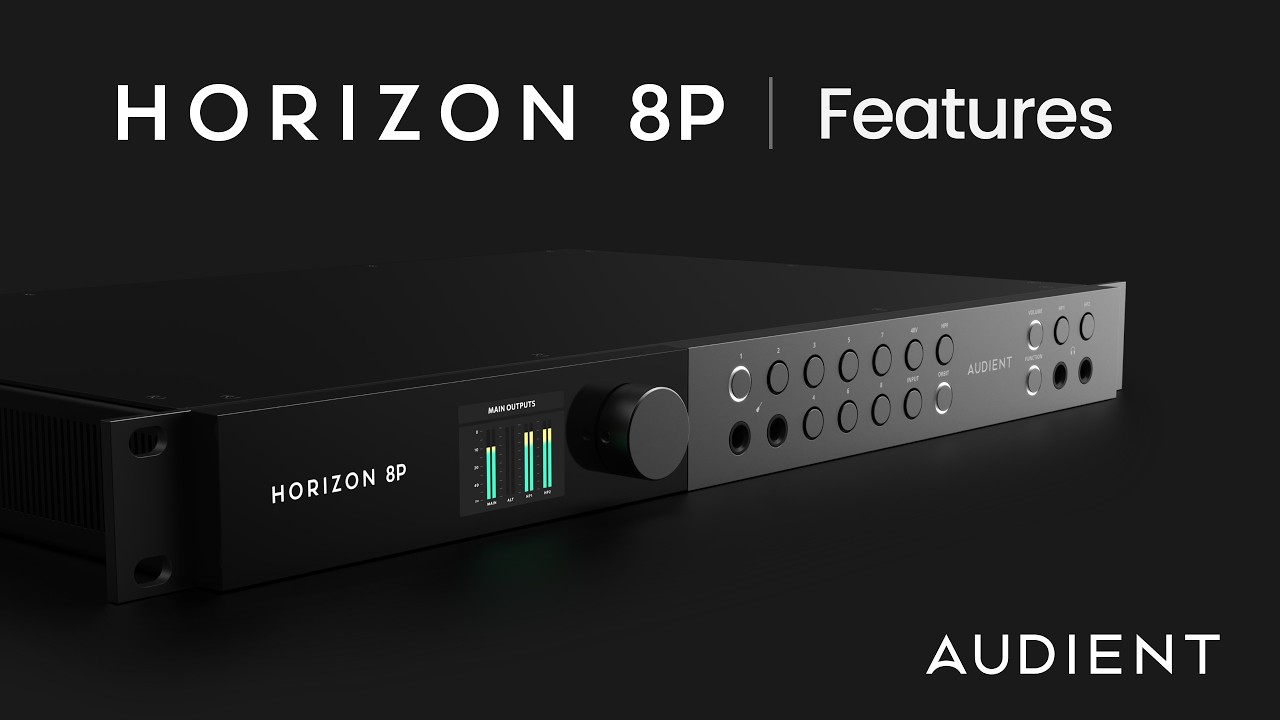
At first glance, the Horizon 8P looks every inch the professional studio workhorse. Housed in a standard 19-inch, 1U rackmount enclosure, its stealthy black finish gives it a pleasingly sleek, understated appearance. There's nothing particularly flamboyant about the design, but it looks suitably expensive, well made and, in purely subjective terms, very cool.
The front panel features a series of buttons for selecting its myriad channels and a single rotary control wheel, accompanied by a compact colour display. It's a relatively small screen considering the complexity of the device, but in practice I found it perfectly readable on the fly, presenting information clearly without resorting to unnecessary visual gimmicks.
Where the Horizon distinguishes itself from smaller desktop interfaces is in its connectivity. Eight combination microphone and line inputs provide the foundation, with a couple of additional dedicated JFET instrument inputs on the front for plugging in guitars or basses. There's also a comprehensive selection of analogue and digital connections, including DB25, ADAT and dedicated monitoring outputs.
For the uninitiated, those DB25 connectors might look a little intimidating. Essentially, they allow multiple balanced audio signals to travel through a single multicore cable, making them useful for connecting banks of external preamps, compressors, EQs and other outboard studio equipment. The Horizon provides eight line inputs and eight independent outputs through these connections, although the line inputs share their recording channels with the built-in microphone preamps.

There's plenty of scope for digital expansion too. The dual ADAT connections allow another 16 channels of audio to be added at standard sample rates, provided you have suitable external equipment. For a studio recording live bands or larger ensembles, that opens up considerably more possibilities than the eight onboard preamps alone. Intricate drum mic setups are well within reach if you have the extra input capabilities.
It's worth noting that the Horizon's headline 24-input, 32-output specification doesn't mean you'll find 24 microphone sockets on the rear. Much of that capacity comes through digital connectivity, and unlocking its full potential requires additional equipment. Nevertheless, the possibilities for growing a recording setup are considerable.
Studio control
At the heart of the Horizon 8P are eight of Audient's console microphone preamps, derived from the company's respected ASP8024-HE mixing console. Audient has built a strong reputation for its analogue circuitry over the years, and there's plenty of that expertise on display here.
Each preamp offers up to 75dB of gain, alongside phantom power, a pad and a variable high-pass filter. More interestingly, the gain settings are digitally recallable, allowing you to return to a previous recording session without having to manually recreate the same input configuration.
There's also Audient's ORBIT variable impedance technology, which allows users to change the input impedance presented to a microphone. This can influence the way certain microphones interact with the preamp, potentially altering their response and character. It's an intriguing addition, particularly for engineers working with a variety of dynamic or ribbon microphones, for example, although it's a feature I wasn't able to explore in depth during testing.
Much of the day-to-day operation is handled by Horizon Control, Audient's accompanying software mixer and routing application. Anyone familiar with applications such as Focusrite Control will recognise the general approach, with access to input settings, monitoring, routing and different mixer configurations.

I'll admit that the initial presentation is a little overwhelming. There's a considerable amount of information to take in, and this clearly isn't a device designed solely around plugging in one microphone and pressing record. However, once I'd spent some time getting everything configured, the logic became clear. The complexity is largely front-loaded, and the payoff comes when you can move between recording tasks without continually revisiting your setup.
Another important feature is Thunderbolt 3 connectivity, which provides a high-bandwidth, low-latency connection between the Horizon and your computer. The benefit here goes beyond simply moving audio data more quickly. Combined with Audient's drivers, it allows musicians to monitor their performances through software instruments and effects with very little delay, something that becomes increasingly important when working with demanding plugin chains or larger recording sessions.
Audient quotes round-trip latency as low as 0.99ms at 192kHz with a 64-sample buffer. That's an impressive figure, although it's worth remembering that real-world performance depends on sample rate, buffer settings, computer performance and the processing you're asking your DAW to handle.
Recording performance
Getting the Horizon up and running proved pleasingly straightforward. Connected to my M4 MacBook Pro, it was recognised immediately by both macOS and Ableton Live 12, with no unexpected glitches or installation headaches. Aside from digging out a few extra cables and spending some time configuring the software, the whole process was reassuringly uneventful.
For my first recording tests, I connected an ESP Eclipse guitar, equipped with a high-output humbucker, directly to one of the front-panel instrument inputs. The signal was routed through Ableton Live 12 and into AmpliTube 5, where I could experiment with a fairly extensive selection of virtual amplifiers and effects.
At 48kHz, the Horizon sailed through recording at buffer sizes of 128, 256 and 512 samples without pops, clicks or unwanted interruptions. More importantly, the experience felt immediate and responsive, even with substantial plugin processing taking place. Dropping as low as 32 samples introduced the occasional crackle, but I couldn't identify any meaningful practical benefit to running at such an extreme setting anyway, certainly not for my use-case.

Next, I turned my attention to the microphone preamps, using a Shure SM57 to record my Orange TH30 guitar amplifier. This is a particularly useful amp for testing recording equipment, offering both an exceptionally clean channel and a wonderfully hairy, harmonically rich overdrive sound.
The results were excellent, with recordings from the SM57 being clean and with little in the way of audible hiss. Audient's preamps have earned their reputation, and I found nothing here to challenge it. I'd have no hesitation using them in a more demanding recording environment.
Monitoring was handled by a pair of M-Audio Forty Sixty studio monitors I’ve been testing, through which I played a selection of my own productions. These ranged from generative ambient pieces built around modular synthesis and an Elektron Digitakt, through to heavy doom metal arrangements featuring AmpliTube and Toontrack Superior Drummer. I also recorded some intricate fingerstyle acoustic guitar passages, providing a more exposed setting in which unwanted noise might become apparent.
Playback quality was superb across the board. Yet, despite Audient's impressive conversion specifications, I struggled to identify a dramatic sonic improvement over my existing PreSonus interface. Using macOS's aggregate device functionality, I was able to switch between interfaces, and in my relatively modest, acoustically treated home studio, the differences were difficult to discern.
In my setup, the extra money bought connectivity and control rather than an obvious improvement in sound. I think excellent sound quality should be expected from a product costing over £2,000, but there's a limit to how much better an already good recording can realistically become simply by changing the interface.
Where the Horizon really came into its own was when I started connecting more of my equipment. At one point, I had my modular synth, Elektron Digitakt, a direct input from a Boss Katana amplifier, Moog Mother-32, microphone and even a small Korg synthesizer I'd built from a kit integrated into the recording setup. With Live handling MIDI sequencing and control, I could record the audio from different instruments onto individual tracks without constantly dismantling and rebuilding the signal chain.
This, more than anything else, transformed the experience of using the Horizon. Having everything connected and ready to record made moving between instruments effortless. Better still, recallable preamp gain settings meant I could return to sessions with much of the configuration already in place.
Anyone who has spent time scrabbling around behind a desk, trying to remember which cable connects to which instrument, will appreciate the difference. Once the initial setup was complete, I could simply concentrate on making music. For me, that was the Horizon's most compelling feature by some distance.
Value and applications
Of course, my home studio is only one possible environment for the Horizon 8P. In a professional recording facility, the advantages become potentially more significant.
For engineers recording bands, eight high-quality microphone preamps provide a solid starting point for capturing drums, amplifiers and vocals simultaneously. Additional ADAT channels allow the system to grow as recording requirements become more demanding, while the monitoring and routing facilities can accommodate more complicated sessions involving multiple performers.
Studios using external analogue processors will also appreciate the DB25 connectivity, which allows outboard equipment to be integrated into their signal chains without constantly reconnecting individual cables. Furthermore, Audient's ability to combine multiple Horizon interfaces through Thunderbolt provides an expansion route for facilities requiring considerably more I/O.
There's a possible application in professional podcast production too. Eight microphone preamps, flexible monitoring and comprehensive routing could serve a multi-person recording environment well. For a typical two-person podcast, however, the Horizon would be an extraordinarily expensive way of accomplishing something a much smaller interface could handle comfortably. And that brings us to the question of value.
At £2,199, the Horizon 8P is undeniably expensive, and for musicians working predominantly with one or two instruments, it's difficult to recommend on audio performance alone. An established home producer with a competent USB interface is unlikely to discover that their recordings suddenly sound dramatically better after making the switch.
There's also the small matter of compatibility. At over £2,000, you might reasonably expect the Horizon 8P to get along with most computers. Windows users, however, aren’t invited, with Audient currently restricting support to macOS.

For the right user, though, the calculation changes considerably. If you're running a busy recording studio, building a substantial hardware-based production setup or regularly working with numerous audio sources, the Horizon's combination of professional recording quality, flexible connectivity and expansion potential becomes much easier to justify.
I'd certainly consider it near the top of my list if my recording requirements demanded this level of capability. Just don't assume that moving from a smaller USB interface to something like the Horizon represents a natural upgrade path for everyone. For many musicians, it's an entirely different class of equipment designed to solve an entirely different set of problems.
Verdict
For me, the real revelation in using the Horizon 8P was the improvements it made to my workflow. Having an entire collection of instruments connected, configured and ready to record made the creative process considerably more enjoyable, removing many of the small frustrations that come with managing a hardware-heavy setup.
At £2,199, it's undoubtedly overkill for many home producers, and its sonic advantages over less expensive interfaces won't necessarily justify the investment. But for musicians and engineers who genuinely need its capabilities, the Horizon 8P is an exceptionally accomplished piece of equipment that should serve them well for years to come.
Hands-on demos
Audient
Alternatives
Specifications
Price |
£2,199/$3,499/€2,499 |
Key features |
Type: Professional Thunderbolt 3 audio interface Connectivity: 24-in / 32-out Mic preamps: 8 x Audient Console preamps with 75dB gain Instrument inputs: 2 x JFET inputs Analogue I/O: 8 x mic/line inputs, 8 x DB25 line inputs (shared channels), 8 x DB25 line outputs, 4 x TRS line outputs Digital I/O: Dual ADAT optical input/output, S/PDIF, BNC word clock Headphone outputs: 2 Audio resolution: 32-bit / 192kHz conversion Dynamic range: 127dB ADC / 132dB DAC (A-weighted) Latency: 0.99ms round-trip at 192kHz, 64-sample buffer Additional features: ORBIT variable impedance, digitally recallable preamps, four independent monitoring mixes Software: Audient Horizon Control Compatibility: macOS 14 or later, Thunderbolt 3 or newer; no Windows support Dimensions: 483 x 44.5 x 330mm (W x H x D) Weight: 4.15kg Format: 19-inch, 1U rackmount |
Contact |
