As it builds to its euphoric coda, you’d never imagine that Harry Styles’ 2026 single Aperture was born in a moment when the energy in the studio had fallen flat.
Speaking to Spotify for its Songlore series, though, Styles’ long-term collaborator Kid Harpoon (Tom Hull) says that was indeed the case. He’s been breaking down how the song was made, and remembers that the seeds of Aperture were sown when both he and Styles were feeling creatively spent.
“I guess the moment for me when it came together was, I'm standing in one room. Harry's in the live room of the studio,” says Hull. “He's playing on the piano. I'm stood there. We're both exhausted. The energy was low, and when the energy gets low in the studio, the songs get slower, the music gets slower. Things become a lot more introverted. You’re tired at work, and you've got to get through the day, but your day and your job is to go and make something creatively. I'm also in the same zone, and I was like, ‘I don't know what to do.’”
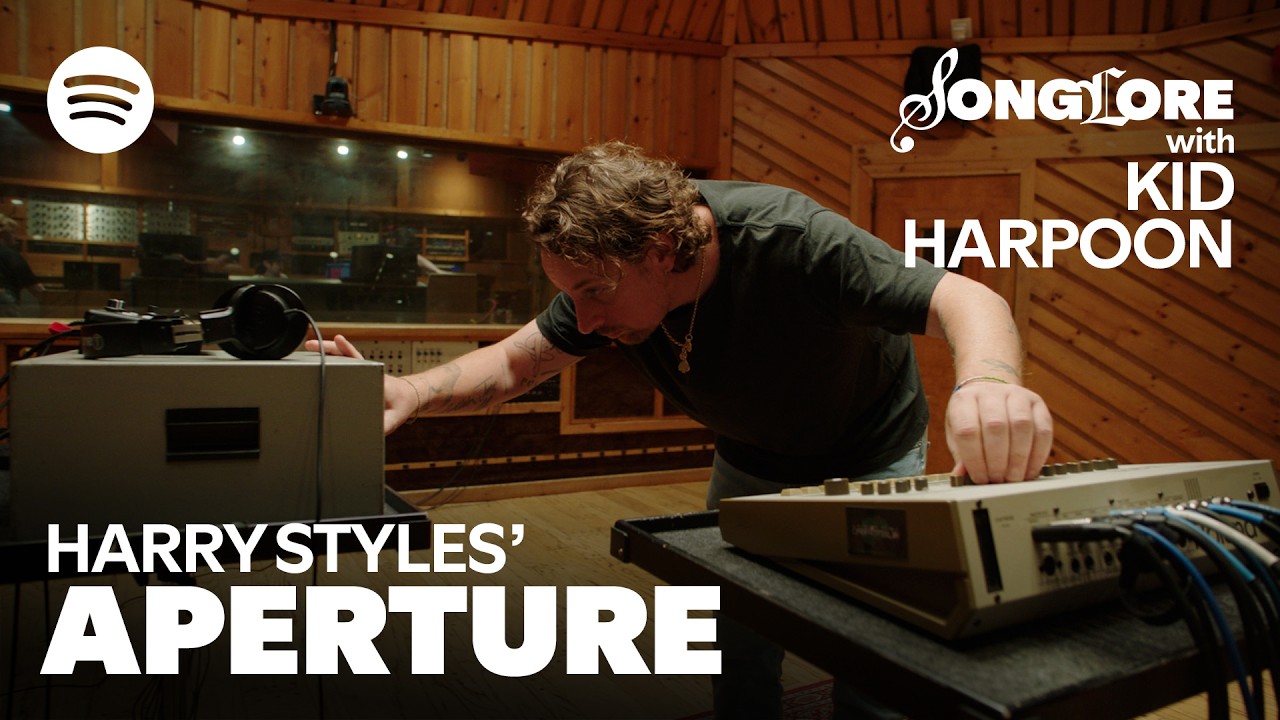
For Hull, the solution was to dig out his trusty Roland TR-909 – a drum machine he describes as a “work of art” – and bang it through a classic ‘80s Eventide digital effects box – the HS3000 SE Ultraharmonizer.
“Aperture started with the 909 and an Eventide delay, and I was like, I'm just going to program something up,” Hull remembers. “I'm just going to play around with some sounds and just try and see if this can bring us some energy.”
We get to see Hull recreating the hypnotic Aperture groove using the same hardware he used to produce what you hear on the record. He recalls that, once he had that initial drum groove, he decided to develop it.
“Start hitting a synth. That's kind of cool. Then I've got my modular setup. We're patching all these cables. I was like, I'm going to dick around with this and see what happens. 20 minutes [later] I had something kind of going, and then Harry came in from the other room. He's like, ‘What are you doing? This is quite good.’”
Soon enough, they were off to the races, with Styles riffing off what his producer was doing and coming up with vocal ideas. “The next thing, I look up, and he's already singing, and he's written some melodies,” remembers Hull. “And around this moment, he goes, [sings] ‘We belong together.’ Then we're sort of pointing at each other, saying, ‘Yep, that's good.’ And he's like, ‘Yeah, that's good.’ A couple of hours later, we kind of have it.”
As Hull tells it, all of this kind of came out of nowhere. “I don't necessarily believe in this ‘divine inspiration,’” he admits. “I think it's just, ‘some good things happen, some bad things happen.’ But if there was any point in my career where I go, that was a sort of divine moment, it was that.”
Hull also says that it felt like a “hands-off-the-wheel moment” that he wasn’t really in control of, but he is proud of his contribution to one part of the song in particular.
“There's a bit that sounds like an electric guitar part. But it's my modular synth, and I was so proud of it. And when I watch the live show I'm so proud because I'm like, everyone thinks it's guitar, but actually, they don't know it's my modular synth.”
Hull says that it was Styles who encouraged him to go against his concise pop instincts and stretch Aperture’s running time out to more than five minutes; at times it feels more like a formless electronic music jam than the number one single it would become. Both men were keen to retain a human element to the production, though – hence the addition of London’s House Gospel Choir towards the end, and the decision to play the synth bassline in a longer section rather than simply creating a loop.
Although Aperture ended up being the lead single from Styles’ 2026 album, Kiss all the time. Disco, occasionally, Hull also reveals that it was the last song that they made for it. It was only when it was done, though, that the project felt complete: “It suddenly became the touchstone – it made everything else make sense,” he says.