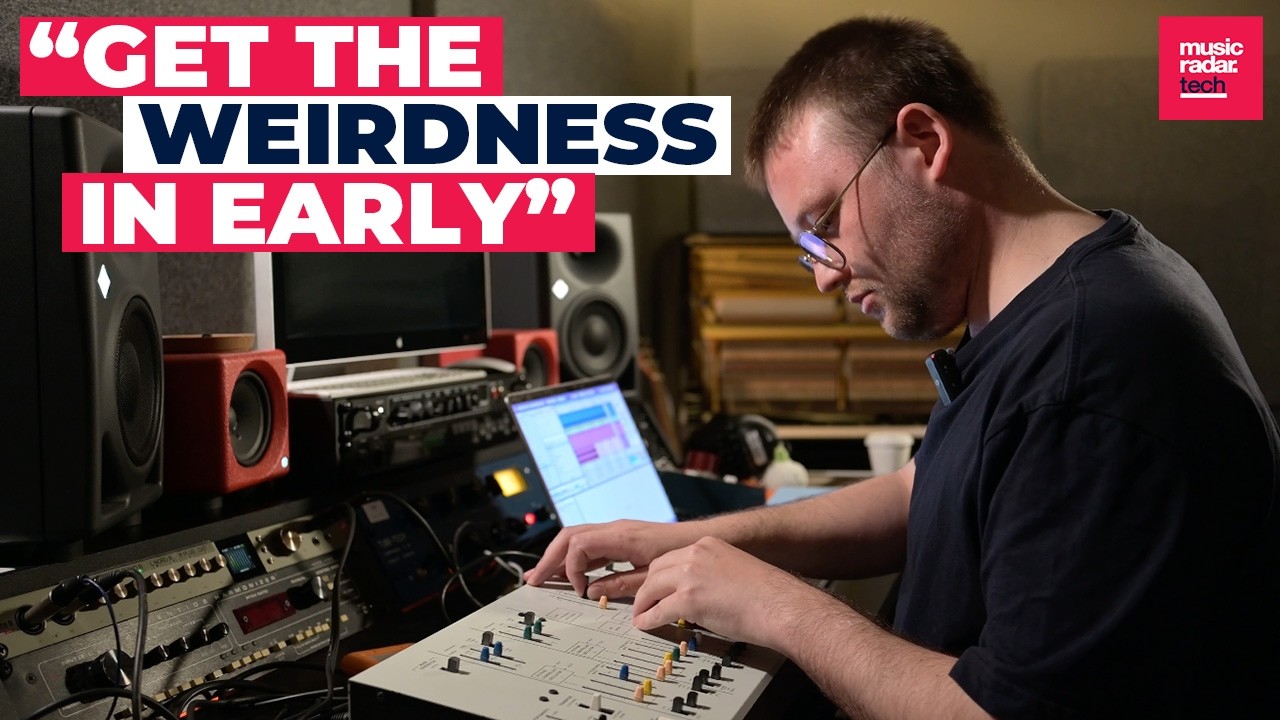
On the title track of London-based producer Tom VR’s latest album, Don’t Know How Fast I’m Moving Until I Hit Something, shifting layers of fragmented samples and synthetic textures coalesce around a driving kick and bassline as tension builds and builds, gradually rising towards what feels like a stratospheric climax.
Just as the track reaches its peak, though, the kick falls away, opening up a gulf of negative space. A shimmering synth line fades in and the song switches gears, its pulsing techno making way for something more spacious, melodic and strange, the 4/4 kick swapped for skittering percussion and warped vocals.
Taken together, the two halves feel like a takeoff: the first a white-knuckled tear down the runway, and the second the moment the plane breaks through the clouds, levelling out to reveal a spectacular view.
The effect is intentional, Tom tells us. “My music reminds me of the idea of taking flight,” he says. “It's something I try to portray when I'm creating, this idea of moving at high speed or ascending – I’m trying to capture the euphoria of that in the music.” But momentum can only be sustained for so long. The project not only reflects his relentless urge to create, Tom says, but also the cost of such single-minded focus.
“The title came from my tendency to move forward restlessly without pause, only to hit walls before realising the mode I was in,” he says. “It’s almost like I'm steamrolling on autopilot, and then there are these moments of profound joy or sadness – whether it's bereavement or breakups or things like that – that just hit you and make you crash.”
Momentum is a fitting theme for an artist who’s spent the past decade quietly establishing himself as one of electronic music’s most singular talents. Early releases on his own label Valby Rotary and All My Thoughts drew comparisons to artists like Floating Points and Four Tet, a noted supporter who regularly drops Tom’s edits in headline DJ sets. More recently, he’s launched a new label and mix series, collaborated with John Beltran, HAAi and Max Cooper, sold out a debut live show at London’s Fabric and caught the ear of everyone from Bicep to Ben UFO. (He may not know how fast he’s moving, but there’s no doubt that Tom’s going places.)
Balancing detailed and kinetic rhythms that draw on house, techno and garage with textural sound design and dreamily evocative melodies, Tom could just as easily soundtrack a sweat-soaked dancefloor as he could a moonlit early-hours walk home. That balance has shifted over time, though, as recent releases have leaned harder into a club context. Tom’s third album takes this even further, cranking up the tempo with a bigger, bolder and more anthemic sound shaped by his experiences performing live.
Somersault feels tailor-made for the crescendo of a live set, and tracks like Unlocked Love and Uplift! (Butterfly) build on the glitchy and immersive take on techno that emerged with 2023’s Heart Can Still Somersault EP. It’s not all peak-time energy, though: pensive closer New Meds and the twinkling lullaby of Little New Heart slow the pace right down, making space for reflection amid all that forward motion.
We visited Tom in the studio ahead of the release of Don’t Know How Fast I’m Moving Until I Hit Something to find out more about the making of the project – due for release September 15 on Heart Somersault – and to film the producer making a Track From Scratch for MusicRadar Tech.
When did you start making music?
"If definitely started with me playing guitar. I was massively into – and still am into – rock music and all kinds of different genres, but quite a significant turning point for me was listening to Bloc Party's music, and their album A Weekend in the City.
"That was a big inspiration for me, and I hadn't really heard music that incorporated both [electronic and rock] elements – that was an album that really made me think about the electronic side. They had this track Flux on that album, and their following album was also quite electronic-sounding. That was definitely a stepping stone.
"I remember that they had a remix from Burial of Where Is Home?, and I was just kind of starting to get into that darker, more minimalistic UK dubstep sound at that time. So there was a bit of a bridge there, where I started to think more about electronic stuff through that lens. Initially it was quite UK-focused, and dubstep was an entry point – a lot of the stuff that came out on Hotflush at the time.
"There was a Hotflush takeover on BBC 6 Music, just four hours of music from that label, and listening to that was a pretty significant moment for me in terms of thinking, ‘okay, I kind of want to do this’. A lot of the music on that label felt a little bit like a different world, and something I hadn't explored before. It became quite addictive for me, right at the beginning."
Was there a moment that something clicked and you realised that this was something you wanted to turn into a career, rather than just something you were doing for fun?
"In a way it clicked immediately. As soon as I started writing music with computers and using DAWs and stuff like that, I got so addicted to it. I would just do it in all of my free time, and whenever I was at home from school or whatever, I basically spent most of my time sat at my computer.
"We had this software at school called Sibelius. It’s music composition software, but I didn't know how to read music and I didn't really know how to use it, so I just did everything by ear and programmed things in. So I was kind of using it as a sequencer almost, and that was the first moment where I realised, ‘okay, I can do stuff with a computer’, which led to getting a DAW.
Immediately I thought, ‘okay, this is a thing that I love’, but I don't ever think that I thought, ‘right, I'll do this as a career’
"Immediately I thought, ‘okay, this is a thing that I love’, but I don't ever think that I thought, ‘right, I'll do this as a career’. In terms of music being a career for me, that's something that's become more prevalent in the last few years. I've always worked a full-time job. I was working a full-time job in customer service until two or three years ago, because the company went bust, and then I started teaching as well.
"So in terms of it being a career, it's a multifaceted thing. It's not just purely that I make music, but being able to view it as something where there are lots of different sources and lots of different ways in which I can make it into a career. I've definitely taken it more seriously in the last five years."
How did you learn? Did you study music or music technology, or did you teach yourself?
"Initially, I was self-taught. As soon as I started using FL Studio when I was quite young, like 14 or 15, everything I did was purely learning through doing and trial and error. I would watch a lot of tutorials for specific techniques, which I still do now. But I did that pretty much up until the age of like 20. Until that point, it was just purely me making my way through the software, and during that time I also started using Ableton.
"I then did a course in Leeds on music production, which was more to do with recording, mixing musicians and bands and things like that. So there was some formal education towards the end, but I still don't really know how to read music or understand music theory. It's all very much just learning as I'm doing, working things out, seeing what sounds good and what doesn't, and moving quite quickly through those mistakes into something that I like the sound of."

It's been five years since your last album came out. Can you take us back to where you were at creatively after that release, and when you began working on the tracks that would become this new project?
"When I finished that album, I was already starting to lean into a more clubby direction, or at least more of an anthemic, vast-sounding direction. The last album was very textural and quite patchworky; it wasn’t really set in a club environment, but also wasn’t purely a home listening album. It was somewhere in the middle, I guess. But before that came out, I'd already written a record for Midland's label Intergraded which was more geared towards the dancefloor, so I was already headed in that direction.
"When that album came out, the stuff I started making afterwards was a little more techno-leaning. I did an EP with Spectral Sound, which is Ghostly International's sub-label, and that was very much me trying out a full-on four-to-the-floor techno approach, and I think a lot of my stylistic traits of the last few years have stemmed from that time. So especially this new album, it does follow on in the story from that, and it takes those same characteristics and moves them into a new area."
The title of the record is Don't Know How Fast I'm Moving Until I Hit Something, and you’ve said that the idea of momentum was a central theme behind the record?
"The title and the inspiration behind the album relates to something that I’ve noticed about myself over the last few years. Maybe just as I'm growing a little bit older, I have this way of trying to do things very quickly, bombarding myself with creativity and really getting locked into things without truly noticing important things that happen in my life personally. Almost like I'm steamrolling on autopilot, and then there are these moments of profound joy or sadness – whether it's bereavement or breakups or things like that – that just hit you and make you crash.
"So in a way, the record is about that feeling: the idea of hurtling along at a certain speed, and then suddenly you have this reality check, sometimes good and sometimes bad. Thematically my music reminds me of the idea of taking flight, and a lot of my song titles are in that world. It's something I try to portray when I'm creating, this idea of moving at high speed or ascending. I’m trying to capture the euphoria of that in the music itself.
"On the title track for the album, I tried to convey that actual idea sonically, which is what gave me the idea for the concept. It hurtles along at this intense, techno-y pace, and then halfway through it completely switches and goes into something that's more broken, way more melodic and way more complex. That track is almost like a metaphor for the concept as a whole."

You’ve also said that performing live shaped the way this record sounded, and you even embedded live recordings in some of the tracks. How do your live sets influence your work in the studio?
"For sure. It's influenced me a lot in the last couple of years when I've been touring more and doing live shows. One thing is that I'm noticing how people react to different parts of the show and different parts of the tracks, seeing what connects in a visceral way with people in a room, and taking that on board back in the studio.
"There are specific parts on the album that are things I tried out for the first time in a live setting. One of the tracks, Mag Fields, I played the bones of that track in two live shows at Magnetic Fields in India, and that was the best reaction I've ever had to any specific track when I've played live. People were asking me about it, coming up to me after the set, showing me videos.
"I remember I worked on the track as I was travelling home, I was like, ‘I need to finish this because it definitely belongs on the album’. It was something that wasn't necessarily taking pole position, but having that experience definitely made me think, ‘okay, this is something that connects with people emotionally and it belongs on there.’"
The visual world you've developed around the record was inspired by a photographic series by Pen Densham that holds a personal significance for you. Tell us more about that?
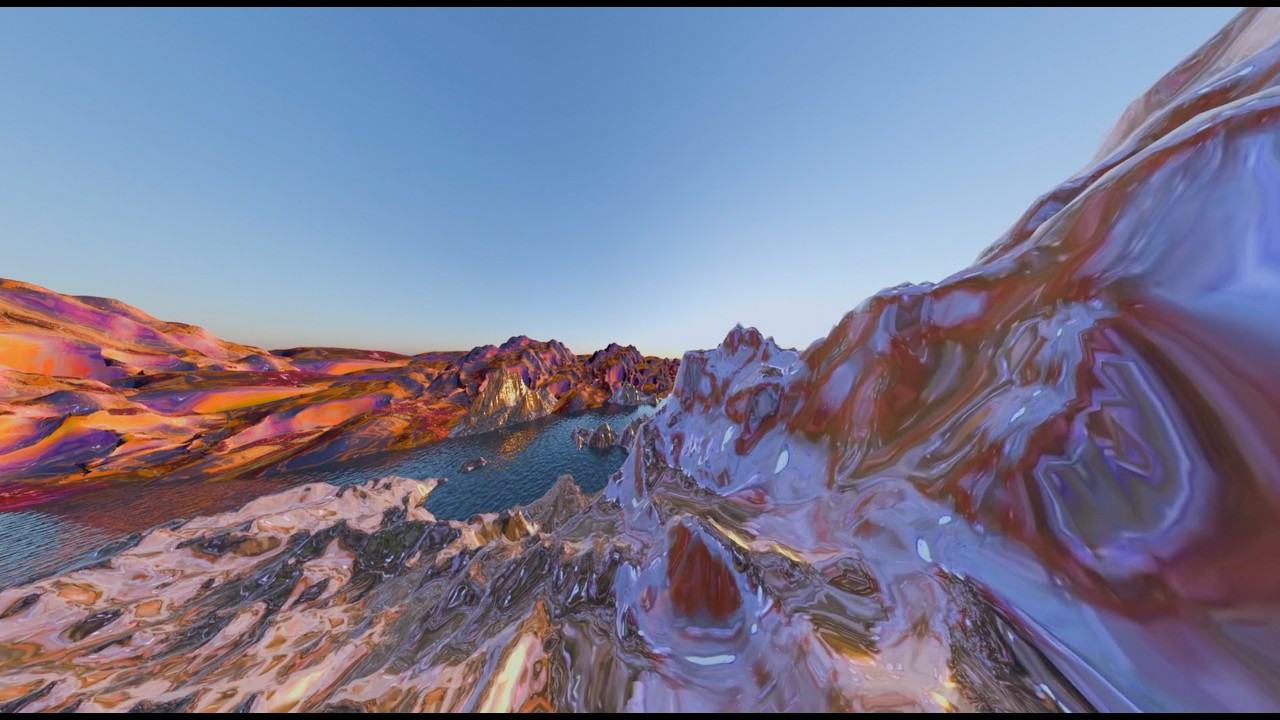
"I came across Pen's work online completely randomly, and I instantly connected to it. It was something about the textures, the colours, and the things that he uses to capture these photos.
"They're photos of koi carp, but they’re all shimmered and trippy and strange. It's almost like a dream to look at them, very psychedelic. I instantly wanted to work with him on that because they affected me in quite a significant way, and it felt like a match because of the textural nature of my music. We've had a lot of talks where he's brought up things I do with my sound, and he does a visual equivalent in his photographs, and I definitely see parallels.

"It has some extra significance for me. His photo series is called Dragon's Gate, which is based on this Chinese mythology of koi carp attempting to jump up waterfalls over and over again, and if they finally do, they ascend and become dragons, which I thought was super cool.
"My grandma – she's from Hong Kong – passed away last year, and a lot of this album was written around the time that I was going through that. Something about the images and the fish is so reminiscent of things that I would see in my grandparents' home, ornaments and designs and paintings and things like that. So the images have this subtle layer of emotional melancholy for me."
Can you talk us through your current studio setup?
"Yeah, so, the studio setup. Obviously there's a MacBook. I use a lot of outboard stuff, so I've been using the Korg ARP Odyssey a lot recently. And the LIVEN Ambient Ø, which is this blue, strange-looking, ambient-generating synth, which is really cool, which I use quite a lot for getting those interesting pad sounds and things like that that can be rippled underneath the music.
"What else? There are lots of in-the-box things that I've been using, like Slate + Ash Choreographs. I use that pretty much every day – that's a go-to for me. I designed 20 presets for them last year, alongside a few others, so it was something that I had my teeth firmly into throughout the album writing process. I'm looking to expand the set-up as well before I start thinking about the next live show."
"I also used the Soma Laboratory Pulsar-23 for the first time on this record, and you can hear that in Somersault. That was the first time I used it, which was really cool. It’s good for those strange bleeps and bloops and things like that – it's pretty untameable.”
When it comes to effects, do you use any hardware effects or pedals, or are you mostly sticking to software?
"Mostly software. There was a long period of time where I didn't even really use any external plugins or anything like that. I was so locked in and comfortable with Ableton's stock stuff, but that has changed quite a lot in recent years. I'll do way more exploring now, trying to look for stuff that's way more unconventional.
There was a long period of time where I didn't even really use any external plugins – I was so locked in and comfortable with Ableton's stock stuff
"It didn't make an appearance on the album, but I have started using some outboard pedals in some music, especially when I've been writing with other people. I did some work with Max Cooper last year and he has loads of hardware, loads of pedals and crazy stuff, and that was the first time I really started getting into running stuff through pedals to get something that's super unique right off the bat.
“The pedal we were using when we made one of our tracks that came out was the Hologram Electronics Microcosm, which I've used quite a lot since, actually. It's a beautiful-looking loop pedal which adds all these crazy fluttery textures, and it's so in my world."
You mentioned you use a lot of the Ableton stock plugins. Is there anything in Live you feel is underrated, or any hidden gems that you rely on that people might not have dug out before?
"It's not really a hidden gem, but it's something that I talk about when I do lessons and things like that and sometimes people may not have heard of it or used it. Roar is a stock saturation and drive effect that is in Live 12, and I've been using that a lot. I use a lot of distortion in my music, a lot of drive and saturation. I used to just use Overdrive on everything – well, not everything – but whenever I needed it I would use Overdrive, and Roar has taken that place.

"There's just so many capabilities in terms of the modulation, and you have control over the different frequency ranges when you're adding saturation to something. I think that's a really cool one to check out. Also, there are some really crazy presets on there as well, which I'll use for mad moments of sound design and stuff like that. So yeah, Roar is worth checking out."
In terms of gear or software, is there anything that you're thinking of picking up soon?
"I am happy with what I've got, but I'm always on the hunt for something new. Definitely when it comes to performing, the live set is always malleable and always changing, so it's always slightly different in terms of the actual equipment and the way it's played. I'm always looking for interesting things to add.
"I kind of want to add the new Roland drum machine, the TR-1000. That would obviously be an amazing addition. But maybe I'll do the TR-8S first, just because of budget. Something like that would be really cool to add. I was using a Behringer clone for my first live tour, which I really liked, but obviously I know that the capabilities of the Roland stuff [are better] and you can do a lot more with sound design and effects. So that's probably a good place to start."
What is your live setup like? Does it change per show or does it stay pretty consistent?
"It's been quite consistent. For the first few dates I did I had a specific setup, and then I changed it again for my first tour. That was using the laptop, Ableton Push 2, Akai MIDImix, the Behringer drum machine, and I think that was pretty much it. I was running through a Pioneer mixer and using the effects on that as well, but that was just when I was first getting into it and I didn’t really know exactly what it was going to be yet.
"Since then it's swapped out a bit. I swapped the drum machines, I swapped the Akai MIDImix for a Novation [controller], and my intention is for it to keep changing. I always want to keep it fresh, and I think by changing the equipment I'm using to play, every time I revamp, it's a good shout.
"The next time I start building the live show, there’ll be more of a focus on actually having synths to play. I'll probably think about how I'm going to bring the ARP into it, because it's such a big part of what I do, and possibly some outboard pedals and things like that, so I can control effects outside of Live rather than just in the box."
Your drums are one of the most distinctive aspects of your music – they often have this very minimal, quite glitchy aesthetic that I love. Talk us through your typical workflow when it comes to drum programming?
"Yeah, it's something I get asked about quite a lot, and it's definitely a part of my music which I've worked on a lot over the years. Generally speaking, I have this approach where I'll try and do the more random and chaotic elements first, and I get those baked into the foundation of the drums, essentially.
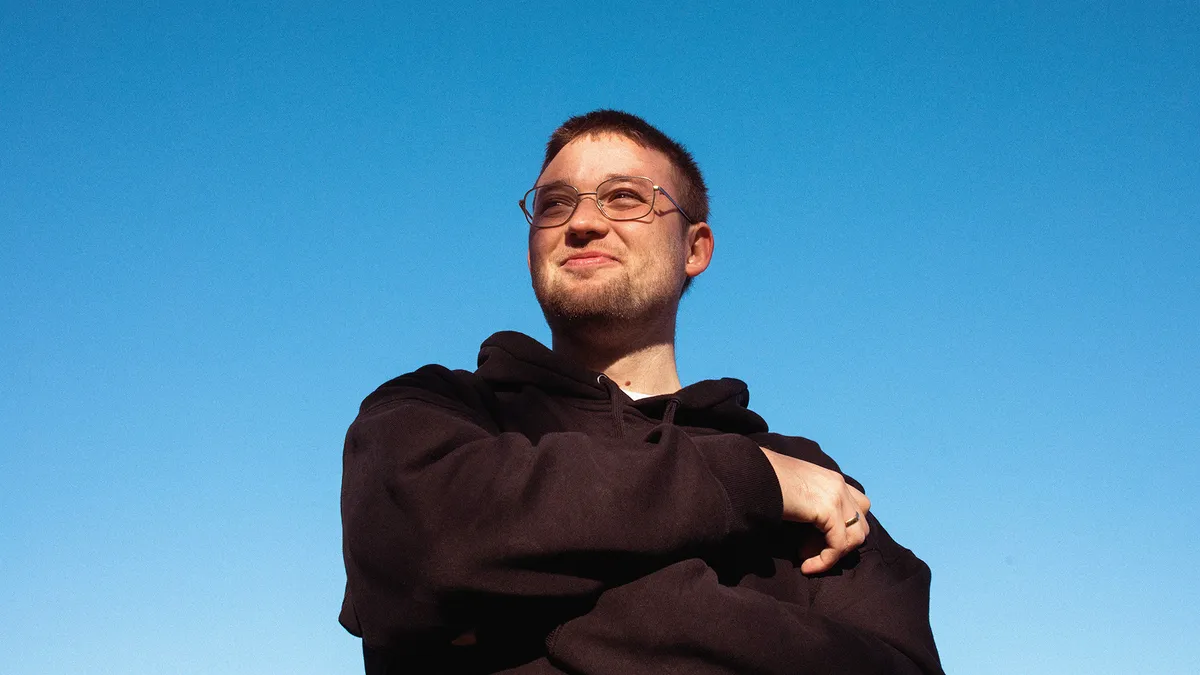
Tom VR: "I've listed the Korg ARP Odyssey on Gumtree three times, but I always come back to it"
“So I’ll either record something with a drum machine, or I'll use drum kits in Ableton, or whatever the source material may be. It might also be a drum loop that I've already made; usually I do a lot of referencing of my own work. So I'll take something, manipulate it, add flangers, use glitchy processing… I use this plugin [Devious Machines] Infiltrator quite a lot, just trying to mess with the percussive elements up top.
"And then I pin it down with the more conventional elements: the kick, hi-hat, shaker. These things come afterwards, and I'm using those to put it back on track almost. So the way I think about it is, you're thinking outside the box first, and then you're taming it afterwards."
Your synth sounds are another unique feature of your music; they can vary from these quite dreamy, pretty sounds to more aggressive bass patches. Talk us through your typical sound design process?
"With regards to synths, I have a few things that I will reach for pretty often. The Korg ARP Odyssey – I'm almost rolling my eyes at the amount that I'm talking about the ARP – but for synthesis that's been a game-changer for me. I use that a lot in my synth sounds, whether that's for big bass sounds or glittery arpeggios and things like that.
I'm almost rolling my eyes at the amount that I'm talking about the ARP, but for synthesis that's been a game-changer for me
"Also there's a lot of stuff within Ableton, the pluckier stuff that I like, that's with Operator. I also use Fors plugins for those plucky, almost guitar-y melodic sounds that I sometimes use. Again, Choreographs by Slate + Ash, I use that a lot. Basically you have three different channels, and you can layer different synth sounds and completely different instruments together, which I really like. It's good for creating interesting textures with your synths.
"In terms of sound design, I use quite a lot of distortion, which is how I get that abrasive feeling. I don't think it's too complex in terms of what I actually do. Usually the weirdness of it happens up top. With the ARP, I'll be recording and switching the octaves up and down, changing the decay and the filter, getting some of those weirder moments of sound design happening before it's processed.
"Again, it's a case of trying to think a little bit more leftfield first and being explorative in the way that I'm doing something, and then seeing how I wind it back in afterwards. That’s what makes it unique."
You've been working with Ableton Live for quite a while now. Can you think of a deeper feature in Live or a technique that's specific to the software that plays an important role in what you do?
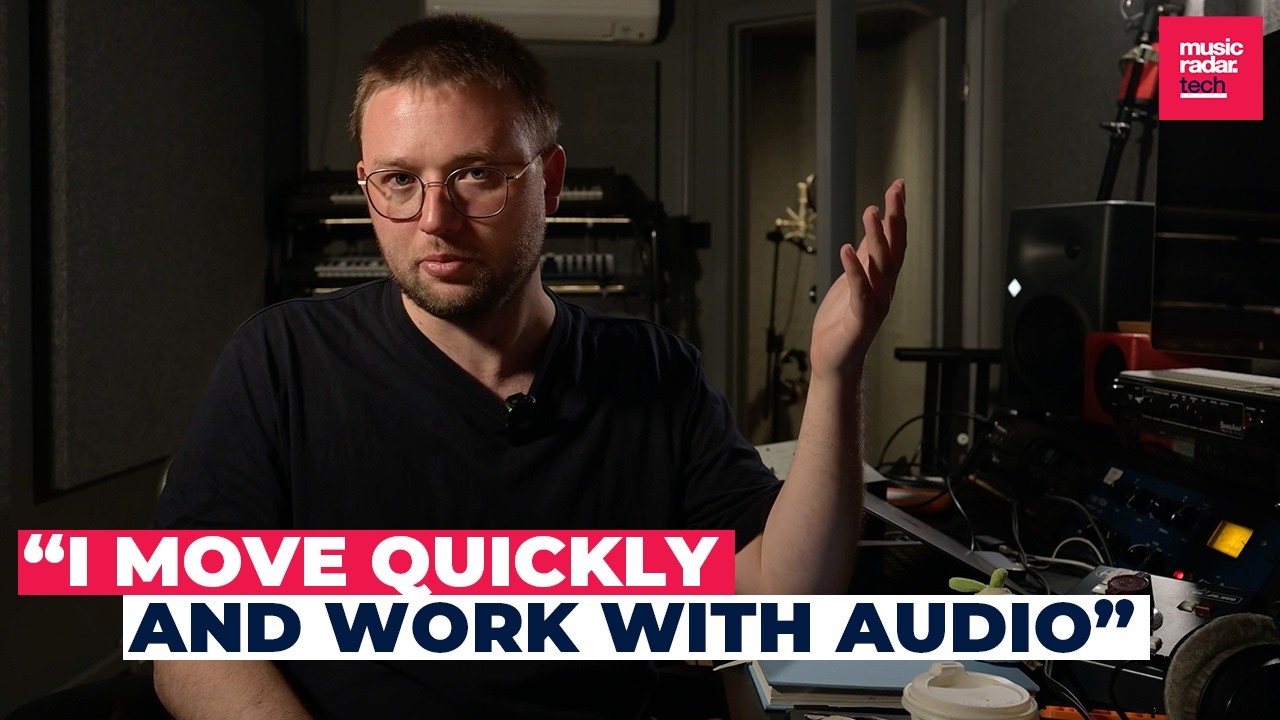
"If I were to pick something that I think is a game-changer in terms of Ableton Live – and this is definitely a more recent thing – it's quite basic to say, but being able to bounce groups in real time is a huge thing for me. In fact, being able to bounce tracks on the spot into audio is a huge thing, because I move quite quickly and work a lot with audio, so I won't be afraid to commit to an idea.
"So let's say I'm creating a drum pattern with MIDI, and then I'm like, ‘okay, I like that, I want to mess around with the audio’, then I can just bounce the audio really quickly. That's just a tiny example, but it'll get to the point where I've got loads of things in a group and I just want them to be easy to deal with, I just want to play with the audio and mess around with that. So I just bounce it and it takes like two seconds. That's quite a powerful tool that was only introduced in the last couple of years, and it's definitely made my workflow super quick."
One thing that jumped out at me on the new record was those processed vocals on the title track. How did you create that effect?
"Those vocals were actually my own. I was just playing the track and thinking about what it needed. It felt like it needed vocals, but I didn't want it to be something super conventional. So I started to try and sing a few bits, and that made it in there. It's melded and intertwined with the music quite a lot.
"I wrote lyrics, sang, and then ran it through a vocoder and did enough manipulation so that I wasn't embarrassed about the vocals [laughs], but that ended up with it being quite nicely tied in. Working with vocals and actually writing lyrics is something that I'm way more comfortable with these days because I've been working with more people."
Another highlight for me was Somersault – the way the arrangement builds and builds is really powerful. Tell us about how you structure tracks to create that sense of tension and release?
"Yeah, I really like that song. The idea with that was to keep these chords rolling throughout the whole thing and not really change them. The track and the emotional direction of it, it's just building and building and building, and then halfway through the bass actually changes and starts doing quite an emotive pattern, but only for a brief amount of time.
"The idea of that was to flip the preconception about what the track was meant to be making me feel. So when it starts, it feels kind of positive; it's got this euphoric, ascending kind of feeling, and then it turns darker in the middle. Not necessarily dark, but it's definitely more of a hit in the chest that I wasn't really expecting. The release comes from an emotional change rather than things getting louder or more chaotic. It builds up, and then there's the tension, and the release comes from the bass changing and making your feeling change.”
Listening to your sound evolve from your earlier releases, one thing I’ve noticed is the level of punch and impact in your mixes. This came to mind when I was listening to your Justin Bieber remix. Can you share any mixing techniques that help tracks hit harder sonically, especially in a club context?
"My mixing has definitely changed over time. I think that’s probably more to do with making more music that’s for the club, and in terms of what that's taught me, usually it's from playing something out. I'll get a good read on what my mixdown is like when I actually play it out.
"There have been so many times where I've done that in the past and played something out that I made that day, or played something that I've just mixed down, and then something about it makes me freak out when I hear it in a club setting. Maybe the kick isn't strong enough, maybe everything's too tinny, or maybe one of the notes of the bass is really chaotically loud.
"What I've learned over the years is to try and be quite subtle with the way in which I mix things, and to not hold back from adding that extra bit of low end, or touching the hi-hats up a tiny bit, or whatever. If there's something that I think might translate better on a dancefloor, I'll try it and see what the impact is when I play it. Trialling a mix in the club, it's almost a bit of a trial by fire, but that's always seemed to me like quite a good way to do it.
"Another specific point that I never used to do that I do more now is making my kicks a tiny bit more clicky. I used to think, ‘okay, it's a kick, it's just got to be deep and booming and thump in a club’, but from a mixing perspective, that's a nightmare. Over time I learned that you still need it to cut through in the mix, and having that tiny little bit of click or high-frequency information really helps. It doesn't make it louder, but it draws attention to the kick in a way where you're more aware of its presence, without just making it louder. [Sonic Academy’s] Kick 2 plugin is really good for that, because you can add those things on quite easily."
You've released quite a few remixes now. What's your typical approach to a remix, and how is that different to working on one of your own original tracks?
"It's different because usually I get to work with really nice vocals, or something like that, right off the bat. Working with vocals, number one, I absolutely love it, and number two, I find it quite an easy way to work. Usually with my production, I need to get something down on the page to get me inspired, and that'll be a jumping-off point. And with remixes – especially the ones I've done more recently – if I can work from a vocal, then my mind starts racing with ideas.

"A good example would be the remix I did for KUČKA, Jacques Greene and Nosaj Thing, the track called Forever. I loved doing that remix so much, and so many ideas were going through my head about how I wanted to execute it. First I wrote a really melodic pattern, and I was like, ‘okay, this has to be it’. And then I was like, ‘but it also works really well when I write this abrasive bass line underneath’. The possibilities are a bit endless, but you need to pick a direction. In this case I actually did both, but I made it work between those two things.
"I love working with vocals. I find it really inspiring, and it keeps it very interesting. I spent so much of my career making music that was purely just me, so having the opportunity to work with other people's vocals and incorporating the human voice into music has been a real turning point for me."
Another remix of yours that really resonated with people was your edit of Charli XCX’s 360. Can you tell us about the making of that?
"The story about how that track came together is actually quite short, to be honest. I was living with my friend Jeigo at the time, and I probably made the track in about three or four hours, just in one go. It was pure flow state.
"The bass is really interesting in that track because it's actually two basses doing a call-and-response thing. One of them is really subby and one of them is a little bit more mid-frequency, and the way they're interplaying with each other creates this nice groove, and that's pretty much the same throughout the whole track. There aren't really many elements to it. There's the bass, there's a sustained chord that's in there as well, and then just the drums, maybe two or three channels.
"I was so invested in the track, I thought it sounded sick when I was making it, and I basically followed it all the way till the end in one sitting. I sent it to Midland, and he played it at Adonis the next day. I sent it to Four Tet, he started playing it, and at that point I was like, ‘okay, people are playing this, clearly it has some impact in a club’. So I touched it up, did a mixdown on it, put it out there, and people liked it."
What were those two bass sounds made with?
"That was actually completely in-the-box. It's actually quite simplistic: I was using a basic sub sine, literally just a sub with some distortion, and the other layer is an audio recording of Choreographs, a patch that I built with tht. It's just the interplay of those two.
“It's one of those tracks where I kept it very minimalistic, which is kind of the point of it, I guess. It's meant to be this rolling, almost tech house kind of vibe. I didn't want to overcomplicate it and give it this massive growling bass line or anything like that. The intention of it was to leave enough space for it to just be, ‘okay, here's the vocals that people know, and it's a pumping club track’. That was the approach."