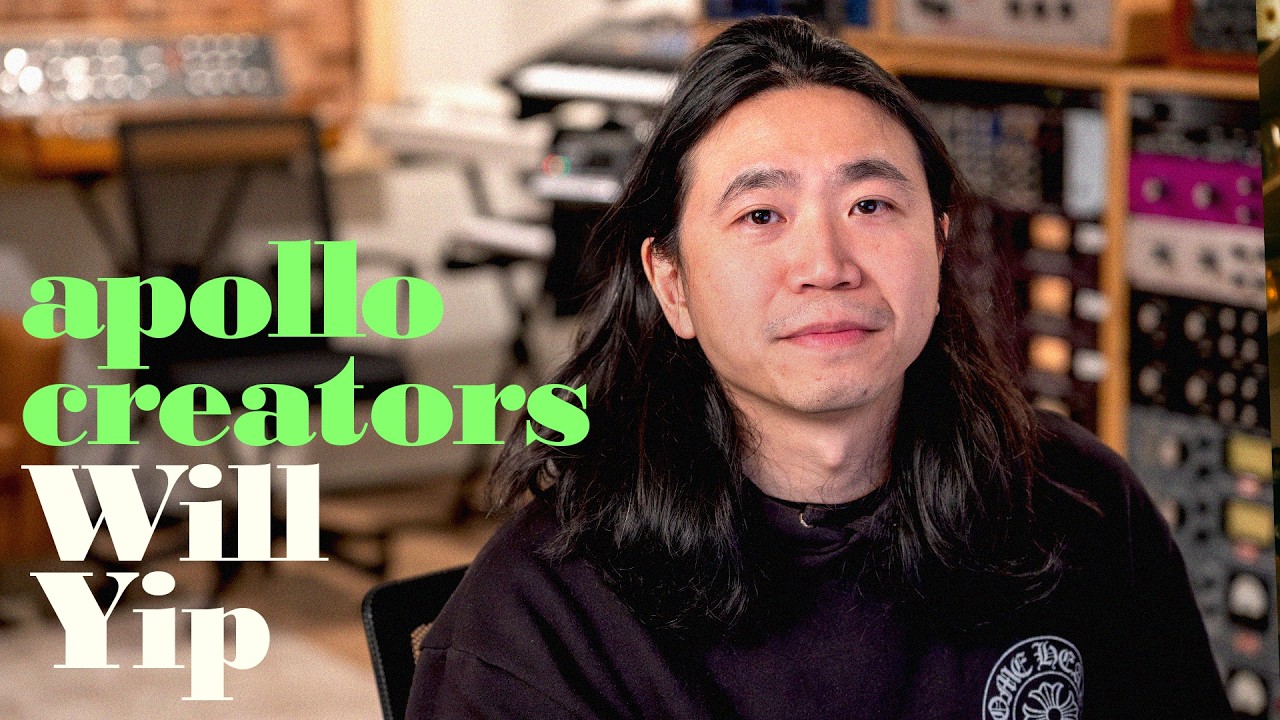
Growing up in Northeast Philadelphia, by the age of sixteen Will Yip was charging eight dollars an hour to record bands out of his mother's basement. It's that sort of persistence that has defined his career, talking his way into an internship at Studio 4 in Conshohocken, which he eventually went on to co-own alongside the production duo known as the Butcher Brothers.
Within a few years, he was engineering for Lauryn Hill and touring as her drummer before returning full-time to work with punk and hardcore bands that would define his reputation. These included Title Fight, Turnover, Circa Survive and Turnstile, who Yip helped earn a Grammy this year as an additional producer/recording engineer for the rock album, Never Enough.
Having spent nearly two decades building a reputation as one of rock and hardcore's most trusted producers, this year Yip opened Memory Music Studios, a four-room, ground-up facility in South Philadelphia. We talked to him about why he left Studio 4 after eighteen years, how a mansion session with Rick Rubin shaped his design instincts, and the gear he considers non-negotiable…

MusicRadar: How did booking studio time at the age of 12 give you a taste for engineering?
Will Yip: “Even at 10, I was an ambitious kid. I thought I was going to be a professional drummer and my parents were like, ‘Sure you are’, but I was a fan of Nirvana and fell in love with music when I bought a pair of drumsticks and a practice pad. My best friend played bass, guitar and sang, so we wrote a couple of hip-hop/pop songs and found a studio in Northeast Philadelphia called Ground Control.
“We saved up all of our allowances and lunch money, got our parents to drop us off outside and walked right into this basement studio. I’ll never forget what that felt like. I could smell the gear, the tubes - even the aged carpet. The second I stepped foot inside I said, ‘I'm going to spend the rest of my life in studios.’
“I'm a true studio rat who was there when no one cared for me to be there, absorbing everything, but I've loved every second of it.”
MR: By the age of 16, you were charging bands $8 an hour to record in your mother's basement. Was that instinct to compete on price, or did it just feel obvious?
WY: “I got help to build a small 12 x 14 studio in my mom's house because I wanted to start getting work. 20 bucks an hour was the golden rate, but I thought I'd charge half that because I was half as good as every other engineer. It was never about undercutting; I just didn’t want to take advantage of people – especially kids because I knew that this was all the money they had.”
MR: Your first solo production role was Title Fight’s Floral Green album. How did that change your life?
WY: “I’d produced smaller stuff for local bands, but Floral Green was the first record where I was officially credited as a producer for a big release. That changed everything - not just because it was successful, but because every producer in the rock, pop, punk and hardcore space wanted to work with Title Fight.
“I’d engineered and assisted on their previous record with legendary producer Walter Schreifels, so I expected them to go with someone like him, but they gave me a call on their way back from Japan and said ‘We think you should produce the next record because we love and trust you’.
“I was shook up - and still am thinking about it now. I took the challenge because I knew that even if my skills weren't comparable to the veterans, I would outwork every one of them because I loved the band and their music.”

MR: Did that experience shape the way you’ve approached everything since?
WY: “A piece of advice that I give to engineers and producers is don't take records for granted. These days, a band is lucky to make five or six records and they have to play those songs for the rest of their lives. That's how I looked at every record.
“The downfall for a lot of our industry is that we're always chasing the next cheque, which is important because everyone has to keep their studios alive, but if you take care of the art, the rest will follow.”
MR: You’ve worked with Turnstile from their Move Thru Me EP right up to last year’s Grammy-winning LP, Never Enough. How has that collaboration evolved over time?
WY: “The second I saw Turnstile live and met them for the first time I just knew I wanted to be around them. I don't go into a job saying ‘This is my role!’ I go in saying ‘What do you guys need?’ Their songs already rocked; I just needed to capture them correctly. Then our relationship grew until they wanted me to produce the next record.
“But what is a producer these days? Everyone’s role is a little different, so I prefer to call myself a collaborator. Whatever your record needs, I'm there, whether that’s writing with you from zero to capturing stuff at the very end.
“To me, Never Enough is the best Turnstile record, and while we were making it I felt in my heart that we were making something special.”
![TURNSTILE - NEVER ENOUGH [OFFICIAL VIDEO] - YouTube](https://img.youtube.com/vi/Nfk1Su1Q8SI/maxresdefault.jpg)
MR: After spending 18 years at Studio 4, why did you decide to open your own Memory Music Studios?
WY: “I’m forever grateful for Studio 4 and some of my assistants still work there, but I felt like I’d outgrown it and needed more space and differently sized rooms. I want Memory Music Studios to be a one-stop shop. It’s not that I'm competitive, but I want to give artists everything they could possibly want.
“Whether you want a small room for tighter drum tones, 150 different cymbals or all the gear in the world, I got you. I've been making rock records for the last 20 years every day for 14 hours a day, and through that time I've collected my own data on what helps a rock band make a record, from the space and the gear to the ergonomics, lighting, and even the HVAC.
“We tried to check off every single box and built four studios and two huge lounges because the second you put five dudes in there with pedal boards and guitars it gets filled up, and I never want people to feel like they're on top of each other.”
MR: We read that Rick Rubin was somewhat influential to the design?
WY: “After working at Rick's mansion I noticed that it wasn't a studio, it was a house that got wired up and they put up panels and moving blankets and it sounded incredible. Obviously, I wanted mine to be more like a ‘proper’ studio, but I also wanted the vibe to be comfortable and I think people tend to overlook that. I don't know why, but in the ’80s and ’90s dark studios became a thing, but it’s such a bad working environment.”

MR: What was the hardest design decision you had to make? And once you’d completed the studio, what was the biggest step up level-wise?
WY: “Everything was a challenge, but it was worth it because I wanted to make the control room of my dreams and for it to be accurate. Not that the other rooms I worked in weren't accurate, but there were issues so we worked on diffuser and absorption sizes until we got what I thought felt good.
“I did the first test mix for Tigers Jaw in 45 minutes, which felt too easy, but I sent it to my assistant engineer and some other people, and they're like, ‘Bro, this is the best mix you've ever done’.
“Maybe it was a fluke, but the low end sounded consistent across the entire room and everything sounded the same on headphones and in my car. I was like, ‘Oh man, this room is accurate.’ So yeah, it's definitely helped my work and there's a lot less second guessing now.”
MR: Your outboard rack is insane, but are there any situations where you would gravitate to using software for processing?
WY: “I have a lot of hardware, but I’m not a collector per se. I just want to accommodate all artists, so if we do need something I got it. I have 225 guitars – and they’ll get used at some point, but for most of the stuff I do I’ll use the same three.
“It’s the same with Omnisphere. I want to create rock records the way I make hip-hop tracks, so if I want a different sound for the verse I’ll use the soft synths. I'm a hybrid guy, but I don't think I can really track without my Neve 1081s because I love them so much.”
MR: What other gear is vital to your recording chain?
WY: “I always say this, but Universal Audio is like my Nike. UA changed my life because they represent exactly what I just said - a hybrid engineering style. They understand the soul of analogue, but they're also a forward-thinking company that has grown with time.
“Everyone reveres them as a game-changing plugin company - and there are more of those than ever right now, but they were the godfathers making quality plugins that sounded like the hardware versions when we all chased hardware and couldn't afford it.”

MR: Do you feel the same about UA's hardware units?
WY: “I’m all-in on the Apollo. I know a lot of people use them for extra DSP plugin power or monitor control, but for me it's the main I/O and it’s in every single studio. If Billie Eilish can use an Apollo on the road and track Grammy-winning records, it’s certainly good enough for me. We actually shot it out against a million different converters; not only did it hold up, but it outperformed interfaces that cost five times as much.
“The UA Console software is also a daily part of my workflow for low-latency monitoring, so Universal Audio is truly the heart of my rig. My Apollos, the plugins, my Neve 1081s, and a few key microphones are how I make records. Along with my monitors, those are the staples that never leave. Everything else can change around them.”
MR: Do you have a bucket-list artist you haven’t got round to engineering or producing yet?
WY: “Honestly, there isn't one. I've done records and sessions with some of my childhood heroes and that was great, but I've had the most fun doing records with Title Fight and Turnstile. I'm grateful for any work I can get, but I want a band that wants to be there with me.
“I know it sounds like a cool guy punk answer, but ask my wife, that's all I give a s**t about [laughs].”
Will has just spoken to Universal Audio and made a new Apollo Creators video with the company, talking more about his reliance on its tech. You can watch it below