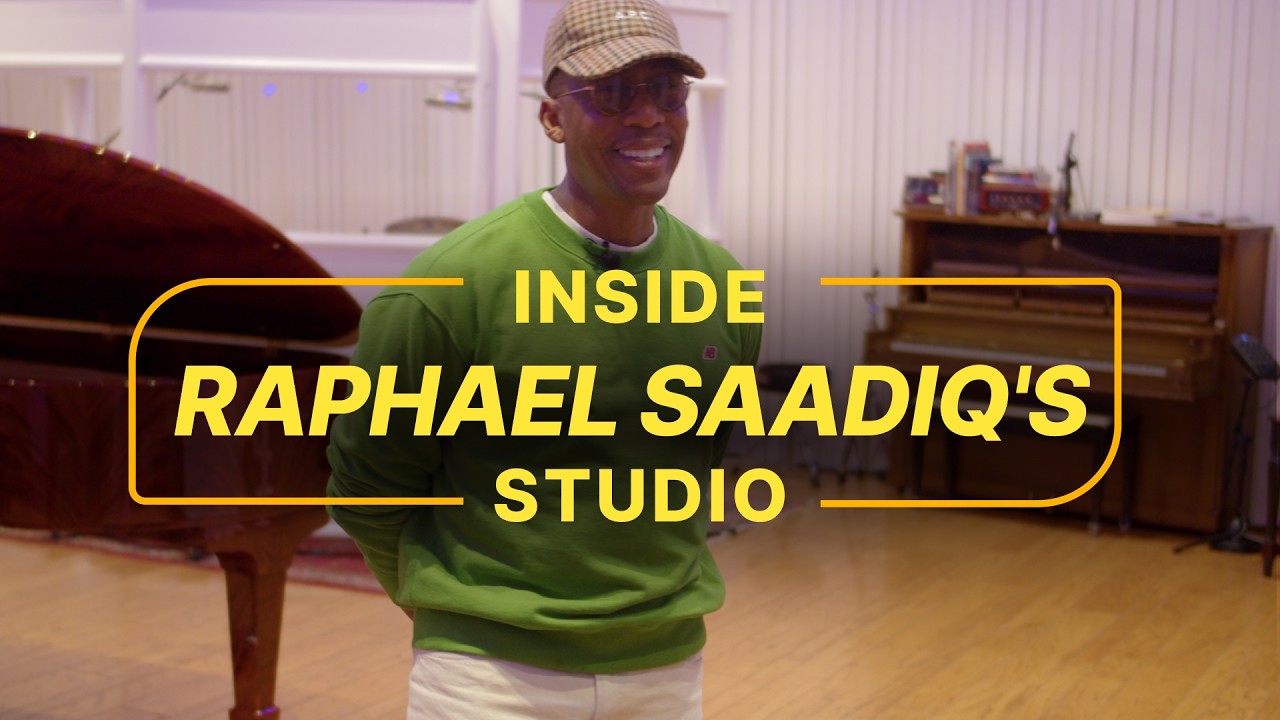
As befits a man who’s had countless hit records – as part of Tony! Toni! Toné!, as a solo artist and producing/writing/playing for others – Raphael Saadiq’s Blakeslee Recording Studio is seriously impressive.
In a new video for Reverb, he gives you a tour of this facility, which contains an almost bewildering array of classic gear.
One of the first things we see is the Yamaha EX-2 Electone, a massive organ/synth hybrid from 1977 that bears some visual and sonic similarities to the CS-80, which was released in the same year. “It’s like the beta [for the CS-80],” says Saadiq.
Soon enough, we’re onto a vintage Fender Rhodes 73, which previously belonged to Leon Ware, the driving creative force behind Marvin Gaye’s 1976 album I Want You (Ware had originally planned to release many of the songs that ended up on this record himself) and hits for countless other artists.
“He made so many hot records that when we turned it on it was smoking,” says Saadiq, possibly in jest.
Among the other keyboards are an Analogue Solutions Maximus 8-Voice, the funky Vintage Vibe Vibanet, and a Clavinet (one of five that Saadiq owns, apparently). Over on the guitar stands, meanwhile, we find Saadiq’s beloved P-Bass, which he’s owned for more than 25 years.
“That bass doesn’t leave the building,” he says. “It’s been on all my records. I grew up playing a Jazz [bass], and then one day, I figured out that to make records I needed to be playing a P-Bass.
Another highlight is the Prince-style Hohner Tele. “This was a hard one to get,” says Saadiq. “You can find guitars that look like ‘em, but this is the actual one.”
There is one thing missing in comparison to Prince’s Hohner, though: “I think his has a different pickguard… a leopard [print] one or something.”
Of course, this being a studio, it’s a place not only to play but also to record, and when the red light goes on, Saadiq’s preference is to commit to tape on a classic Studer machine.
“I don’t want any undos,” he says. “There’s no ‘undo’ in good music. It’s a performance.”
That said, there are times when Saadiq works in the box – using Ableton Live and the Telepathic Instruments Orchid, by the looks of things – as it enables him to create without having an engineer in the building. When it’s time to get serious, though, it’s always tape – even if that sometimes means losing a great take.
“This thing makes you take chances,” says Saadiq, pointing at his Studer. “I remember recording here one day, and I was doing a vocal, and I had my vocal, the one I loved, and I was recording myself, and I left the vocal on input. I recorded it, and then when I realised that I recorded over the vocal that I wanted, I was just sitting there by myself, going, you can't get mad at yourself, because it's gone. There's nothing you could do. There's no undo. You can't even get mad. You just have to do it over. And I didn't like that feeling of me losing that track, but I do like the feeling of… I just knew I had to do it over.”
Later on, we move back to the keyboard area, where we discover another Prince favourite: the Oberheim Four Voice synth.
“I've been wanting one for 15 years,” says Saadiq. “I finally pushed the button, and the thing for me is I like the way Prince used the Oberheim. I'm now finding out how other people used it, but I like how he used it – I like how [Revolution keyboard player] Doctor Fink used it. He's an amazing programmer of this thing. He defined it for me.”