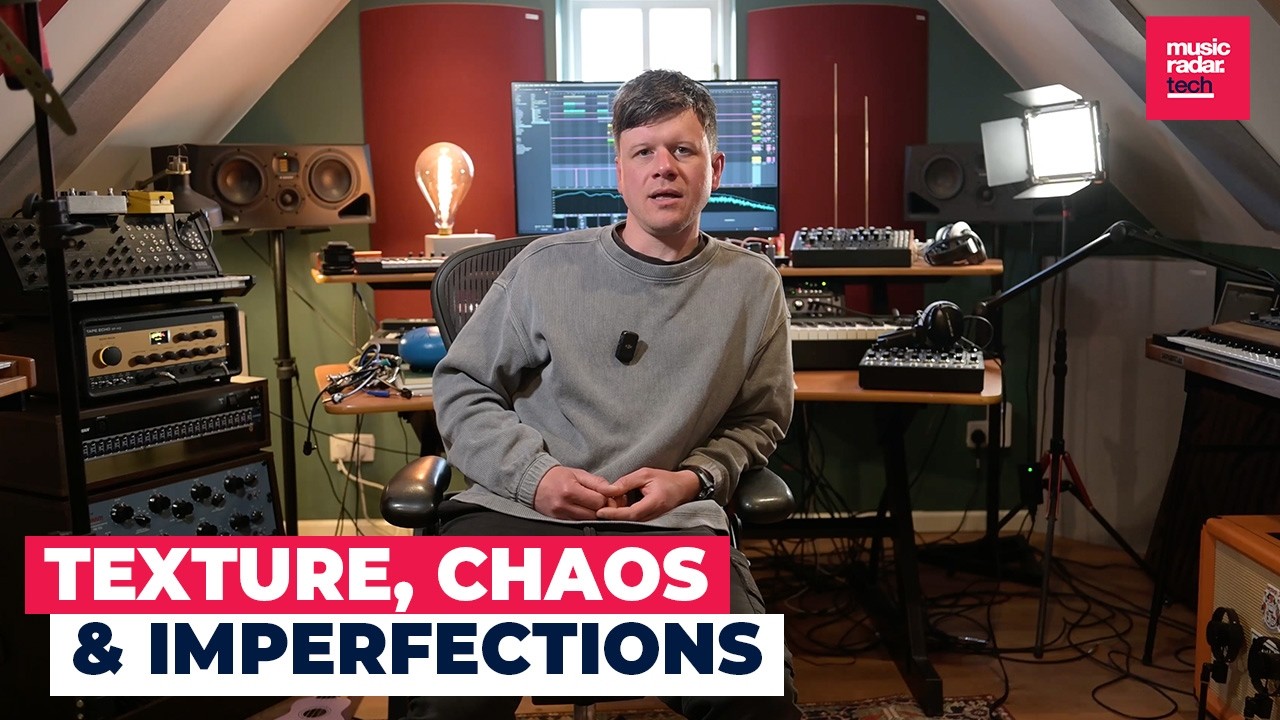
Alan Myson is a producer, composer and sound designer whose versatility within electronic music spans work for film, TV and advertising alongside his own output as a recording artist. As Ital Tek, he's released eight adventurous, varied albums for lauded underground label Planet Mu.
It’s a two-decade journey of sonic exploration that started when Myson picked up his first effects pedal as a teenager.
“I got an electric guitar when I was about 13, and that was what really set it alight for me,” he tells us when we visit him in his Oxfordshire studio. “My first setup that I remember feeling like I could actually get something cool out of it was an electric guitar, a multi-effects pedal and a MiniDisc player. I used to just make loads of really long droney, ambient guitar effect loops.”
His career as Ital Tek started a few years later, following a move to Brighton for university that was largely inspired by a desire to break into the city’s music scene. Myson began handing out demos and posting tracks on Myspace, which caught the ear of Planet Mu founder Mike Paradinas, best known for his output as μ-Ziq.
Over the 20 years since then, Myson has become one of the label’s key artists, releasing multiple albums, EPs and singles, ranging from his early experiments in atmospheric dubstep and IDM through to the dark cinematic sounds of recent albums Outland and Timeproof.
His latest full-length, Mind Abandon, landed this May, and sees Myson pushing his sound into new territories, warping recorded instruments, synths and vocal sounds into ambient textures with granular processing and creative effects.
We visited Myson in his Oxford studio to break down the multi-layered sound design behind album highlight A Hidden Path (above) and discuss his studio setup and outlook on music (below).
![Ital Tek [Planet Mu] on creating his own sonic worlds and the making of new LP Mind Abandon - YouTube](https://img.youtube.com/vi/wyqaXG-GBpg/maxresdefault.jpg)
Tell us about your studio…
“I've been through quite a lot of studios, I've been doing music as my full time job for nearly 20 years now. I was lucky enough to start doing it when I was 19. Over that time I’ve had different home studios, rented studios and purpose-built studios.
“The place I’m in at the moment is outside of my house in a separate building. I'm lucky enough to have accumulated quite a few toys over the years, which I get to spend all my time messing around with. It's a cool place to work.”
Tell us about your new album, Mind Abandon…
“The new album is definitely a very introspective album for me. It focuses on the feeling of getting older, kind of losing a sense of your identity as you get older, as your life changes, you have kids, your priorities change, your time changes.
“Music is something that's really precious to me. I put so much of my energy into it and so much of my time into it. As I'm a solo artist, I spend a huge amount of time by myself trying to get something going with these instruments. It's by definition very introspective. I think this album in particular came from a place of really trying to understand my own mind, trying to focus on what makes me inspired, what makes me a better person. It was a deep dive.
“A lot of this record comes from a place of feeling quite shit, to be honest, but there's also a lot of love and a lot of optimism in my music. I like to think that what I'm doing is focusing on harsh extremes. I sometimes go down a path of just making really hard, dark music, and then other times I'm really motivated to try and make something that's soaring or optimistic. Sometimes I merge the two together.”
Your last few albums have been quite conceptual – is having a defined concept important to your creativity?
“I think having some idea of a theme is important when going into a body of work or an album. That can be something that's more conceptual, or it can be something a bit more tangible, something to do with the actual sounds or equipment you're using.
“For each record I do try to have a distinct sound palette or sound world that I'm exploring. That tends to then influence the emotional output of what I might be writing.I kind of see the two things almost the same really. The individual sounds that I create are like a way of expressing a mood, a picture, a story.
“I've been putting out records since 2007. It's been a long time and there's a part of me that feels like it's all part of the same body of work. It's all just this wave you're on and it never stops, but then it is punctuated by these releases. So every two to three years I definitely try to reset my brain a bit and just freely create sounds without thinking about how it's going to be used, what the record's going to be like. Hopefully that creates something interesting and keeps me inspired as well.”
How has your approach to production evolved over that time?
“I think my production techniques have definitely changed over the years, although I don't necessarily see becoming more proficient in the technicalities of what you're doing as a bonus, as such. Some of the best things I've ever written, in my opinion, were quite naive, where I didn't really know what I was doing. I like to keep that in mind when I'm writing tracks and writing larger bodies of work.
“That’s why I collect lots of instruments that I can't play. A lot of the time when I go and visit somewhere, I'll be eyeing up some weird, you know, Indian banjo or something. I have no idea how to play it and whilst it may not even feature that heavily on a track, just having all these inspiring bits of kit, along with synthesizers, guitar pedals, it's all nice to have. It's inspiring and it sparks something in the process.
“There is something to be said for the naivety of just making do with what you've got though. I think those are things I try to balance.
“I'm fortunate in that over the years I've managed to accumulate lots of cool bits of kit, and I enjoy using them, but whether they inform what I'm doing or vice versa, it's hard to say. I don't think of myself as particularly good on any of these instruments either. I'm kind of sound led rather than gear led. I just sort of tinker with them all and try to get something that interests me out of it.”
Were there any new techniques you explored on Mind Abandon?
“Going back to what I was saying about trying to find new sounds every cycle of making a record, I thought this time it'd be interesting to feature my own voice a bit more, although not in the form of traditional singing. There are no lyrics and it isn't even particularly discernible that it is my voice. It was just a way of getting ideas down quickly. I’d pull over the mic arm to the desk, and just be ready to go. It was about being able to immediately just hum something, sing something or make some weird beat boxing sounds – anything like that.
“It just felt quite immediate. There was absolutely no interface – it's just me on the track, I can then mess around with it and treat it like any other sound source, whether that's one of my guitars or a synthesizer or a field recording or anything like that. It was just a nice way of having immediacy and a very personal connection to the music.
“Another thing that has always been a part of my sound but was particularly important for this record is processing sounds. Processing things with guitar pedals and processing live sounds through digital means.
“Going back to when I was a teenager, I was absolutely fascinated by guitar pedals, although I couldn't afford any of them. I just had quite a cheap multi-effect, but I dreamed of having a pedal board with loads of knobs to tweak.
“Guitar pedals were a huge part of this record. Also just trying to dive back into the guitar in general, in a textural way, rather than chords and song structures. That's kind of what I was doing years and years ago, before I started doing my Ital Tek stuff. I wanted to bring some of that DNA from my original music experiments, harking back to when I was doing it on MiniDisc in my parents' garage. I just wanted to bring some of that energy into this record.”
You’ve been doing film and soundtrack work in recent years, how does your approach to that differ from your Ital Tek work?
“Aside from doing all my Ital Tek work, in recent years, I've also been hired to do a few composing jobs, for film and television, and some video game work as well. I've done all manner of things – dance projects, some adverts, stuff like that. I think it's a good way of keeping you sharp, kind of testing your ability to work with other people.
“It's quite an isolated experience, just making solo electronic music. I've spent a lot of time by myself in this room, just hoping that something's going to come out of my brain, whereas I've actually really enjoyed the last few years or so of collaborating.
“It's amazing to work with people where, yes, you might be the person being tasked with doing the music, but it's their project and they've got their ideas. You're trying to make their project as great as it can be by bringing something that you do to the table.
“I've loved doing that, and I hope to do a lot more of it, like working with directors, editors, producers, sound designers, is brilliant, and it makes it feel like being in a band or something. Everyone kind of leans on each other a bit to bring out the best in each other.”

What one piece of studio gear could you not go without?
“My desert island music kit is the Korg MS-20. For making electronic music and doing my Ital Tek records, it is really expressive. I feel like I know what I'm doing with it, which isn't true of all my gear.
“There are lots of bits of gear in my studio that I am not as well versed in, but the MS-20 is just fantastic for getting ideas out. It just gels with me. I think it suits the extremes of my music very well: it's super dark and gnarly, and heavy and nasty, and then it's also lyrical and you can get these beautiful tones out of it as well.”
What one piece of advice would you give to other producers?
“It's easier said than done, but focus less on what other people are doing or expecting, and try and home in on why you’re doing what it is you’re doing. What clicks for you hopefully clicks for other people.
“It took me a long time to get to the point of realising that. I spent a good 10 years feeling extremely unconfident with making music. I still don't really – everyone's kind of got some level of imposter syndrome with what they're doing, but I definitely pay less attention now to expectation, what I'm supposed to be doing or what anyone else is hoping I'm doing.
“I've enjoyed the process of making records a lot more since I tried to harness that kind of mindset.”
