
MusicRadar Verdict
Monumatic is a fast and intuitive module, that can sit centre stage in anything from the tiniest rig to the largest, with everything covered from waveshapes, to filters, reverb and more. A must buy!
Pros
- +
Small footprint.
- +
Great build.
- +
Can replace multiple modules.
- +
MPE/MIDI compatible.
- +
Sounds wonderful.
Cons
- -
No FM.
MusicRadar's got your back Our team of expert musicians and producers spends hours testing products to help you choose the best music-making gear for you. Find out more about how we test.
What is it?
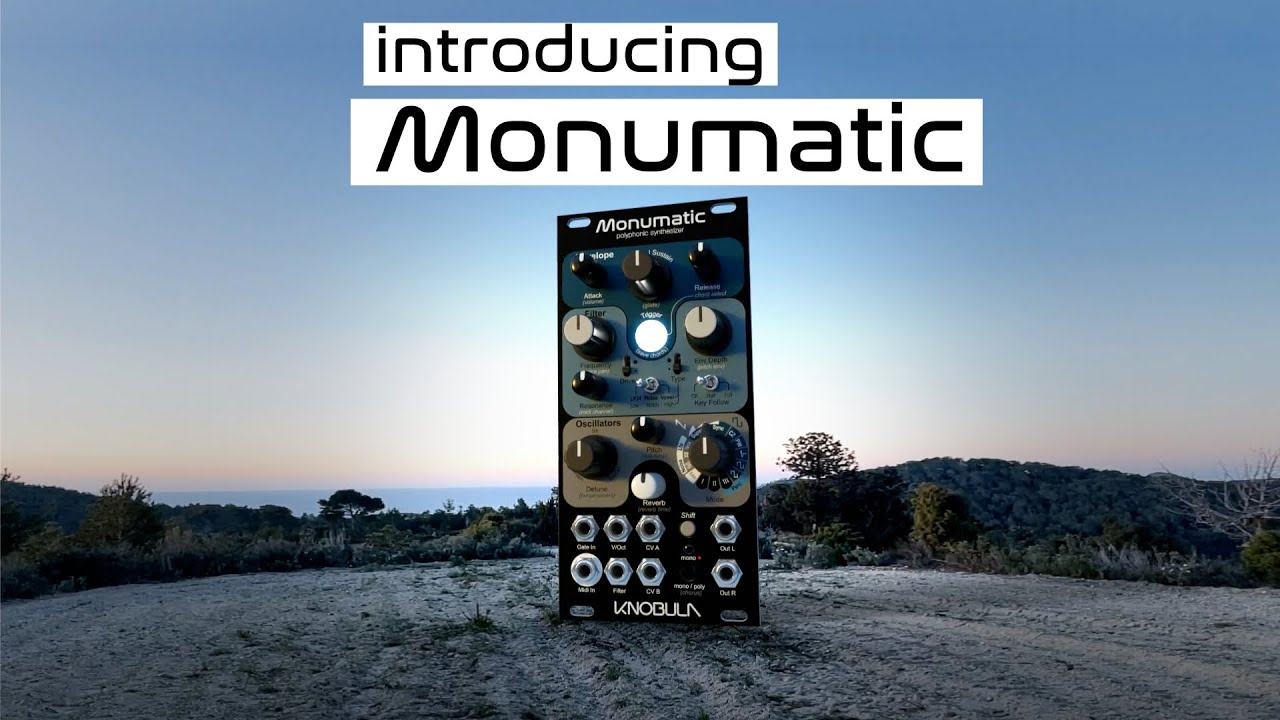
Monumatic is the sibling and successor to the immensely popular Poly Cinematic and it follows on where that left off. It’s an eight-voice polyphonic synthesizer, with monophonic mode, which covers a lot of ground, including square and saw sync, strings, Moog tones and many more, all accessible from a rotary control. That in itself is a great start. There are many fundamental tones you can use as a starting point to shape as you see fit. The oscillator section has a large rotary control to the left, where much of the tone tweaking takes place, with detuning from unison, to fifth and on to sub octave. There’s also a small pitch control for tuning.
Normally, this shaping would take place on a number of different modules, but Monumatic, even in its small 12hp footprint, is home to filtering, drive, envelope generation, reverb and more. These aren’t cut-price additions either. Multiple filter types are on offer, from ladder to a vowel, with switchable keyboard tracking and drive.
The envelope has attack and release, with a central knob handling combined decay and sustain, much like the Poly Cinematic.
The reverb has a single control for the mix, although the shift button changes that to a time control. The shift button actually comes into play a lot, as almost every knob and switch has a secondary function, clearly labelled on the face plate. It’s a good system that keeps the module clean and clear.
Patching options might look minimal at first glance, but the reality is rather different. You get the MIDI port, which is compatible with both CC and MPE, a gate and V/Oct in, alongside a filter cutoff input. The two remaining ports, labelled CV A and CV B, can be used to modulate any of the other controls on the Monumatic. Simply plug in a cable and touch the control, and that CV input is assigned.

Performance
Using Monumatic is as simple as you get. No menu diving and only one button combo, using shift, so everything is on the front panel, easy to see at a glance (there are options for coloured or black panel too) and quick to access and adjust.
Having the patch points at the bottom keeps them out of the way, making for a clean rig. That said, you might not need much of a setup for this. It could live in a case all on its own, with a MIDI controller acting as an outboard device. We’ve used it with our KeyStep Pro for both playing manually and sequencing, as well as pairing it with the Tetrachords, and both work very well.
As for modulation, this is pretty standard fare. Input your source into one of the CV inputs, touch a control and off you go. Having a pair of assignable CVs is handy and opens up a lot of possibilities for evolving sound design. We’ve found that having a faster LFO modulating the filter, especially in vowel mode (based on a clocked signal) and a slower one changing the detune amount, can produce some really interesting results, but that’s a single example. There are so many things you can do, it’ll keep you occupied for days, but without ever losing your way.
But how does it actually sound? Well, in our view, it’s glorious. There’s no FM or wavefolding, but what you do get is rich analogue-sounding voices, with buckets of room to manoeuvre. Shaping the 16 different modes brings out lots of flavours and it does a great job of covering lots of ground from classic ladder filtered Moog types, through to some gnarly pulse width tones.

The filter is fabulous too. It allows you to dial in some really soft, delicate pads to ultra- aggressive leads and with the distortion engaged, there are lots of harmonic overtones. The filter has six modes to play with. A pair of low-pass, notch, high-pass, vowel and a phasing filter. Resonance has its own control, so it can be manually adjusted or assigned to CV. Like the Poly Cinematic, the filter has keyboard tracking, switchable between half and full range, something we appreciate, as darkening the low end can be very useful.
Then there’s the envelope generator, again similar to the Poly Cinematic one. It has a pretty broad range and can go from ultra snappy to long and lush.
Monumatic is also a stereo module, with a simple yet beautiful reverb, capable of shorter, subtler ambience to spacious grand atmospherics, and some modes let you pan the voices (in polyphonic mode), giving a wide breadth of sounds, which adds a whole new level of richness, ideal for moody pads and chords. Speaking of chords, you can play chords and even save them, using the shift button and the release knob to select them. This might be a little limited in playability, but it’s a great option and in a tiny setup could be more useful than you’d think.
Which is really what you find across the whole module. Each element is simple to use and individually may not be rammed with features, yet the entirety of the module is something capable of vast ranges of tone and design opportunities.

Verdict
Monumatic is a playground for sound designers and musicians. It may not have absolutely every feature and it would be nice to see some FM or wavetable, but really, as it stands, it is a fantastic one-stop shop of all that you need in a synth. It has a lot to offer for any user, whether it finds a home as the centre of a tiny setup, or as part of wall-sized rigs.
Hands-on demos
knobula
Alternatives
Specifications

Price |
£345 |
Key features |
8 Voice polyphony 12hp 16 voice types 6 filter types Stereo output On board reverb |
Contact |