
After more than a decade in development and several months in beta, U-he has announced the official release of Zebra 3.
The next generation of its beloved semi-modular soft synth, Zebra 3 has been "rebuilt from scratch" and brings together analogue modelling, physical modelling, wavetable and additive synthesis with an updated "adaptive" user interface designed to streamline its workflow and make the synth more user-friendly.
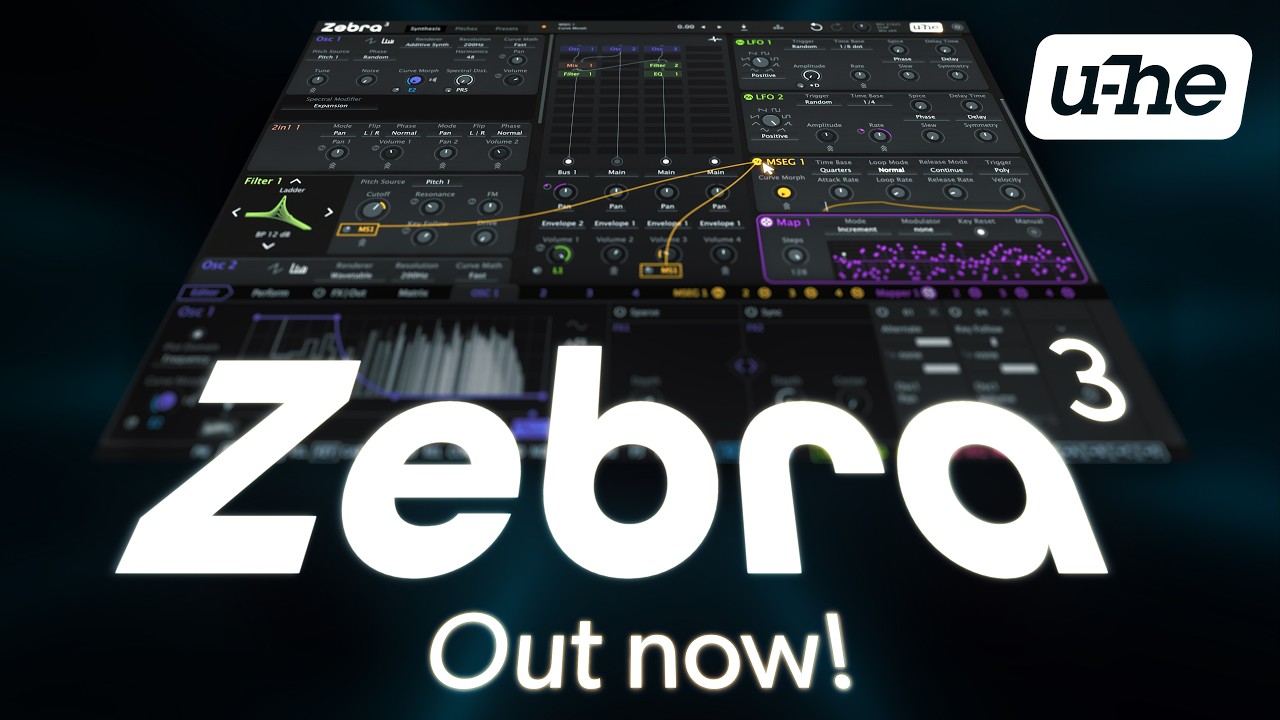
Zebra 3's oscillator system has been completely overhauled, and is now based around a vector-based spline editor that U-he has described as "Photoshop for synthesis", allowing custom waveforms to be sculpted from multiple hand-drawn Bézier curves arranged along a timeline that Zebra's four oscillators can morph between.
Curves can then be rendered in the form of a classic wavetable or using Zebra 3's updated additive engine with up to 1024 partials, and each oscillator is equipped with two oscillator effects slots capable of dramatic sound alterations, drawing on spectral, warping, windowing and animation effects.
Zebra 3's filter collection has been expanded to include 13 distinct filter models, spanning everything from SVF and ladder emulations to all-pass and phaser models, with low-pass, band-pass and high-pass modes and multiple slopes on offer, adding up to a total of 105 potential responses accessible via a handy matrix interface.
Along with its wavetable and additive engines, Zebra 3 features updated FM oscillators with various FM modes and feedback options, including through-zero FM, and a new Vector mixing module allows you to morph between four sound sources on an XY grid. Also new in Zebra 3 are several physical modelling tools: new modal resonator and comb filter modules work in tandem with an exciter module to emulate the acoustic properties of physical objects.
The synth's modulation system has also been significantly expanded, offering up a whole world of possibilities for creative sound design: four ADSR envelopes and four LFOs are joined by four MSEGs (Multi-Stage Envelope Generators) that can be shaped using eight morphable curves in the same spline editor as the oscillators. These are joined by four Mappers and Mod Math modules that can shape and combine modulation sources before they hit their destination.
Also onboard in Zebra 3 is a comprehensive arsenal of effects, accessible via a modular grid with three per-voice sends, that features multiple flavours of reverb, delay, distortion, compression, chorus, phaser, flanger and more – including a new granular TextureVerb effect that can produce "shimmering, abstract ambiences".
"It’s been a very long time in the making, and we at u-he are beyond proud of what Zebra 3 has become: a deep workhorse synth with many powerful new modules wrapped in a sleek, modern interface," reads a statement on U-he's website. "Although it builds on decades of experience gained through several generations of Zebra2, Zebra 3 is an entirely new development."
Priced at €249, U-he's Zebra 3 is available now in VST3/AU/AAX/CLAP formats for macOS, Windows and Linux. Zebra 2 owners can pick up the plugin for only €30, and if you own Zebra 2 and The Dark Zebra, you can have it for free.
Head over to U-he's website to find out more.
U-he Zebra 3
- Adaptive interface: Modules only appear when added to the patch, organised via drag and drop
- Over 1,200 factory presets
- Unified spline editor for oscillator waveforms and MSEG curves with geometric morphing
- Two oscillator engines: Wavetable (up to 16× unison) or additive (up to 1024 partials, can be inharmonic)
- 20 oscillator effects including spectral decay, sync, phase remapping and more
- Filters with 13 models, both classic and original (Ladder, Cascade, SVF etc) each offering up to 12 responses (e.g. LP, HP, BP with 6/12/18/24 dB/Oct)
- FM oscillators with 2 operators plus an audio input as a third operator
- Modal resonators and comb filters with detailed control over feedback and damping for physical modelling synthesis
- Noise and Exciter modules for realistic transient and physical modelling sources
- Vector & Scan mixers: Blend 4 sources with XY pad (loopable) or scan through them sequentially
- Pitch, gate and trigger signals as first-class modulation — modular-style routing freedom
- Mod Math modules for combining and transforming modulation signals
- Mappers that act as step sequencers or as freely drawable transfer curves for other modulators
- Ring modulators, distortions, wavefolders, equalizers (as global effects and per voice)
- Delays, multitap delay, reverbs, compressors etc. in global FX grid with per voice send amounts
- Available as CLAP, VST3, AU and AAX on macOS, Windows and Linux
- Support for MPE, microtuning, MTS-ESP (realtime tuning)
