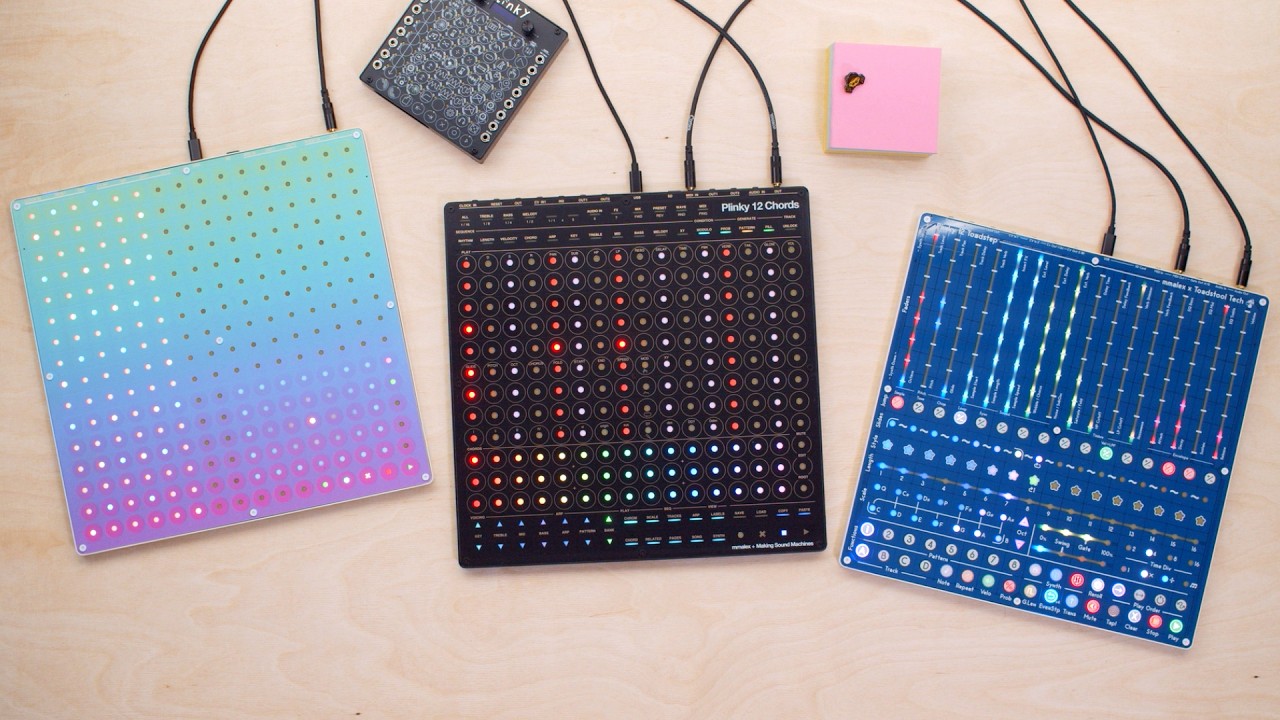
SUPERBOOTH 2026: German developer Making Sound Machines has announced Plinky 12, a trio of touch-focused instruments with swappable faceplates, each of which makes use of the same core hardware design and a shared synth engine.
Plinky 12 is, essentially, a single instrument, although its interchangeable panels allow it to function in a multitude of different ways. According to its developer, this concept means that “it can become different instruments built for different kinds of musical thinking”.
Each iteration of Plinky 12 will be available as a fully assembled distinct instrument, but additional panels will be available to purchase separately, allowing owners to expand the capabilities of the unit.
The Plinky 12 series is an evolution of the original Plinky, an open-source touch-sensitive polysynth that is available in both DIY and fully assembled forms.
Beneath the faceplate, each Plinky 12 unit is built around the same 12-inch by 12-inch hardware, based on a RP2350 microcontroller CPU and equipped with MIDI and CV I/O, as well as a stereo unbalanced audio input and output and USB connectivity.
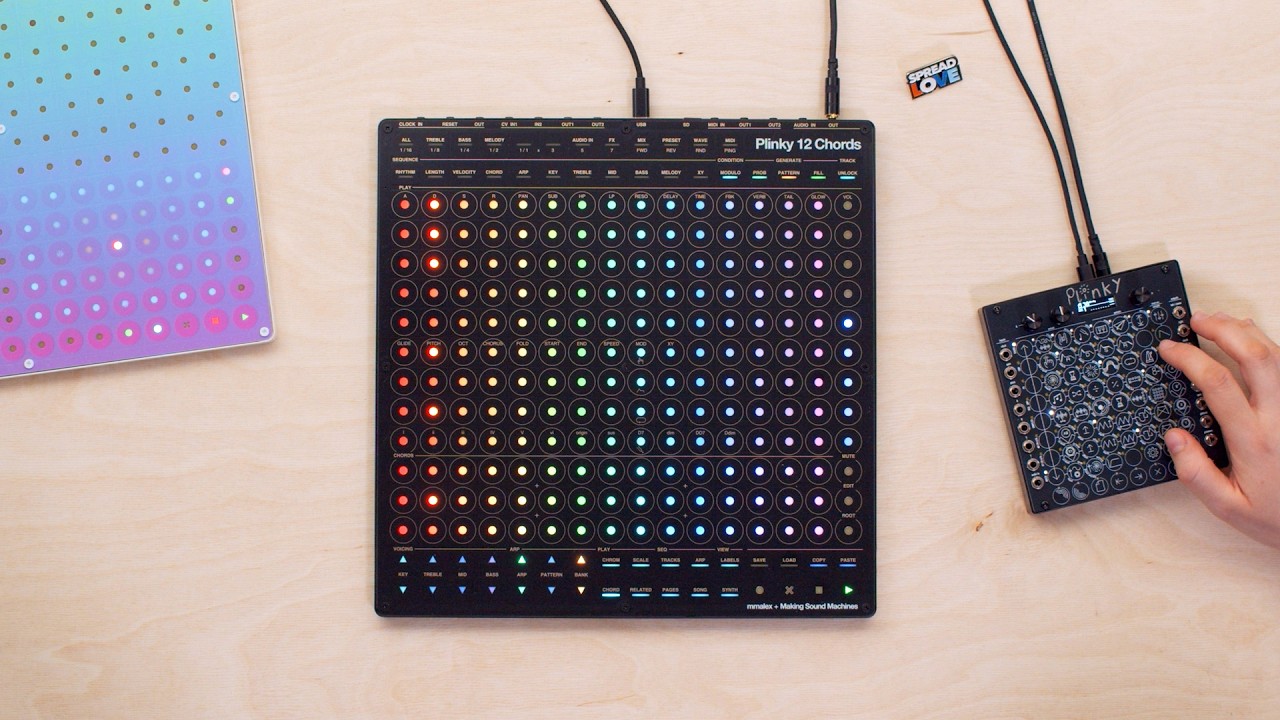
The hardware interface consists of a 16x16 grid of touch capacitive buttons, the functionality of which is dictated by the attached faceplate. Each of the three variations in the initial range is created by a different designer and allows users to interact with the machine in a unique way.
Chords is designed by Making Sound Machines itself, and is described as a ‘harmonic inspiration machine’. The layout is intended to aid improvisation around melodic and harmonic patterns, with expressive control over chord voicing and progressions.
Toadstep is a sequencer layout created in collaboration with Eurorack developer Toadstool Tech, known for its Ectocore sampling module. The Toadstep turns the Plinky 12 interface into a 4-track sequencer designed for performing with acid-style synth riffs and generative melodies.
Blocks is the most open and adaptable of the three configurations. It’s designed by mmalex, who is one of the developers behind Making Sound Machines and designer of the original Plinky synth. It uses a monome-compatible grid for touch-controlled synthesis, based on the original Plinky concept. A browser-based code editor will also be launched alongside the Plinky 12, allowing users to create their own custom grid controllers.
In all cases, Plinky 12 makes use of the same sample-based polyphonic synth engine, which the developer says can ‘turn samples from simple sounds into frozen wavetables’. According to Making Music Machines, “since synth presets, system settings and certain control styles like LFOs and envelopes are shared across panels, once you learn one panel, the others already start to make sense.”
In the demo videos – above – it sounds appropriately bright and percussive, befitting of its onomatopoeic name.
The interchangeable faceplates can be swapped using a screwdriver. The Plinky hardware will automatically adjust to any new faceplate, adapting the software without the need to change the firmware.
There’s no definitive word as yet on a release date or price, but the Plinky 12 will be on display at Superbooth next month, and Making Sound Machines promises the instruments will have a price that is “as competitive as we can make it.”
Head to the official website for more information and to sign up for updates.
