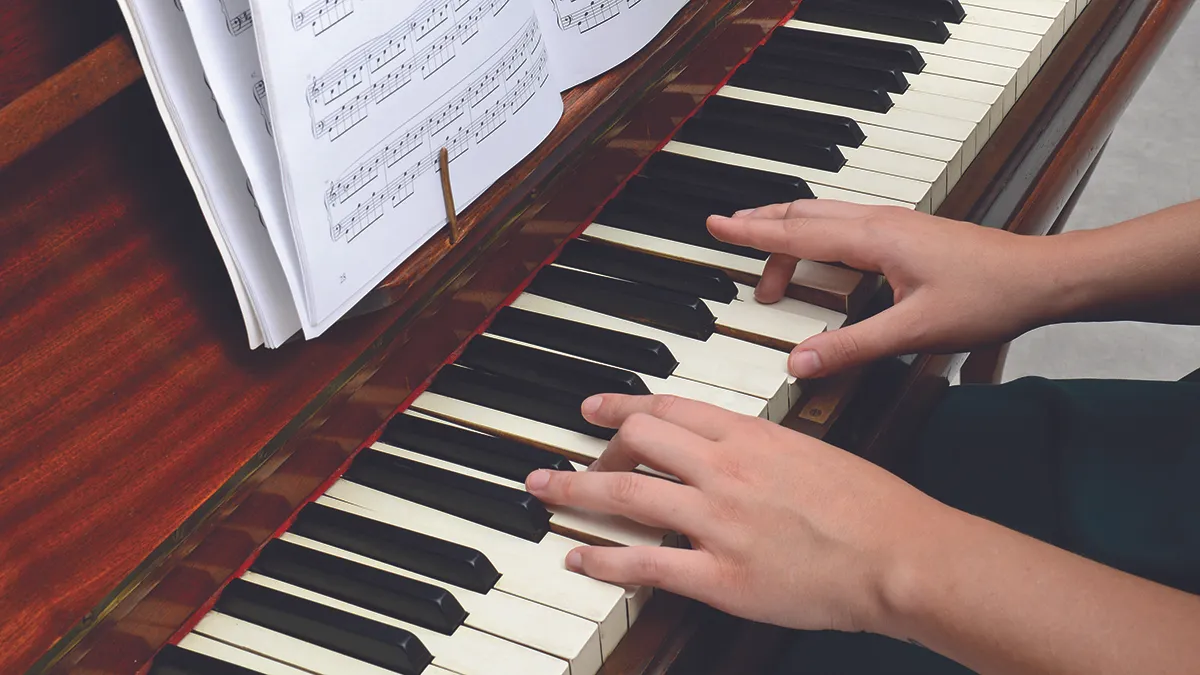
Every good pianist knows the importance of dynamics – how loudly or quietly you play, basically – but other tonal terms have always been somewhat more subjective. Can you really make a piece sound ‘warmer’, ‘darker’, ‘brighter’ or ‘heavier’, for example, given that, once the hammer hits the string, the tone of the sound is supposedly out of your control?
This is a question that’s long been debated, but new research led by Dr. Shinichi Furuya of the NeuroPiano Institute and Sony Computer Science Laboratorie (published in ScienceDaily) claims to show that this level of touch and timbre variation is indeed possible on a piano via subtle movements of the player’s fingers and hands, and that listeners can identify it when they hear it.
In order to measure these movements, the researchers used a custom-built non-contact sensing system called HackKey. This is capable of recording the movements of all 88 piano keys at a speed of 1,000 frames per second and with microscopic spatial precision.
20 “internationally acclaimed” pianists were asked to play this specially modified piano in a variety of tonal ways – brightly, darkly, lightly and heavily, for example. It was shown that listeners - even those with no musical training – were consistently able to recognise the tonal qualities that the pianists were trying to convey, with professional pianists being particularly adept at doing so.
When the researchers analysed the HackKey data, they discovered that just a few very precise movements influenced the tonal changes, causing subtle variations in acceleration, timing and synchronisation between left and right hands. What’s more, it was noted that just one single movement could influence how listeners perceived the sound.
The researchers believe that these extremely subtle gestures are picked up through years of piano training, and are consistent among advanced players. As such, the findings challenge the assumption that such playing techniques are subjective, and that their perceived impact is somehow psychological.
Going forward, this means that students could potentially be taught how to play in tonally different ways by showing them the exact techniques required as opposed to giving them more ambiguous descriptive instructions. Music technology companies might be interested, too, as the research could give them a better understanding of how pianists actually play and enable them to tailor their products accordingly.
The study also feeds into growing scientific interest in understanding the nature of creativity and ‘dynaformics’ – the science of music performance.