
PLUGIN WEEK 2026: Chances are, most of the music production plugins that you use rely on fairly commonplace logic. Your synthesizers model the flow of electricity through components, while the effects in your chain rely on a recreation of the signal flow-structure of classic outboard gear.
These instruments and effects processors may be useful, but the predictable results can also get a little stale. A compressor compresses. But what if your compressor reacted not to volume - but behaved according to the laws of thermodynamics? Your musical decisions would be quite different then.
A thermodynamic compressor is more than just a hypothetical, though. It’s a very real plugin, and one of a growing selection of instruments, effects and modulation systems that use physics as a basis for their behaviour.
Here are four developers using physics in their plugins - and how you can apply science-based decisions to your own productions for a boost of real-world-inspired creativity.
1. Baby Audio Atoms - "It's a physical instrument that never existed in the real world"

Thanks to increases in computer processing power, physical modelling - the mathematical recreation of instruments in digital form - is becoming ever more popular. By modelling an exciter and resonator, you can whip up all kinds of acoustic instruments, such as violins, pianos and percussion.
But, and this is where it gets interesting, you aren’t restricted to just real-world instruments. You could just as easily model, say, a mass and spring network to create never-before heard sounds.
Atoms from Baby Audio is one such bizzaro-instrument builder.
Although it looks like a typical soft synth from the outside, under the hood it’s modelling not oscillators and filters but bows and springs.
“Think of it as a complex string instrument that might have existed in the real world if a group of scientists decided to make a new kind of instrument,” explains Caspar Bock Soerensen, the CEO of Baby Audio.
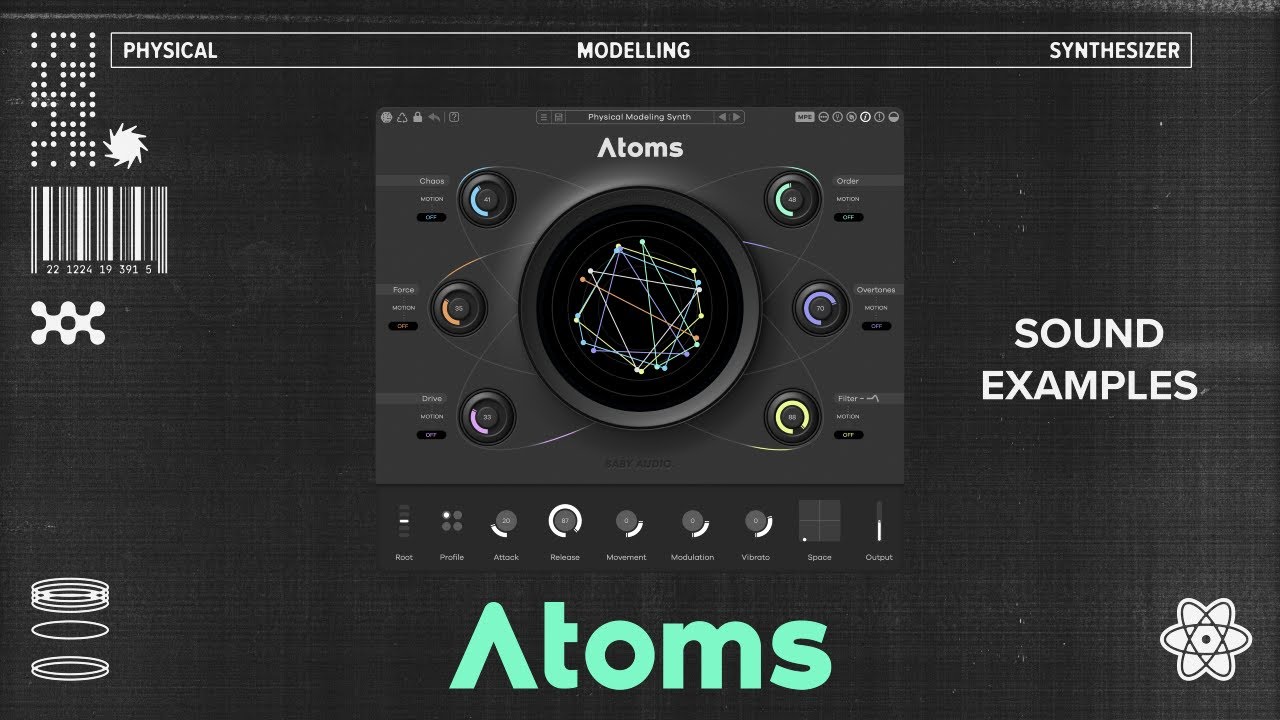
Developed in collaboration with Silvin Willemsen, a PhD in the field and co-author of several scientific papers on physical modelling, Atoms behaves like a physical instrument, with real-world properties and constraints. “And just like anything you do on an acoustic guitar or a piano will have a certain ‘sound’ to it,” says Caspar, “Atoms is the same - but still a lot more flexible than a piano or guitar. It's a physical instrument that never existed in the real world.
“There’s an eeriness to the mass spring model that reminds me of the Twin Peaks soundtrack,” says Caspar. This ‘unreal-ness’ comes from the use of physics, specifically the vibrations brought about by the movement of the virtual mass of springs.
“Physical modeling has (an) organic sound because the elements that create the sound are not statically programmed but part of a complex and chaotic network of inter-dependencies,” explains Caspar. “The result is something that sounds more like playing an acoustic instrument, but with the artificial/unreal timbre of a synthesizer."

To get the most out of Atoms, Caspar recommends reaching for it when you want an alternative to basic strings.
“Use it where you'd normally use strings and you'll have beautiful, eerie and alive textures.”
2. Anukari - "Then it does something totally weird and different. That's part of the creative process"

Another instrument that models masses and springs is Anukari, but instead of presenting as a synthesizer with the physics tucked away unseen, as with Atoms, it renders the unreal instrument in a graphic 3D space for you to interact with.
It also lets you build your own instrument structures. Like an Erector Set but one you can play, with Anukari you can assemble springs and masses and then strike them with a variety of resonators like mallets and plectrums, and then capture the vibrations via virtual microphones.
It may sound like a lot, but the visual element makes it easy to understand. If you’re still having trouble getting your head around it, inventor Evan Mezeske recommends that you just start playing around.
“The best way to learn is to find a preset that's interesting to you and start changing stuff,” advises Evan. “Disconnect something, see what happens. Grab something and move it and see what that sounds like.”
If you’re worried that you don’t understand physics, don’t be, says Evan. “I don't think you need to understand physics at all. In a certain way, we all understand physics. You know what happens if you pull a spring back.”
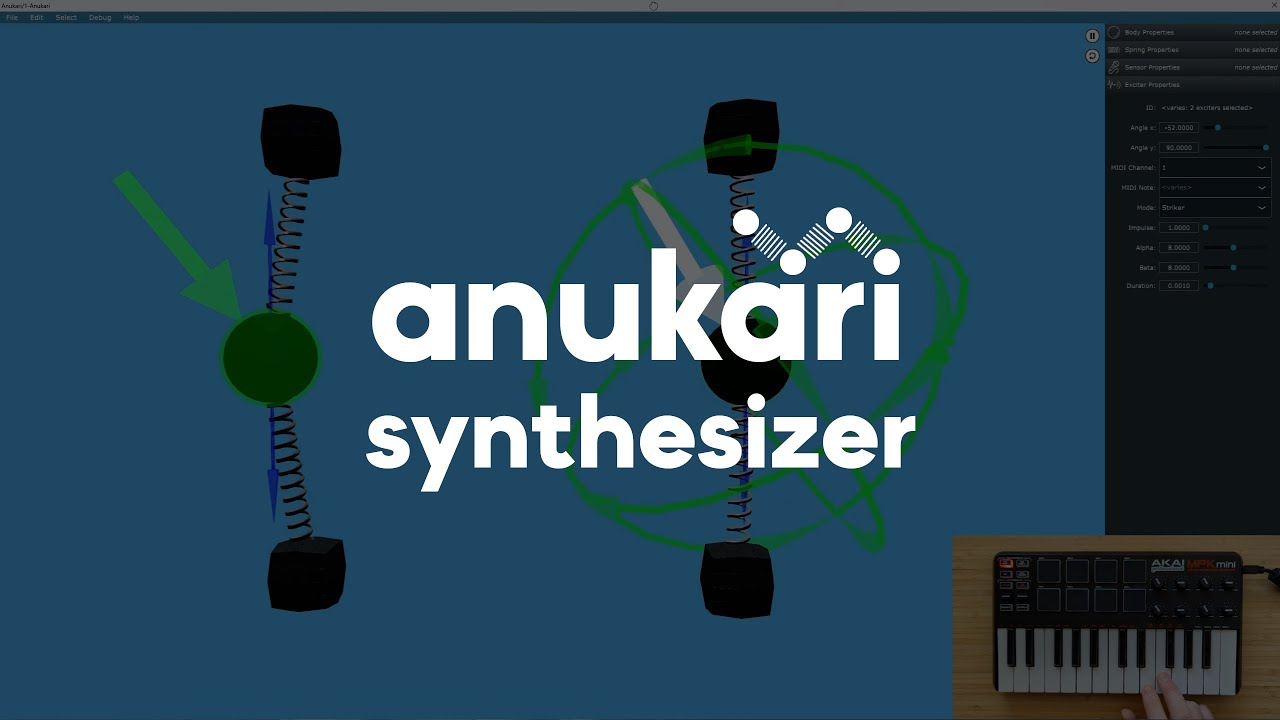
The fact that we all live in the physical world makes what happens in Anukari relatable at a fundamental level. “Even things like the LFO,” continues Evan. “It's modelled as a piston from a car, because I like cars. I grew up in an auto shop. My granddad owned one so I think of rotating pistons in an engine. It’s kind of fun, because if you don't know what a square wave is, you can just watch the animation for the LFO.”
You also don’t have to know what you want going in. Just as you might explore what happens when you bang two pieces of scrap metal together that you find in a junkyard, Anukari lets you experiment with how different physical objects relate to each other sonically.
“Sometimes I want to just mess around and see what happens,” says Evan. “The physics are good for that because there's this unpredictable, emergent nature. You build something and you think you know what it's going to do. Then it does something totally weird and different. That’s part of the creative process.”

To get the most out of Anukari, Evan suggests using it for metallic sounds, bells, and inharmonic sounds.
It’s especially good for pads with a lot of unusual harmonic motion. “With Anakari and the way the physics come out,” says Evan, “introducing a lot of energy into a system will cause it to bend out of shape in weird ways.”
You can also use Anukari as an effect, with your audio signal acting as a resonator through the springs. “I'm primarily a guitarist,” says Evan, explaining how he uses Anukari. “You're creating this resonant structure, you're playing stuff into it and you're hearing how it resonates. When you push it too hard, it distorts. The way that it goes crazy is quite unique.”
3. Unusable Engineering - "You do not need to know chemistry to enjoy fireworks"

There’s a theme that runs throughout physics-inspired plugins: unpredictability. You turn a filter cutoff knob on a traditional synthesizer, you know generally what will happen. But when you hit a mass of springs with a virtual hammer, or push audio through a distortion model based on fluid dynamics, the variables become so great that there’s no way to anticipate everything that can happen. And therein lies the potential for creative inspiration.
“When it comes to physics, I have always been drawn to visualisations of things like turbulence,” says Rasmus Nyåker, the developer behind Unusable Engineering, a software company with a whole stable of physics-powered plugins. “They are chaotic and mesmerising.”
This mesmerising chaos can be found in effects like the fluid-dynamics distortion plugin, Cavitation Fractures, and Spectral Pressure Chamber, a thermodynamic multi-band compressor.
“In all of them,” Rasmus says, “the point was not just to use science as a little visual, but to let the model itself shape the sound in ways that are a bit more organic, strange, and less predictable than the usual effect structures.”
As with Atoms and Anukari, you do not need to understand the physics at play to effectively use Rasmus’ creations.
“I do not think of them as being for people who know physics,” he explains. “I think of them as being for people who enjoy sound, movement, and a bit of uncertainty in the way things react."

In fact, because we all intuitively understand how physical properties behave, Rasmus thinks that physics-based instruments and effects might be easier to grasp than traditional music gear.
“In a lot of plugins,” he says, “you have ten knobs, you turn one, and the sound changes, but you do not really get much sense of why. By adding this simulation layer, you can actually see and hear the reaction at the same time. So even though it is, objectively, a very roundabout way of achieving an effect, I think it can actually be easier to grasp than many more conventional interfaces."

If you’re still not sure what’s happening in his plugins, Rasmus advises you to, “just go nuts. Push things around, break them a bit and see what happens. That is often where the fun starts. A lot of the plugins make the most sense once you stop treating them too carefully.”
Lastly, you don’t need to feel intimidated by the science. Because, as Rasmus notes, “You do not need to know chemistry to enjoy fireworks. The physics are not there to test anyone or make the plugins feel academic. They are there to transform sound and interaction in ways that (are) more surprising, more visual, and often more alive. If the result feels good and inspires you, that is really enough.”
4. Korg Kaoss Physics - "Make some gestures and see what happens"

So far, we’ve looked at using physics to add creativity to instruments and effects, but that’s not the extent of how developers are intertwining the laws of the universe with music production. Another area is modulation, something that Korg has explored with Kaoss Physics.
Originally developed for the hardware Modwave and later applied to Multi/Poly and the ensuing native software versions as well, Kaoss Physics takes the idea of the X/Y control environment (as used in the Kaoss Pad) and applies it to modulation.
Kaoss Physics models a ball that rolls across a virtual surface and bounces off walls.
You can also create dents and bumps on the surface to further affect the motion of the ball, with gravity and friction also playing their part. The ball’s actions generate modulation signals that can then affect parameters in the instruments.
“For all of the interesting complexity behind the scenes, for a user it’s really just a simple game controller,” says Dan Philips, Manager of Product Development at Korg R&D, about how a musician can approach programming with Kaoss Physics.
“The Korg factory sounds already have it set up to do something useful, so you can just play with it and see what happens.”
When asked how Kaoss Physics can enhance creativity, Dan answers that he thinks of it as a gesture amplifier.
“You move your finger on the pad (or launch the ball in the software), and the position, speed, and direction of that motion sends the ball into the Kaoss Physics environment,” he says. “All sorts of things may happen after that, but it’s that initial, human gesture that starts it all.”

One of the benefits of working with the environment is how many different parameters can be affected.
“It’s interesting to have a large number of different modulation signals - X and Y positions, distance, and angle - generated from a single system,” Dan notes. “That creates something like a multi-dimensional LFO or envelope, good for creating interactions between sets of parameters.”
Modulating the physics environment with the ball position can open up a lot of interesting possibilities. “For example,” he says, “check out Kaoss Physics in the Modwave sound ‘Biegerish’. The ball is slowly pulled towards the upper right corner, but when it gets there it’s quickly pushed away again. ‘Torus’ changes the X/Y tilt and the bump height as the ball moves around on the surface, creating interesting patterns of motion. ‘Orbit Wander’ changes the position of the dent, leading the ball in circles. ‘Space-Time’ slows time as the ball gets closer to the centre.”
As with the other plugins profiled here, you don’t have to be a physics professor to find the modulation system useful. “Approach it like a game controller,” Dan advises. “You don’t need to program the game; you can just play it! Play the factory sounds, make some gestures, and see what happens. Just have fun with it. Later, if you’re so inclined, you can always dig into the details under the hood.”
