
MusicRadar Verdict
A capable and versatile portable piano, the ES120 delivers impressive sound quality, a comfortable graded action, and solid connectivity in a lightweight package that works equally well at home or on stage.
Pros
- +
Comfortable, well-balanced key action
- +
Strong sound through speakers and headphones
- +
Sturdy yet lightweight build
- +
Low Volume Balance keeps tone natural at lower volumes
Cons
- -
Action may be on the lighter side for some players
- -
Button combinations not always intuitive
- -
Advanced settings require the PianoRemote app
MusicRadar's got your back Our team of expert musicians and producers spends hours testing products to help you choose the best music-making gear for you. Find out more about how we test.
What is it?
The Kawai ES120 is a portable 88-key digital piano and the successor to the popular ES110. Released in 2022, it builds on an already strong foundation with an improved keyboard action, refinements to its sound engine, enhanced Bluetooth connectivity, and a sleek visual redesign. Aimed at a broad audience from beginners and home players to gigging musicians and teachers, it sits in the mid-range portable stage piano bracket at a competitive price point.
Portability is a key feature of the ES120. Weighing only 12.5kg and measuring 130.5cm wide by 28cm deep, it is easy to transport to rehearsals or gigs and fits comfortably into most gig bags. Its design is minimal and functional, with a row of clearly labelled buttons along the top left of the instrument handling voice selection and key functions.
The ES120's keyboard features Kawai's Responsive Hammer Compact action, a fully-graded keyboard that mirrors the weight distribution of an acoustic piano, with heavier keys in the bass and lighter ones in the treble. Updated cushioning materials and revised key mechanics contribute to a quieter action and a more consistent playing experience across the keyboard, and both black and white keys feature a matte finish.
This model uses Kawai's Harmonic Imaging sound engine, with every one of the 88 keys individually sampled from the Shigeru Kawai SK-EX concert grand. Recording each note separately rather than stretching a smaller number of samples across the keyboard results in a more natural and consistent tone.

The ES120 also includes Kawai's Virtual Technician feature, accessible via the PianoRemote app, with 18 parameters covering everything from voicing and damper resonance to key volume and temperament. A Low Volume Balance function keeps the tone and touch natural at lower volumes, a useful addition for home practice.
It offers 25 built-in voices, covering all the essentials. In addition to its main piano sounds, you will find electric pianos, organs, strings, and other useful instruments such as vibraphone, harpsichord, and a bass and ride cymbal combination that is especially useful for exploring jazz styles.
Kawai’s ES120 is equipped with a dual 10-watt amplifier that powers a pair of 4.7-inch speakers, designed to provide ample volume for home practice and produce a clear, balanced sound with a convincing stereo spread. The keyboard is equipped with two headphone inputs.
Through headphones, the ES120 benefits from Kawai's Spatial Headphone Sound technology, which adds depth and dimension to the listening experience and, according to Kawai, helps reduce ear fatigue during longer practice sessions.
On the connectivity front, Bluetooth MIDI and Audio handle wireless app integration and audio streaming, USB to Host takes care of computer connectivity, and two headphone outputs alongside dedicated stereo line outputs cover both practice and performance needs. And of course, it is compatible with both PianoRemote and PiaBookPlayer apps.
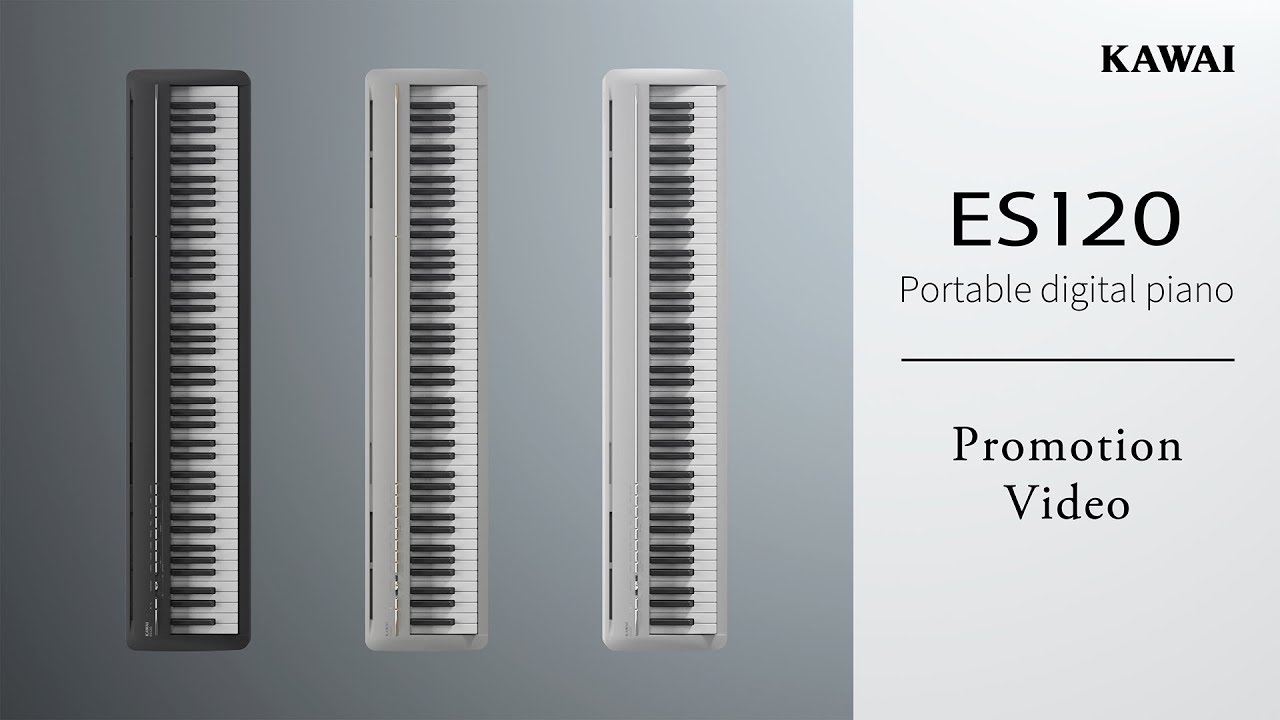
Out of the box, the ES120 includes a damper pedal and a music rest. Half-pedal support is also available when using a compatible sustain pedal. An optional wooden designer stand and matching triple pedal unit are available separately, which neatly transforms it into a compact home digital piano. The ES120 is available in two finishes: Black and White.
Performance


- Yamaha P-225 (£699): Yamaha's entry portable piano
- Roland FP-30X (£799): Roland's popular portable
- Casio PX-S3100 (£799): Casio's slim stage piano
Right off the bat, the ES120 makes a pretty strong first impression with its simple, sleek design. The control buttons sit neatly in a single row and are easy to access. Although it is lightweight, the ES120 feels solid and well-built, with a sturdy chassis and quality plastics that give it a reassuringly robust feel. It genuinely feels like it won't rattle apart on the way to a gig. However, the included damper pedal is quite basic and may not meet the needs of more advanced players. I’d say that upgrading to a better sustain pedal that supports half-pedalling is recommended to get the most out of the instrument.
The ES120's minimal button layout keeps things refreshingly simple, with direct access to the essentials. That said, navigating beyond the basics can get a little confusing without the manual, as some functions rely on button combinations that are not immediately obvious. For deeper customisation, including the Virtual Technician parameters for fine-tuning touch and tone, you will need the PianoRemote app; a reasonable trade-off that keeps the physical design clean, but worth knowing before you buy.
For me, the ES120's key action is where Kawai's expertise truly shows. The keyboard has a modest, no-frills appearance, with a plain matte finish on both the black and white keys and no simulated ivory texturing, but I don’t mind that at this price point. The touch is on the lighter side with an even response across the full range; some players may notice a slightly firm initial resistance before the action settles into a smoother feel once past that first point of contact.
Players who rely on precise pianissimo technique may need a little time to adjust. That said, playing fast and complex passages feels natural and comfortable, and Kawai has struck a good balance; the keys are neither sluggish nor overly forceful, making the ES120 a genuinely enjoyable keyboard to play at any level.
The sound of the ES120 is impressive for a portable piano and delivers a surprisingly wide, immersive tone. There is a slight boxiness to the sound that is common to beginner digital pianos, but it does not detract from what is an engaging and enjoyable listening experience at this price.


The piano sounds are responsive and organic, the electric pianos warm and colourful, and the remaining keyboard instruments feel realistic and characterful.
Now, a particularly useful feature for home players is Low Volume Balance, which automatically adjusts tone and touch at lower volumes, keeping the sound natural and responsive even during late-night practice sessions.
Personally, I think the ES120 performs particularly well through headphones. The main piano voices feel lush, warm, and detailed, and Kawai's Spatial Headphone Sound technology adds a welcome sense of space and depth to the experience, while also aiming to reduce ear fatigue during longer practice sessions; a thoughtful inclusion for an instrument at this price, for sure.
When it comes to voices, the ES120 offers a simple but well-chosen selection. The piano sounds are responsive and organic, the electric pianos warm and colourful, and the remaining keyboard instruments feel realistic and characterful. A personal highlight is the upright bass and ride cymbal combination, a fun and practical addition for anyone looking to explore jazz accompaniment.
In practice, the connectivity of the ES120 works exactly as it should. Bluetooth pairing is seamless, the dual headphone outputs are genuinely useful for shared practice or teaching, and the line outputs make plugging into a PA at a gig a straightforward affair. Everything performs reliably and without fuss, and I can’t ask for more than that.
Verdict

The Kawai ES120 is a confident and well-rounded portable digital piano that punches above its weight in almost every area. The key action is its strongest card; light and approachable without ever feeling cheap, and is comfortable enough to satisfy players at any level. The sound holds up impressively on both speakers and headphones, and the SK-EX sampling delivers a level of tonal quality rarely found at this price point.
It is not without its compromises. The plain matte key finish and the basic included pedal are the most obvious, and players with a classical background may need time to adjust to the lighter action. But these are conscious trade-offs rather than oversights, and none of them undermines what a genuinely strong package this piano is.
For a beginner looking for a first serious instrument, an intermediate player wanting something portable, or a gigging musician needing a reliable, lightweight stage piano, the ES120 makes a compelling case. At this price, it is hard to find a more complete portable digital piano.
Hands-on demos
MusicRadar
Kawai Pianos Global
Specifications
Number of Keys |
88 |
Keyboard Action |
Responsive Hammer Compact (RHC), fully graded, matte key surfaces |
Maximum Polyphony |
192 notes |
Number of Voices |
25 |
Sound Engine |
Harmonic Imaging, 88-key sampling |
Output |
20W (10W x 2) |
Speakers |
12cm x 2 |
Connectivity |
Bluetooth MIDI and Audio, USB to Host |
Available Finishes |
Black or White |
Dimensions |
Width: 1,305mm (51⅜") Depth: 285mm (11¼") Height: 150mm (5⅞") |
Weight |
12.5kg (27½ lbs) |
