MusicRadar Verdict
For players new to the world of multi-effects and amp modeling, the Mooer GE150 Max Li offers some excellent functionality, particularly with the ability to use it sans power supply. The core amp and effects tones offer a solid platform to build from, with plenty of choice on offer. It won’t impress those who’ve experienced more expensive units with a higher DSP count, though, and the NAM profile conversion leaves a lot to be desired in its current state.
Reasons to buy
- +
Solid selection of amp and effects models.
- +
Long-lasting battery operation.
- +
A lot of features for the money.
- +
Lightweight but sturdy build.
Reasons to avoid
- -
Stock presets need a lot of tweaking.
- -
NAM profile conversion significantly degrades quality.
MusicRadar's got your back Our team of expert musicians and producers spends hours testing products to help you choose the best music-making gear for you. Find out more about how we test.
What is it?
We’ve come a long way in the world of multi-effects pedals. This new dawn of battery-powered units that deliver accurate modeling, looping, drum machine capabilities, IR-loading –– and more tone options than you’ll know what to do with –– for lower and lower prices has really been something to behold over the past few years. The Mooer GE150 Max Li is very much part of this movement, delivering an incredible number of features for relatively little cash.
The GE150 Max Li gives you access to 50 amp models, 26 cabs, and 170 different effects, further augmented by the addition of 3rd party impulse response support and the ability to load NAM (Neural Amp Modeler) profiles. It’s got spillover, which lets your effect tails continue when you change presets, and an expression pedal which can be mapped to control volume, wah, and pitch effects, as well as controlling any effect parameter.

It delivers up to 9 hours of playing time on a single charge through an integrated, rechargeable Lithium-Ion battery, so you can run it without an adaptor or pedalboard power supply. It’s got a full colour 3.5-inch display, and plenty of connectivity for live players, with stereo 1/4-inch and XLR outputs, as well as a ground lift switch to deal with any extraneous noise when playing live.
Add in a stereo looper capable of 80-second loop times, 40 drum patterns and 10 metronome sounds, both adjustable via a Tap Tempo switch, and you’ve got a seriously capable, budget multi-effects pedal.
Specs

- Launch price: $259 | £207 | €240
- Type: Multi-effects pedal
- Controls: Master, select, mode, 8x footswitches
- Features: Expression pedal, rechargeable battery, looper, drum machine, ground lift switch
- Connectivity: 1x 1/4-inch input, 1x 1/8 aux in, 2x 1/4-inch outputs, 2x XLR outputs, 1x 1/8-inch output (headphones), USB-C
- Bypass: DSP bypass
- Power: 9V DC 1.5A, lithium-ion battery 2000 mAh (7.4 V / 14.8 Wh)
- Dimensions: 326 mm × 204 mm × 63 mm
- Weight: 1.73 kg
- Options: N/A
- Contact: Mooer
Build quality

Build quality rating: ★★★★½
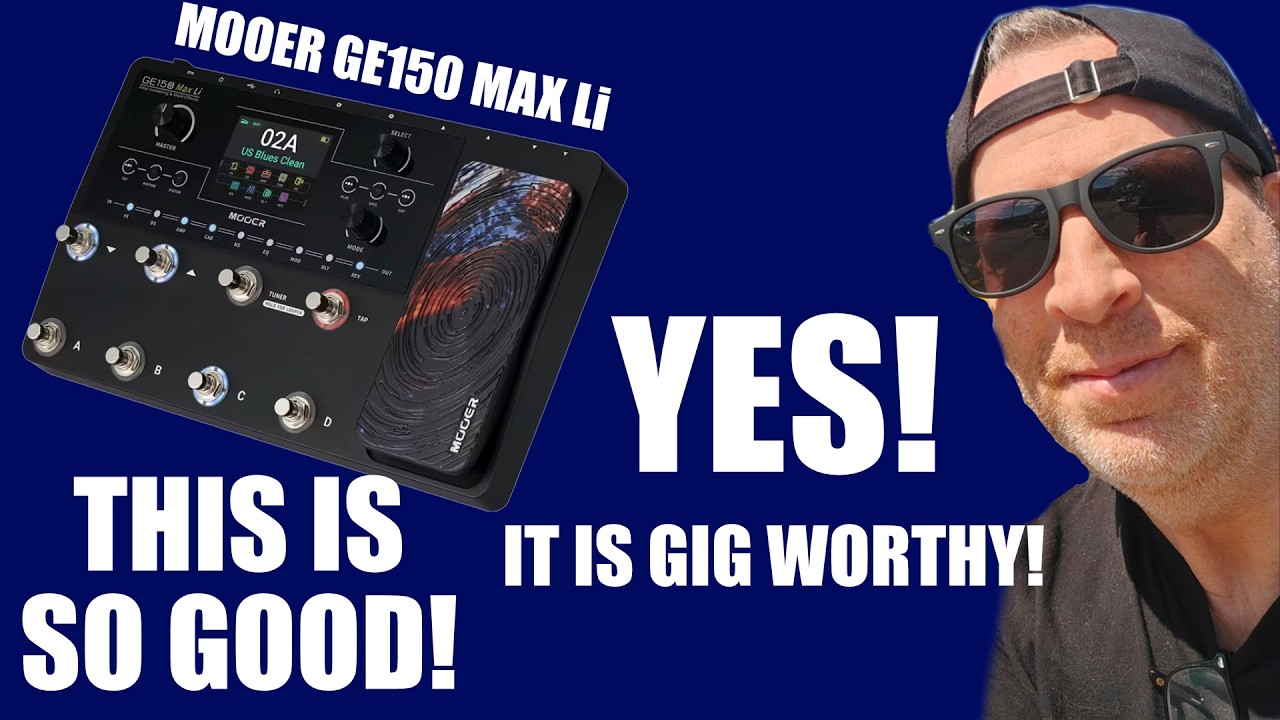
The GE150 Max Li is a fairly lightweight unit, not too dissimilar in size to the Quad Cortex. You can definitely chuck it into a backpack and not worry too much about the weight, or even a large gig bag pocket if yours will accommodate.
It’s overall pretty sturdily built, with the majority of the front face composed of a hard plastic, while the back panel is metal. The 8 footswitches offer a satisfying click that lets you know when you’ve pressed them, but doesn’t give the huge ‘clack’ you typically get from cheaper stompboxes. The expression pedal is also metal, and features a Milky Way-esque grip pattern with a similarly galactic-themed paint job.
The screen is a nice size and plenty bright even when using the unit on battery. The preset name and number are big enough to be seen when playing standing, but the coloured signal chain icons need to be seen closer up to determine what they are.
Overall, it's really well put together, and there was nothing here that worried me during my testing, even with some exuberant expression pedal use and rough stomping to simulate live playing.
Usability and features

Usability and features rating: ★★★★☆
I began using the GE150 Max Li in battery mode for my testing with a pair of headphones and a PRS SE Silver Sky, and it’s easy enough to start navigating for anyone who’s used a multi-effects before. The four lettered footswitches along the bottom each access a different preset, with Bank Up and Down switches in the top left, and the Tuner and Tap Tempo in the top right. You hold the Tuner footswitch down to access the looper.
The signal chain is displayed in two places, on the bottom of the screen and in individual white lights that run left to right underneath the screen. It would be nice if the colours of each lined up for a better visual, but at this price point I'm nitpicking.
Using the two Select and Mode rotary encoders, I start diving into the signal chain to make edits, which, as I’ll come to in the sounds section, is definitely something you’ll need to do.
A turn of the Mode knob lets you start tweaking the presets, with each turn thereafter moving across the signal chain from left to right. The corresponding light blinks on the signal chain diagram below the screen to let you know what you’re editing.
When you’re on the module you want to tweak, the Select knob moves through each setting, with a press down activating that particular parameter for you to tweak.
It’s pretty self-explanatory, and when you get to the extreme left or right of the signal chain, you’re automatically brought back to the main screen.

Each block of the Overdrives, Amps, and Cabs has exactly the same settings, so every drive has Volume, Tone, and Gain; each amp has the same six settings that can be tweaked. Weirdly, there’s a tube type setting in the Cab menu, alongside the more sensical Mic, Center, and Distance settings for tweaking your cab sound.
Each block can be engaged or disengaged by pressing the Mode button. It definitely feels unintuitive at first, moving up and down between the encoders, and I make plenty of errors accidentally exiting editing modes before getting the hang of it.
The expression pedal has a dedicated button which lets you specify exactly what you want it to do, and you can assign it to any of the parameters from any of the blocks in the signal chain. This means you can use it to ramp up the gain, delay time, or even change the distance of the mic from the cabinet, making it very useful for those who want to do changes more in-depth than just those typical volume or wah functions.
The looper is engaged by holding down the tuner footswitch, which gives you access to a typical looper configuration. Footswitch A handles the recording, playback, and overdubs, while footswitch B acts as a dedicated stop. Footswitch C lets you bring in a drum track while footswitch D exits the looper. The rhythms need to be set via the separate dedicated button beneath the Master Volume encoder, but you can quickly adjust the tempo on the fly using the Tap Tempo switch, which makes it pretty flexible.
The built-in rhythm sounds aren’t anything to shout about. All of the hits of the drum kits are at the exact same velocity, so it only takes about a minute of listening to them before my ears start to get some serious fatigue. They definitely feel like an afterthought. The metronome offers a good range of time signatures though, with 2/4, 3/4, 5/4, 6/4, 7/4, 6/8, 7/8, and 9/8 all available, making it a good option for honing your rhythm chops.

Downloading the latest firmware update so I can use the NAM profiles with the unit turns out to be a convoluted affair on my Mac. Actually finding the correct software is slightly confusing, as it tells you to download the Mooer Studio app, but the software isn't actually called this. I eventually work out that what I need to download is also labelled as the latest firmware update. I get there in the end, but it would be nice if this was more clearly marked and I didn’t have to search on Facebook to find the correct information.
I find using the software itself a bit more intuitive than tweaking presets on the hardware itself. It’s pretty basic-looking, but it does the job, allowing me to change presets and get hands with my tone with ease. Versus tweaking tones on the hardware itself, I much preferred doing it this way.
To get access to the NAM profiles, I need to install the converter plugin, which takes around a minute or so. I then have to convert the NAM profile to Mooer’s configuration, called GNR, which adds another couple of minutes to the time taken. All in all, it’s fairly painless though, with the hard work already done after navigating and installing the firmware update and associated software.
Sounds

Sounds rating: ★★★½
Before I install the firmware update and the NAM profiles, I cycle through the presets to see what’s what, and…they’re not great. It’s pretty typical with cheaper units that not much effort goes into setting up the stock presets, and these are particularly bad.
On a lot of them, the treble is piercingly high, the volumes jump around a lot, and some of them are just way off the mark considering the names, which seem to imply a certain sound - looking at you, ‘Enter Night’ preset.
Something doesn’t seem right, so I factory reset the unit to be doubly sure. I’m not sure what happened with the original unit, but now these high-frequency issues appear to have fixed themselves, making me think there was some kind of software bug present during my first play-through.
The presets still aren’t mind-blowing, though. It’s a theme I’ve found with many of the cheaper units I’ve tested from Mooer, Nux, Hotone et al.; they’re all capable of great sounds, but it doesn’t feel like someone knowledgeable or experienced has put together the presets.
There’s still some harsh high end present in a lot of the sounds, which, although not as bad as it was previously, is tough on the ears when using the single coil pickups on a Sire S7. On some of the presets, this is down to the presence being boosted unnecessarily high, whereas on others it just seems like a natural characteristic of the amp models. There’s also a lot of volume jumping between presets, which needs to be resolved if you ever wanted to use this unit live or in a rehearsal room.

Once I’ve tweaked the stock sounds, there are some really nice tones here. The Fender amp-inspired cleans do that mid-scoop thing, there’s some nice Marshall crunch tones, and some chunky high-gain Mesa and 5150-inspired stuff. They’re solid amp models that do a great job considering the price point of the unit. It’s not going to compete with flagship models of the big brands, but it can certainly get you close with some patience.
There’s some nice reaction to picking dynamics, and the edge of breakup sounds are handled reasonably accurately. The high-gain sounds are my pick of the bunch, although again with the stock presets, I found them needing a boost in the low end to get them to where they should be. It can cover a wide variety of styles thanks to the selection of amps, as alongside the classics mentioned earlier it’s packing models based on Orange, Vox, ENGL, Bogner, Two Rock, and plenty of others.
The effects are similarly a mix of mainly great but some not-so-good stuff. The drives are accurate, delivering a good selection of additional saturation options. Ditto with the delay tones; they accurately model digital, tape, and ping-pong stuff. The spring reverb leaves a lot to be desired, though, and for some reason the pitch effects are in the modulation section after the amp and didn’t track well in my testing.

The addition of NAM profiles definitely raised my eyebrow, especially considering the price point, but I was left disappointed here, too. The profiles need to be converted to Mooer’s own proprietary format, GNR, and in this process there’s a huge loss of audio quality. Uploading three of my favorite NAM profiles that I know intimately - a Fender DRRI, Marshall JMP 50, and an EVH 5150 - the conversion process has compressed the life out of them.
They’re noticeably quieter than the stock presets even with the volume dimed, and are a shadow of the tones that I’m used to, sounding much less dynamic and lifelike than the stock presets.
It’s unfortunate, because I was quite looking forward to seeing if those on a beginner budget could get access to some of the best profiled tones around at the moment. However, it seems like we’ve still got a little way to go before we can get them sounding their best on units with lower DSP power.
Verdict

I went into my testing of the Mooer GE150 Max Li with very high hopes. It ticks a lot of boxes with its rechargeable battery operation, NAM compatibility, built-in looper, expression pedal, and typical amp and effects modeling capabilities. It does some of these really well, and others less so, making it a bit of a mixed bag overall.
For its core audience, beginner players and those on a budget, it handles the basics well. You get some good-sounding amp and effects models once you’ve tweaked them a bit, and plentiful features like a usable looper, built-in tuner, and battery operation, which is a real boon for keeping things neat at home.
It’s got pretty much everything the beginner player needs to get up and running, done at good enough quality that it’ll take you from first riffs to first gigs.
It’s a shame, then, that the stock presets aren’t particularly well done
It’s a shame, then, that the stock presets aren’t particularly well done, and that the NAM profiles suffer some serious degradation during the conversion process. This may well be something that Mooer can iron out with further firmware updates in the future, but for now, the NAM compatibility doesn’t give it any huge advantage over units from Mooer, Hotone, Boss, etc.
The battery life, on the other hand, is really impressive. I play-tested it for a good 3 hours, and it only decreased by a single bar, so Mooer’s claim of up to 9 hours of life appears not to be hyperbole. It also means if paired with a wireless guitar system, you can get totally cable-free operation, which is super handy considering that most of its target audience will be practicing at home with the unit.
MusicRadar verdict: For players new to the world of multi-effects and amp modeling, the Mooer GE150 Max Li offers some excellent functionality, particularly with the ability to use it sans any power supply. The core amp and effects tones offer a solid platform to build from, with plenty of choice on offer. It won’t impress those who’ve experienced more expensive units with a higher DSP count, though, and the NAM profile conversion leaves a lot to be desired in its current state.
Test |
Results |
Score |
|---|---|---|
Build quality |
Very well put together and lightweight |
★★★★½ |
Usability and features |
Lots of great features, some executed better than others |
★★★★☆ |
Sounds |
Good enough for a beginner ear, but lacking in depth |
★★★½ |
Overall |
A solid multi-effects pedal for not a lot of money |
★★★★☆ |
Also try
Rock Mixer