MusicRadar Verdict
Obviously the amps and IRs are the star of the show, and NAM A2 support pushes this to the next level. Even so, if you have a decent amp, there's enough variety and depth of effects in the Stage to justify integrating it into an existing rig.
Pros
- +
Great core sounds.
- +
Intuitive user interface.
- +
Includes Celestion models.
- +
Includes more out-there effects.
Cons
- -
No built-in expression pedal.
MusicRadar's got your back Our team of expert musicians and producers spends hours testing products to help you choose the best music-making gear for you. Find out more about how we test.
What is it?
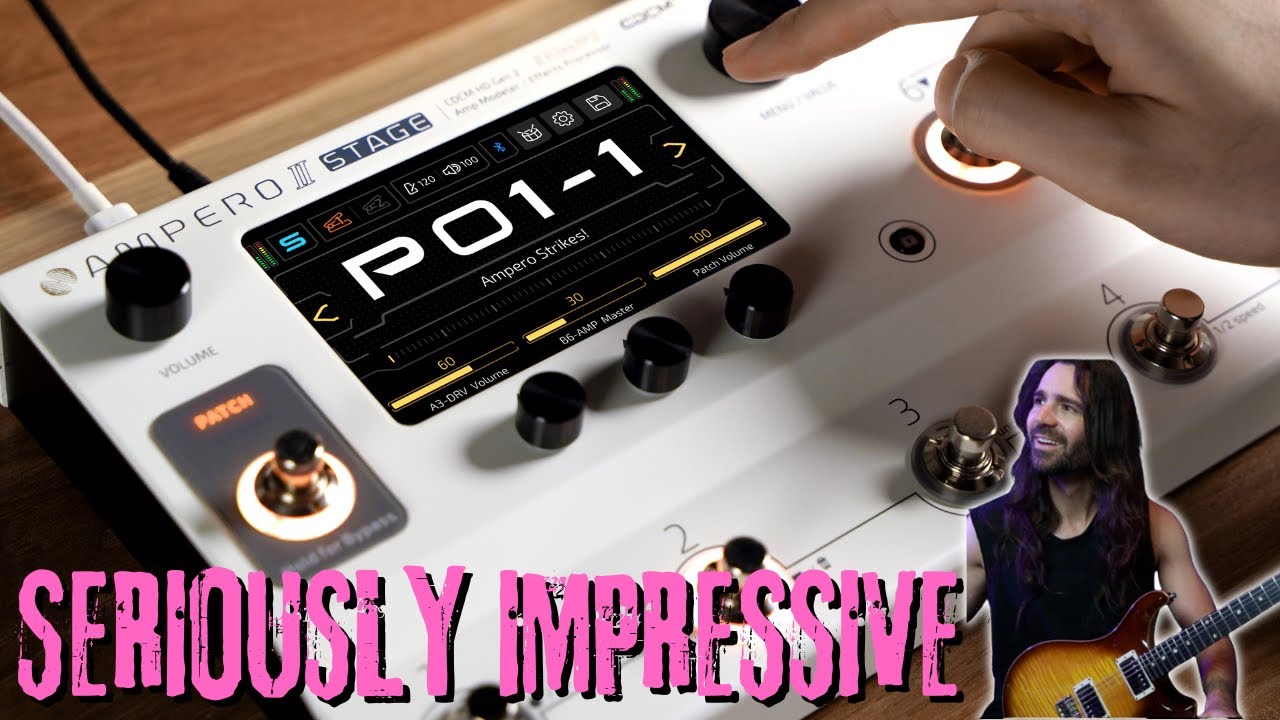
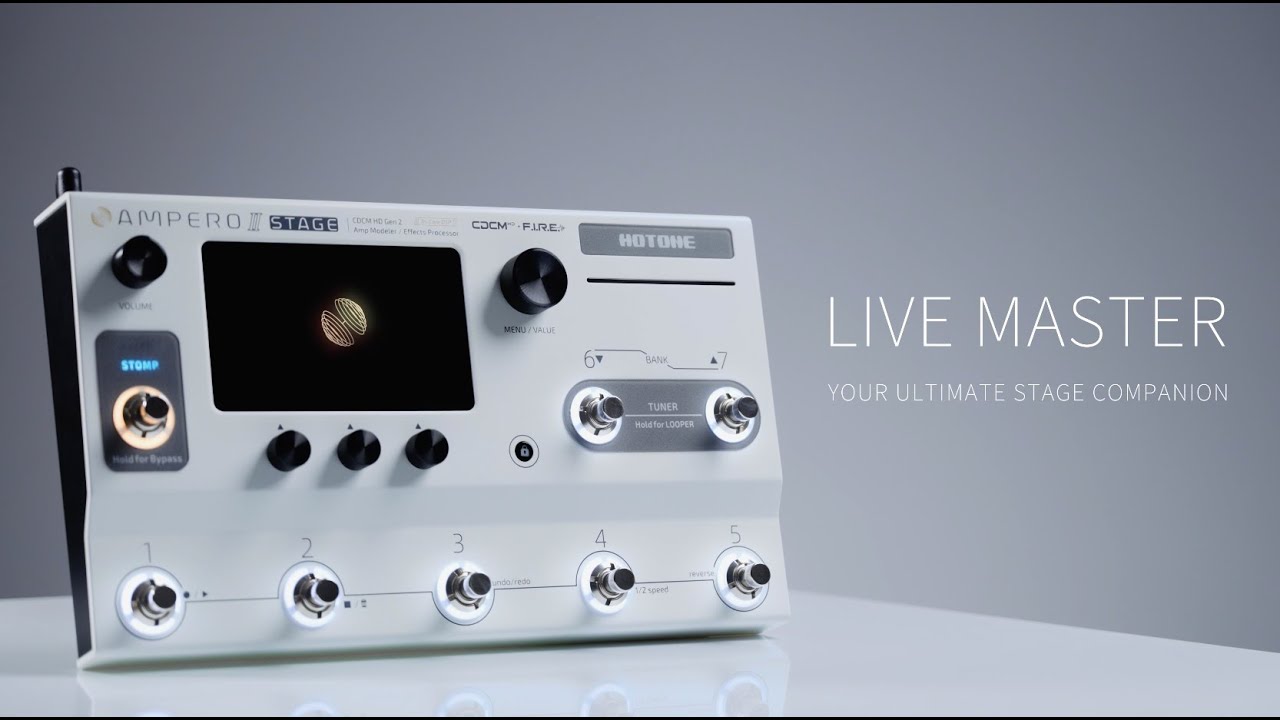
Following on from its successful second-generation Ampero floorboard, Hotone has released the Ampero II Stage.
It includes a streamlined back panel and new features enabled by Bluetooth and a companion app. Aimed at live players, it pairs twice as many footswitches with the same dynamic UI and large touchscreen.
Specs

- Price: $559 | £699 | €599
- Type: Multi effect and amp modeller
- Controls: Volume, Menu, 3 parameter rotary encoders, 8 LED footswitches, Lock button
- Features: 8-in/8-out audio interface with 460+ effects, amps and models
- Connectivity: Stereo in/out, FX send/return, 1/8" aux In, 2x expression In, 1x XLR in, 2x balanced out, ground lift, MIDI in/out/thru, USB-C
- Bypass: Buffered
- Power: 9-18V Power supply (included)
- Dimensions: 301mm x 58mm x 180mm
- Weight: 1895g
- Contact: Hotone
Build quality

Build quality rating: ★★★★★
Like you'd expect from any flagship floorboard, the Stage is solidly built, with good attention to detail. Unlike the first efforts at touchscreens on floorboards, the Stage's doesn't feel fragile or slow to respond.
Instead, it's intuitive, and means I don't need to reach for the manual at any point to dial in some great-sounding patches.
Compared to the Ampero II floorboard, there's space for another expansion footswitch. However, that's in exchange for the loss of the built-in expression pedal.
Usability and features

Usability and features rating: ★★★★★
The audio engine is the same as that found in the Ampero II which has already been available for some time. The main differences are in build and control functionality. On the build side, the Stage has some major usability improvements.
The Ampero II relies on a touchscreen and two rotary controls, whereas the Stage has three mini rotary encoders underneath the screen. On top of that, there's the same 2 large rotary encoders, and eight LED footswitches versus the original 4. Although it seems initially a bit pointless, the metering bar LED is very useful, especially when using the Stage as an audio interface.

One of the big selling points of the Stage is Bluetooth and app control, but it's unclear how many players are crying out for these features.
I've always suspected that most prefer user experience improvements in hardware or firmware rather than external software, which can feel distracting or gimmicky.
Like the Ampero II, the Stage has stereo input and output, and it's straightforward to make wet/dry or stereo patches.
Sounds

Sounds rating: ★★★★½
The stock patches are surprisingly good as starting points. There's the standard 'clean' options, as well as EVH 5150 patches, 80s metal, grunge, and specific presets that nod to bands like Tool, Pink Floyd and A Perfect Circle.
With a trusty pair of AKG reference headphones it's easy to dial in a modern rock sound and knock out some riffs, rhythm parts, and leads. Moving to a patch with more gain finds decent chug on tap with higher-output Ibanez pickups.
True 'djent' or modern progressive metal requires more tweaking, and some careful EQing. Tele and Les Paul single coils and 'buckers, meanwhile, sound as you'd expect from Fender-style cleans, all the way to Peavey high gain. As standard, many of the patches don't filter low-end rumble, and on most, I end up throwing on a gentle high-pass at around 70Hz to tame the low end.

The headphone experience carries over straightforwardly to audio interface use. Helpfully, there's a USB-C cable in the box with an appropriate USB-A adaptor. Even if you already have a drawer full of cables at home, it's still a nice touch for a flagship unit.
There's the ability to load IRs externally, or import them from user-uploaded IRs, but IR option paralysis finds me mainly using the stock IRs or the included Celestion cab models. I'm a sucker for a closed-back 2x12, and the models do not disappoint.
Should you want to use NAM A2 captures – and you probably should - then there's a firmware patch to support loading these on the Stage. There's 30 slots available, and you can import directly via the software editor or the Tone3000 library. Due to the processing overhead, you can only run a single NAM capture, but there's no noticeable latency, and they respond well to the other effects.
Moving to a real tube amp results in a fair bit of wrangling, as you'd expect. Plugging directly in to the front panel means disabling all the models and re-EQ'ing at a minimum. Still, I generally prefer this to using the effects return. After all, we own the amps we do because we like the sound of them!
Into a Marshall half-stack, the Ampero has enough gain to kick it into greater saturation, but the most satisfying results come from gain pedals within the pedal. The Tube Screamer and Klon sound as you'd expect, though there's something not quite right about the Rat model to my ear. The Guv'nor, on the other hand, sounds great, and is nearly indistinguishable from the real thing.

Running in a hybrid setup with 'real' pedals, the Stage stacks well with other overdrives. However, it is likely to be at the end of the chain, making this less useful unless you play around with the send-return options. As my rig isn't completely set up around the Stage, I find myself mainly using it for EQ, delay, mod and the amp blocks, with my drives, wah, and pitch-shifters in front.
On the effects front, the Ampero is a generation beyond the original Line 6 Helix units that threw at least a few token weird effects into the mix. Of course the standard effects are present, with excellent BBD, TC 2290, and tape delay emulations.
However, there's also a glitch delay that recalls the Red Panda Particle, and pitch-shifted ducking delay pedals that veer into weirdo, boutique territory. Going as far back as the old BOSS floorboards and VOX ToneLab, it's these little hidden weird settings that tend to deliver the most unexpected, creative moments.

The Stage makes it easy to access the Looper, and it has one of my favourite features, reverse, always-accessible via footswitch, as well as half-time playback. These are two of my favourite things about the usability of the Ditto X2, and it's great to see them here.
Finally, it's a minor thing but the ability to bypass the whole board is super useful when you're practicing with a real amp. You have to hold to bypass, so I don't know how useful this is live, but I ended up using it while jamming to change to a totally clean guitar tone. In a practice space, I'm sure my bandmates would thank me for doing that at the end of a heavier song.
Verdict

For its price point, it's hard to fault
For its price point, it's hard to fault the Ampero II Stage. Like most modern modellers it's indistinguishable from a real amp, especially when recorded, and the Stage is a big user experience improvement over the original Ampero II. That is, unless you needed a built-in expression pedal.
Though perhaps modelling units are well into the territory of marginal gains at this point, it's still satisfying to see a solid unit coming out at an accessible price-point.
MusicRadar verdict: Obviously the amps and IRs are the star of the show, and NAM A2 support pushes this to the next level. Even so, if you have a decent amp, there's enough variety and depth of effects in the Stage to justify integrating it into an existing rig.
Test |
Results |
Score |
|---|---|---|
Build quality |
Built tough and rugged, bright touch-screen and fast to boot up. |
★★★★★ |
Usability and features |
No onboard expression pedal is the only minus but you can easily connect one. |
★★★★★ |
Sounds |
A superlative range of tones plus NAM A2 support. |
★★★★½ |
Overall |
Hotone antes up with a flagship unit that has great sounds, is roadworthy and stacked with features. |
★★★★★ |
Also try
Hands-on videos
Hotone Audio
John Nathan Cordy
Leon Todd