MusicRadar Verdict
It’s difficult not to be impressed with the M-Audio Forty Sixty. Anyone seeking a substantial upgrade without a substantial financial commitment should have these firmly on their shortlist.
Reasons to buy
- +
Powerful, expansive sound
- +
Excellent value for money
- +
Versatile connectivity options
Reasons to avoid
- -
Large, heavy cabinets
- -
Some functionality is arguably not necessary
MusicRadar's got your back Our team of expert musicians and producers spends hours testing products to help you choose the best music-making gear for you. Find out more about how we test.
What is it?
There’s a certain point in every home studio’s evolution where the limitations of smaller speakers become difficult to ignore. You can only ask so much of a compact set of budget monitors, particularly when you’re working with bass-heavy music or need something capable of filling a larger room. With its Forty Sixty monitors, M-Audio is offering a relatively affordable route to something altogether more substantial.
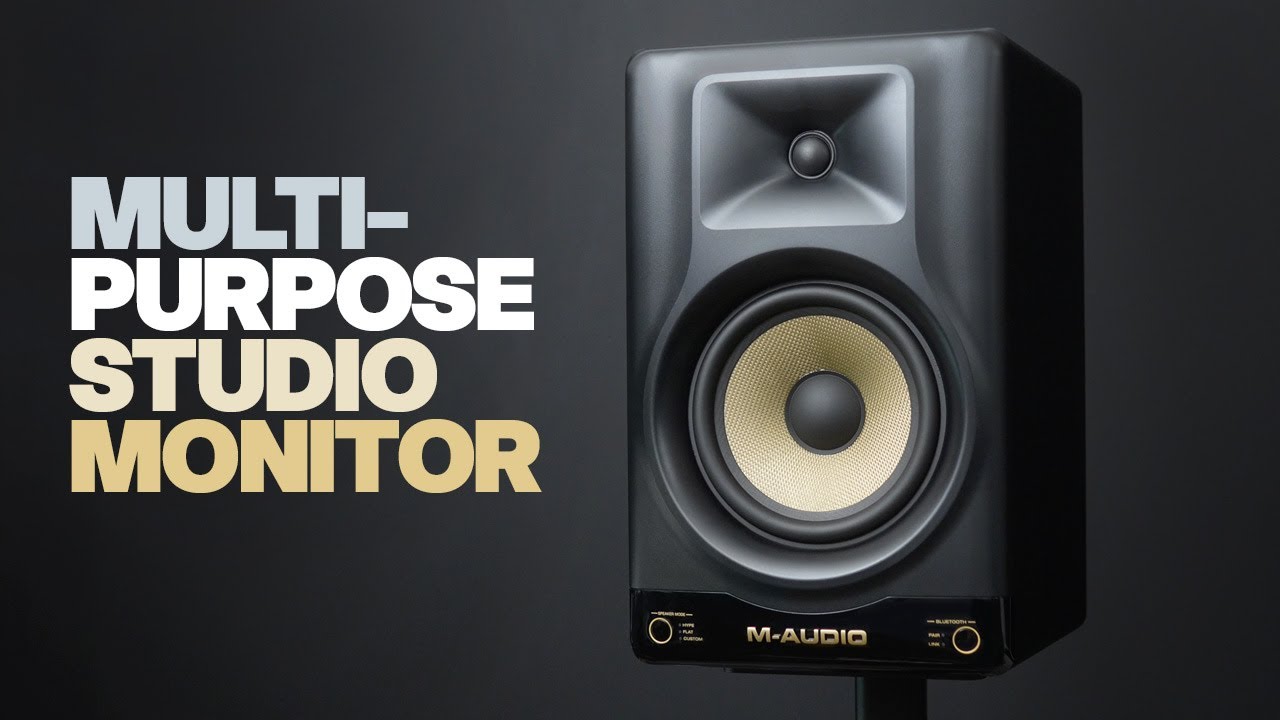
The Forty Sixty is a two-way active studio monitor built around a 6.5” Kevlar woofer and a 1” soft dome tweeter. Each speaker has its own 100W Class AB bi-amplification system, split between 60W for the woofer and 40W for the tweeter, with a rear bass-reflex port helping to extend low-frequency response. Internally, M-Audio has also incorporated some fancy DSP-based crossover and equalisation to help it thrive in different listening situations.
Where the Forty Sixty differs from more conventional studio monitors is in its willingness to embrace features usually associated with consumer audio equipment. Bluetooth 5.3 connectivity, for example, allows wireless playback from a phone or tablet, while a dedicated button on the front panel provides quick access to different listening modes, including ‘Flat’ for flat-frequency response studio work and ‘Hype’, which provides a more flattering output designed for gaming, movies or regular music listening. There’s also a custom setting, accessible through a companion app, which incorporates a five-band EQ for tailoring the sound to individual preferences or room characteristics.
For conventional studio duties, connectivity comes courtesy of balanced XLR and quarter-inch TRS inputs, with a rear-mounted level control. At 335mm tall and weighing over seven kilograms each, these are large speakers, particularly if you’re graduating from smaller desktop monitors.
The overall proposition is straightforward though. Heavy-duty amplification, larger drivers and modern connectivity, all at a price that puts the Forty Sixty within reach of home producers looking for a more capable monitoring setup.
Features & performance

Coming from a pair of 5” monitors, namely the trusty M-Audio BX5 D2 I’ve been using for donkey’s years, the first thing that struck me about the Forty Sixty was their sheer physical presence. These are relatively large speakers, and positioning them in my studio required a little more consideration than I’d anticipated. In fact, their weight was enough to make my generic metal speaker stands wobble slightly under the weight, although that probably says more about my habit of cheaping out on the non-exciting parts of my studio than the speakers themselves. Either way, you’ll want to make sure you have somewhere suitably sturdy to place them.
Once everything was connected, however, the benefits of larger cabinets and drivers became immediately apparent. The Forty Sixty sounded phenomenal in my studio, providing a sense of scale and authority that represented a significant improvement over the smaller monitors I’d been using previously.
Most of my testing involved a MacBook Pro, connected through a Native Instruments Komplete Audio 6 interface and running Ableton Live 12 and IK Multimedia’s excellent Tonex amp simulator, providing a familiar setup for evaluating the speakers across music production and everyday listening tasks. I also connected a Eurorack modular synthesizer, giving the Forty Sixty pair an opportunity to handle a different type of sound source.
The M-Audio Forty Sixty stand out through their combination of features and their pricing
Across these more traditionally studio-based applications, the speakers performed superbly. I had in mind the smaller speakers I was used to and found the difference was almost night and day. There was much more clean headroom, and the greater low-frequency capability was particularly welcome, giving bass tracks on a song I’m working on in Live much more definition which, in turn, made mixing much easier.
Likewise, the overall experience felt far bigger and more rounded than I was used to from my previous setup. Testing out some streamed video content - Visionquest, if you’re interested - demonstrated a much broader sonic palette too although, realistically, these are likely to be pure studio monitors in my possession rather than do-it-all speakers. Nice to hear the difference a larger speaker can make in everyday life though.
Of course, it’s important to distinguish between a speaker that sounds impressive, and one that provides an accurate reference for mixing. Larger drivers and greater bass extension can make an immediate difference to how enjoyable music sounds, but room acoustics, speaker position and familiarity remain just as important when making critical production decisions. Here, the Forty Sixty pair made a compelling case for moving up from a smaller monitoring system. It’s everything you think you’ve heard previously, only more of it.

Connectivity is another strength. The balanced analogue inputs made integration with my existing studio equipment straightforward, as you’d expect, while the Bluetooth is a useful thing to have alongside. I also like that the pairing button is on the front, not hidden away round the back of the unit. Would I use the Bluetooth functionality regularly? Probably not. My studio is primarily a music-making space, and a wired connection through my interface remains the obvious choice for recording and production. Bluetooth introduces latency, making it less suitable for time-critical monitoring, but it’s handy for casual listening or checking material from another device.
I felt similarly about the selectable listening modes. Being able to switch between Flat and Hype modes from the front panel is convenient, and the additional custom EQ functionality adds flexibility. However I suspect many users with dedicated studios will set-and-forget their chosen mode and rarely, if ever, change it.
Competition is strong in this category. While a step up in price is clear, Adam Audio’s T7V offers a 7” woofer and the brands’ distinctive U-ART tweeter, while KRK’s Rokit RP7 G5 combines a 7” driver with extensive DSP equalisation options. Pioneer’s VM70, meanwhile, provides similarly sized drivers and flexible voicing options, particularly for producers and DJs. All three deserve consideration, however the M-Audio Forty Sixty stand out through their combination of features and their pricing. For someone upgrading from basic monitors, or looking to equip a slightly larger studio without spending a fortune, the Forty Sixty makes a persuasive argument.
Final verdict
The M-Audio Forty Sixty shows you can buy a lot of monitor for not a lot of cash, relatively speaking. With powerful amplification, large drivers and a surprisingly comprehensive feature list, they deliver an experience that feels considerably more ambitious than the price might suggest.

- Adam Audio T7V
- KRK Rokit RP7 G5
- Pioneer VM-70
For me, the biggest revelation was the improvement over my previous 5” monitors. Pound for pound, the old speakers have done well over the years but the additional scale and low-frequency presence made working with synths, tracking guitars and mixing a much more pleasurable experience. That alone makes them a compelling upgrade for anyone who feels they’ve outgrown a smaller monitoring setup.
There are compromises. These speakers need space and appropriate support, and their size might make optimal placement more difficult if your space is smaller. Likewise, some of the headline features might prove unnecessary in a dedicated production environment.
Bluetooth and selectable EQ modes are welcome conveniences but they’re unlikely to change the workflow of someone who already has a well-established studio setup.
Still, those extras don’t detract from the fundamentals. The M-Audio Forty Sixty offers impressive sound, straightforward connectivity and enough flexibility to appeal to producers, creators and enthusiasts alike.
Specifications
- Type: Two-way active nearfield studio monitor
- Woofer: 6.5-inch / 165mm Kevlar
- Tweeter: 1-inch / 25mm soft dome
- Amplification: 100W per speaker, bi-amplified Class AB (60W LF / 40W HF)
- Frequency response: 39Hz–22kHz (-10dB)
- Maximum SPL: 113dB
- Inputs: Balanced XLR and 6.35mm TRS
- Wireless: Bluetooth 5.3, True Wireless Stereo
- Processing: DSP crossover, Flat/Hype/Custom modes, app-based five-band EQ
- Enclosure: Rear-ported, vinyl-wrapped MDF
- Dimensions (H × W × D): 335 × 216 × 218mm
- Weight: 7.2kg per speaker
- Contact: M-Audio
Hands-on demos
Gear4Music

Taps Das