If you play an electronic drum kit that you like the sound of and you’ve so far only listened to it through headphones, adding a monitor to your rig is the logical next step. In this guide I’m going to talk you through the best electronic drum amps and monitors to suit your budget.Once an afterthought, a drum amp or monitor has become an essential part of the electronic drummer’s setup. It makes sense. Why spend all that money on an e-kit only to hear it through headphones? One need only look at modern recording and rehearsal studio setups to see how important proper monitoring has become.
A good monitor can deliver the punch of your kick, the crack of your snare and weird electronic textures without everything turning to audio mush. Some electronic drum amps are designed specifically for this job, while there are also PA speaker systems that happen to work brilliantly with e-kits.An electronic drum amp can be useful for far more than just practising, too. If you're rehearsing with other musicians, playing live or simply want to hear your kit without being sealed off from the world, good monitoring makes a huge difference. And with everything from tiny personal monitors to powerful 12-inch PA-style speakers available, there are options to suit all sorts of setups, rooms and budgets.
Right now the best of the bunch is the Alesis Strike Amp 12 Mk2, delivering the ideal balance between power and crisp sound out of the box. If you’re on a budget, the SubZero DR-60 is an affordable home practice tool.
Best overall

✅ Buy if: You want the best and most versatile electronic drum monitor around
❌ Don't buy if: You mainly play at home and don't need enough power to shatter a brick wall.
The original Strike Amp 12 was already one of the easiest recommendations in this category, so it's nice to see Alesis improve upon it. The MK2 now delivers 2,500W of peak power through a 12-inch woofer and high-frequency compression driver, while keeping the relatively lightweight design that made the original so popular.
It's also extremely versatile; I even had to use one as a DJ monitor once, and it worked perfectly! It’s a versatile beast, too: you can use it as a floor wedge, stand it upright or pole mount it, while the two inputs mean you can connect more than just your drum module. Bluetooth has also been added on this version, which is handy for playing along to tracks or just blasting some music before rehearsal. Alesis has also improved the ground noise rejection and EQ contouring.
The main thing to remember here is that this is a proper PA-style speaker. It isn't designed specifically to sit next to an electronic kit like the Roland PM range, but that's also what makes it so useful. There's plenty of headroom for rehearsals and live work, and the XLR output means you can link another speaker if you need more coverage.
With this level of power, it's potentially overkill for someone who just wants to practise quietly in a bedroom. But if you want one speaker that can handle home practice, rehearsals and live performance without leaving you wishing you'd bought something bigger, this is a very easy recommendation.
Best budget

✅ Buy if: You just want one affordable amp that can handle your drums plus other musicians.
❌ Don't buy if: You need something lightweight or portable.
This rugged 60-watt amp from SubZero boasts a large 12” speaker along with 3-band EQ and a host of separately controlled inputs. That means you can use it for much more than just your electronic kit. Plug in a microphone, keyboard, backing track or another sound source and you've suddenly got a little rehearsal amp that can handle several musicians at once. There's also a 12-inch coaxial speaker, 60W of power and a three-band EQ.
In addition to a dedicated 1/4” jack e-drums input, there is also another one for a separate line input (ideal for bass guitar or keyboard) and an XLR microphone input - all mixed independently.
The ability to run three sound sources independently makes the DR-60 ideal for practicing with other musicians and is a particularly welcome addition at such a low price point. It's fairly heavy at 20kg though, so again: lift with your legs, not your back!
Best compact

✅ Buy if: You want the smallest, simplest way to get your electronic kit out of headphones.
❌ Don't buy if: You need big low-end or enough volume to play with a band.
The Alesis Nitro Amp is so cute! It’s almost comically small compared with some of the other monitors here. That’s the whole point, though. This 1.5kg speaker is designed to mount directly onto compatible Nitro drum racks, giving you a personal monitor without taking up any extra floor space.
It has a 3-inch full-range driver, 70W of peak power and a maximum SPL of 98dB. That makes it much more suited to personal monitoring, lessons and bedroom practice than full-band rehearsal, but for that purpose it makes a lot of sense.
The variable-angle mounting lets you point it straight towards yourself, while the single balanced/unbalanced input keeps things nice and simple. It's also mono, so don't expect the spacious stereo image you get from something like the Yamaha MS45DR. This is a tiny way of getting your kit out of headphones when space is at a premium, and at 1.5kg, your bandmates can’t hate you for it.
Best for bass

✅ Buy if: You want a powerful, dedicated electronic drum monitor with plenty of low end.
❌ Don't buy if: You’re not an Olympic weightlifter.
The Roland PM-200 is the flagship V-drums monitor for good reason. It’s about as close as you can get to a dedicated electronic drum monitor without simply buying a speaker designed to sit inside the kit. It has 180W of power, a custom 12-inch speaker and horn tweeter, with an angled cabinet designed specifically for the seated drummer.
There's also a quarter-inch and 8th-inch line input, so you can connect another electronic instrument, phone or music player and play along. There's an integrated mixer too, with independent volume controls and bass and treble adjustment. Two XLR direct outputs make the PM-200 useful on stage as well, allowing you to send your sound to a mixer or recording device while still using the speaker as your personal monitor.
The downside is fairly obvious: at 21kg, it is an absolute beast. Gigging musicians be warned: your bandmates will hate you. Lift with your legs, kids…
Best compact PA-style

✅ Buy if: You want serious volume from a smaller, more portable speaker.
❌ Don't buy if: Big, room-filling low-end is your main priority.
A more portable version of the Strike Amp 12 at number one in this guide, this one uses a smaller 8” woofer rather than 12”. It does however feature the same powerful 2000-watt amplifier as its big brother.
The smaller cabinet makes it considerably easier to move around, although you obviously lose some low-end compared with the 12-inch model. That isn't necessarily a bad thing, especially if you're looking for something to use in a smaller rehearsal room or as part of a stereo setup.
It's still a lot of power for an 8-inch speaker, so don't mistake "compact" for "quiet". This is a proper little PA speaker that happens to work particularly well with electronic drums, and the pole mount and wedge positioning mean it can be used in a few different ways.
Best for live

✅ Buy if: You’re a pro drummer who needs to feel “in the room” at every gig.
❌ Don't buy if: You're looking for a conventional speaker to hear your whole kit through.
If this product were half the price, it would be higher up the list. The BC-X is the odd one out here, but in a good way. Instead of simply blasting your electronic drums through a speaker, it uses a tactile transducer inside the throne top to physically transmit the low end through your body. In other words, you don't just hear the kick drum, you feel it… yup.
The system consists of a compact amplifier engine and a 13-inch round throne top, with the whole thing designed to give you the physical sensation of an acoustic kit without needing to turn the volume up. Porter & Davies says the BC-X delivers around 75 to 80 percent of the performance of its larger systems, which is plenty for most players.
Best e-drum specific monitor

✅ Buy if: You want a simple, dedicated electronic drum monitor for home use.
❌ Don't buy if: You need something powerful enough for full-band rehearsals or gigs.
The PM-100 is essentially the PM-200's smaller sibling. If you have the money and don’t mind lifting an entire car’s worth of mass every time you want to reposition your amp, get the PM-200.With that said, for plenty of home players this probably will be the more sensible option. It delivers 80W through a 10-inch woofer and 2-inch tweeter, with an angled cabinet designed to point the sound directly towards a seated drummer.
There's an integrated mixer with separate drum and line inputs, plus bass and treble controls, so you can connect your kit and play along with music without needing another mixer. Roland also includes a dedicated V-Drums input, although you aren't restricted to Roland equipment, which is nice.
The cabinet is considerably smaller and lighter than the PM-200 too, although at 13.5kg it's definitely not the lightest option of the bunch. There's no direct XLR output either, so this is much better used as a solid personal monitor.
Best stereo

✅ Buy if: You want your electronic kit to sound more like a proper stereo drum setup at home.
❌ Don't buy if: You need something loud enough for rehearsals or live performance.
Every now and then those cats over at Yamaha Japan like to do things their own way. The MS45DR takes an interesting approach by giving you a complete 2.1 monitoring system rather than one wedge speaker. You get two 20W satellite speakers and a 20W subwoofer, with the satellites designed to mount directly onto compatible electronic drum racks.
That gives the MS45DR a much more immersive feel than a single mono monitor, particularly if you're sitting directly in the middle of the system. The subwoofer handles the low end while the satellites take care of the mids and highs, giving you a much more convincing approximation of an acoustic kit in the room.
The satellites are designed to work with the 1.5-inch tubing found on many electronic drum racks, and the system comes with the cables needed to get everything connected. There's also a separate bass control on the subwoofer, which is handy for getting the low end where you want it.
It's primarily designed for home use and doesn't have the power or flexibility of, say, the Strike Amp 12, but that's not really what Yamaha is going for here.
How to choose the best electronic drum monitor for you
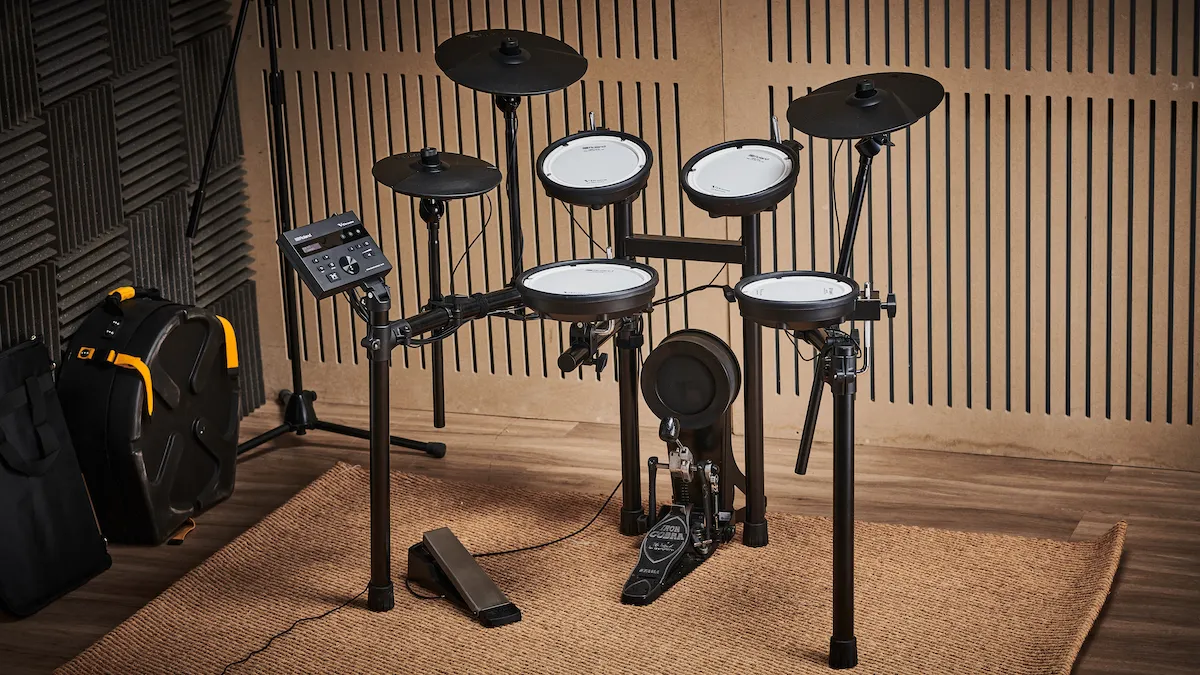
If you're just looking to get away from headphones at home, you don't need a 2000W PA speaker. Something like the Roland PM-100, Yamaha MS45DR or the cute little Alesis Nitro Amp will give you plenty of volume without taking over the room.
If you're rehearsing with other musicians or playing small gigs, you'll probably want something with a bit more headroom, such as the Laney DH80 or Alesis Strike Amp 8.
For proper live work, power becomes much more important. A 12-inch speaker will generally give you more low-end authority than an 8-inch model, while something like the Strike Amp 12 MK2 gives you enough headroom to compete with other instruments. Connectivity matters too, particularly if you're planning to run backing tracks, another instrument or send a feed onwards to the PA.
Then there's the question of stereo. A single monitor will generally give you a mono signal, which is absolutely fine for most drummers, but a stereo system such as the Yamaha MS45DR can make your electronic kit feel much more spacious. You could also use a pair of PA-style monitors if you have the room and budget.
Finally, have a think about whether you actually want to hear your kit, just feel it, or both. The Porter & Davies BC-X doesn't work like a conventional speaker at all, but for drummers who miss the physical impact of an acoustic kick drum, it’s a game changer.
FAQs
Can I use any amp with an electronic drum kit?
Pretty much. You don't have to match the brand of your electronic kit and monitor. The important thing is making sure the connections are compatible and that the speaker can reproduce the frequency range of an electronic kit properly.
Do I need a special amp for electronic drums?
Not necessarily. PA speakers can work extremely well with electronic drums, and are often a better choice if you want something powerful and versatile. Dedicated electronic drum monitors are usually voiced specifically for the frequencies and dynamics of an e-kit, though, so they can be a particularly easy solution for home use.
How many watts do I need for electronic drums?
It depends entirely on where you're playing. For bedroom practice, 30 to 100W can be more than enough. Rehearsing with a band or playing live requires considerably more headroom, and this is where larger 12-inch PA-style monitors start to make sense. Don't get too hung up on the wattage alone, though. Speaker size, sensitivity and maximum SPL all affect how loud a system can actually get.
Do I need a subwoofer for electronic drums?
You don't, but you'll probably notice the difference if you add one. Electronic drum kits contain a lot of low-frequency information, particularly in the kick and floor toms, so a larger speaker or dedicated sub can make the kit feel considerably more substantial.
Can I use two monitors for stereo?
Yes. If your drum module has separate left and right outputs, you can use a pair of compatible speakers to create a stereo monitoring setup. This can give you a wider, more immersive sound, although a single good monitor is usually simpler and cheaper.
Can I use an electronic drum monitor for other instruments?
Usually. Many monitors have additional inputs for keyboards, phones, backing tracks or other instruments. PA-style speakers are particularly useful here because they are designed to handle a wide range of sources.
Key terms
Active speaker: A speaker with its own built-in amplifier. Most electronic drum monitors are active speakers, meaning you can connect your drum module directly without needing a separate power amp.
Coaxial speaker: A speaker design where the high-frequency driver and woofer share the same axis. This is common in electronic drum monitors because it helps provide a consistent sound from a compact cabinet.
Frequency response: The range of frequencies a speaker can reproduce, usually measured in Hertz (Hz). A wider frequency response generally means the speaker can reproduce more of the low and high-end detail from your electronic kit.
Headroom: The amount of volume available before a speaker begins to distort. More headroom is particularly useful when playing with a band or on stage.
Monitor: A speaker designed to let a musician hear themselves while playing. An electronic drum monitor is generally designed with the particular frequency range of e-drums in mind.
PA speaker: A more general-purpose powered speaker designed to project sound to an audience. PA speakers can work extremely well with electronic drums and tend to offer more flexibility than dedicated e-drum monitors.
Woofer: The speaker driver responsible for reproducing lower frequencies. Larger woofers generally have an easier time producing the low-end punch of an electronic kick drum.
Why trust us?
☑️ MusicRadar established 2007
☑️ Over 5,000 reviews on-site
☑️ 85+ e-kits reviewed
MusicRadar first launched in 2007 and has been an authority on electronic drums ever since, rigorously testing the majority of key launches and accessories since day one. The site is run by a diverse team of passionate musicians who live to gig, record and jam, alongside a core group of trusted specialist freelance writers. We understand what players need, because we’re players ourselves, and we test from this perspective.
Our team have been testing music gear for 18+ years, constantly refining our methodology, delving deeper into products and drawing on our experience of what has come before to understand today’s products better than anyone.
Find out more about how we test music gear and services at MusicRadar.
15/10/26: This guide hadn't been updated since 2023, so it's had a major overhaul, both in terms of the product choices and the layout. It's now easier to navigate to the right product for your needs and budget, and our new buying advice, FAQs and glossary should help you understand the world of e-drum monitoring much deeper.
Read more:
MusicRadar's got your back Our team of expert musicians and producers spends hours testing products to help you choose the best music-making gear for you. Find out more about how we test.
- Start your drumming journey with the best beginner electronic drum sets
- The best electronic drum pads for studio and stage
- Loads up on the best drumsticks for your budget
- The best electronic drum sets under $500/£500
- Essential drum accessories every player needs