We’re sorry to be the bearers of bad news but, in case there was still any doubt, it’s seemingly been confirmed that the urban legend that Eddie Van Halen’s guitar solo on Michael Jackson’s Beat It was so ‘hot’ that it set a speaker on fire isn’t actually true.
But, on the plus side, the story does have its roots in something that didn’t actually happen when the song was being mixed.
That’s according to Matt Forger, who worked with engineer Bruce Swedien on the Thriller album at Westlake Studios in Los Angeles and later became Michael Jackson’s personal recording engineer. He was in the building when the alleged ‘flaming speaker’ incident occurred, and has given his version of events to Anthony Marinelli Music.
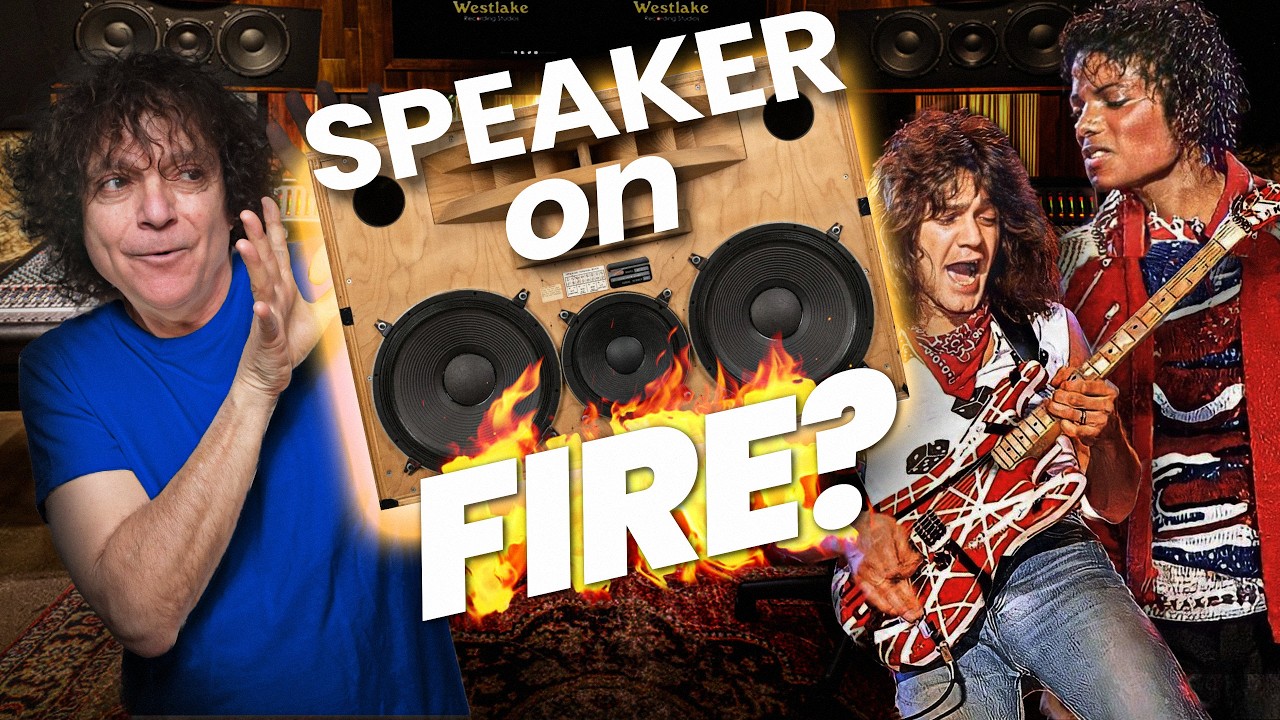
Some of what he says we already knew. Writing in his 2001 autobiography, Q, Thriller producer Quincy Jones had already confirmed that it was during the mixing rather than tracking process that things took a fiery turn.
“We knew the music was hot,” he began. “On Beat It the level was literally so hot that at one point in the studio, Bruce Swedien called us over and the right speaker burst into flames. We’d never seen anything like that in 40 years in the business.”
Forger doesn’t dispute that this happened, but his recollection is that it was an electrical problem rather than a level one that started the smokeshow.
What’s more, if you really want to get pedantic, he says that the event actually occurred at the pre-mixing stage, when Swedien was preparing elements such as backing vocals for final mixing.
“At one point in time when they were working on this, one of the amplifiers, the Crown power amps to the Westlake soffit-mounted speakers – the ones in the wall, the HR-1s – the amplifier for whatever reason failed,” explains Forger, though he can’t tell us exactly why.
“It might have been a power supply, a filtering cap, I don't know what it was,” he says. “Something let loose in the amplifier and put out a tremendous power surge into the right-hand set mounted Westlake speaker.”
Explaining what happened in more detail, Forger says: “Normally there's AC current going into a loudspeaker because the speaker cone actually moves. But when you get DC that's just a giant enormous surge of power. That caused the voice coil – which is the element that moves the speaker in the permanent magnet – to heat up. It overheated and glowed red like the element in a toaster or a toaster oven.”
So… you’re saying this is an… AC/DC story? Let’s not even go there.
Were there any actual flames, though? “It was glowing red and it emitted a tremendous amount of smoke,” says Forger, but the speaker cone was made of fireproof material.
“So, it's not like it's a giant flame, like a jet engine flame is going to come out. Instead, it's going to smoulder like an ember and create a horrendous atrocious smell, that real acidic electronic burning smell. The thing was lighting up like a toaster. It was glowing red.”
“Well, that’s a speaker on fire,” says Anthony Marinelli, clearly wanting the legend to be true just as much as the rest of us.

Forger also seems to confirm that Beat It was playing through the speakers when the problem occurred, but he can’t say which part.
“It wasn't necessarily Eddie's guitar solo. They were working on the song in general when it happened, but of course… it could have been.”
That’ll do for us – let’s just say that it was.
For the record, Forger says that both he and Quincy Jones were actually in a different studio at Westlake when all of this happened, and were altered to the incident when Bruce Swedien popped his head round the door and said “We just caught the speaker on fire”.
“So, everybody, you know, runs in to see this,” says Forger. “The assistant engineer in a cautious fashion did take out the fire extinguisher, made sure that there weren’t any flames and nothing caught on fire, nothing was damaged. But the smell was absolutely horrible.”
Little did anyone know at the time that we’d still be talking about the burning speaker more than 40 years later, but perhaps British songwriter Rod Temperton, a mainstay of the Thriller team who was working alongside Bruce Swedien, had some sense that this was going to make for a good story.
“Rod Temperton – Marlboro man, smoking a cigarette – in his dry British humour says, ‘This song must be really hot for it to catch the speakers on fire,’” laughs Forger, and who are we to disagree?