


Ryuichi Sakamoto was a man of numerous gifts; a pianist, keyboard player and musician, producer, singer, songwriter, composer and even an actor. Despite considerable success as a solo artist and founder member of the Yellow Magic Orchestra, the Japanese artist made his acting and film scoring debut in 1983, in the feature film Merry Christmas, Mr. Lawrence.
Directed by Nagisa Ōshima and starring in the film himself alongside David Bowie and Tom Conti, Sakamoto not only played the pivotal role of Captain Yonoi, but bagged a BAFTA award for his original score. Not bad for a first outing in two different feature film camps!
Ryuichi Sakamoto was well known for playing synthesizers as part of the Yellow Magic Orchestra, but the acoustic piano continued to be an integral instrument for his work.
While touring as a solo artist (albeit with a superb group, which included Manu Katche and Pino Palladino) he could often be seen fronting the band from behind a Yamaha grand piano, which he also used to trigger MIDI devices live.

When working in film scoring, the piano often became a central element to his work, and there is no clearer example of this than the extraordinarily haunting theme from Merry Christmas, Mr. Lawrence.
Sakamoto was heavily influenced by Asian music, while also citing Claude Debussy as an enormous influence on his work.
“Asian music heavily influenced Debussy, and Debussy heavily influenced me,” Sakamoto was quoted as saying on his official website. “So, the music goes around the world and comes full circle.”
Despite the film also starring the global superstar David Bowie (then at the peak of his commercial fame following the release of Let's Dance), there was never any doubt that it was to be Sakamoto who would write the score.
“We never wanted David Bowie to write the score,” said the film’s producer, Jeremy Thomas (as quoted here). “It would have been a cliché for him to write the score and secondly, he didn’t want to do it. But also Ryuichi Sakamoto was always going to write the score for the film. He’s an enormous rock’n’roll star in Japan. [Director] Nagisa Ōshima told him to write the score as if he was [his character] Captain Yonoi and he did.”
Sakamoto hit upon the divine melody by chance, when searching for a particular ‘timeless’ motif that wouldn’t obviously date.
“I had read the script and knew the story, and I thought about how to come up with a special Christmas song that’d be played in a tropical Asian island,” Sakamoto said in 2018. “That’s a strange concept in itself. And then you add in war. But anyway, I was thinking logically about it for weeks. One afternoon I was sat in front of the piano looking for an appropriate melody. I was unconscious for a while. Then the melody was written. Right in front of my eyes."
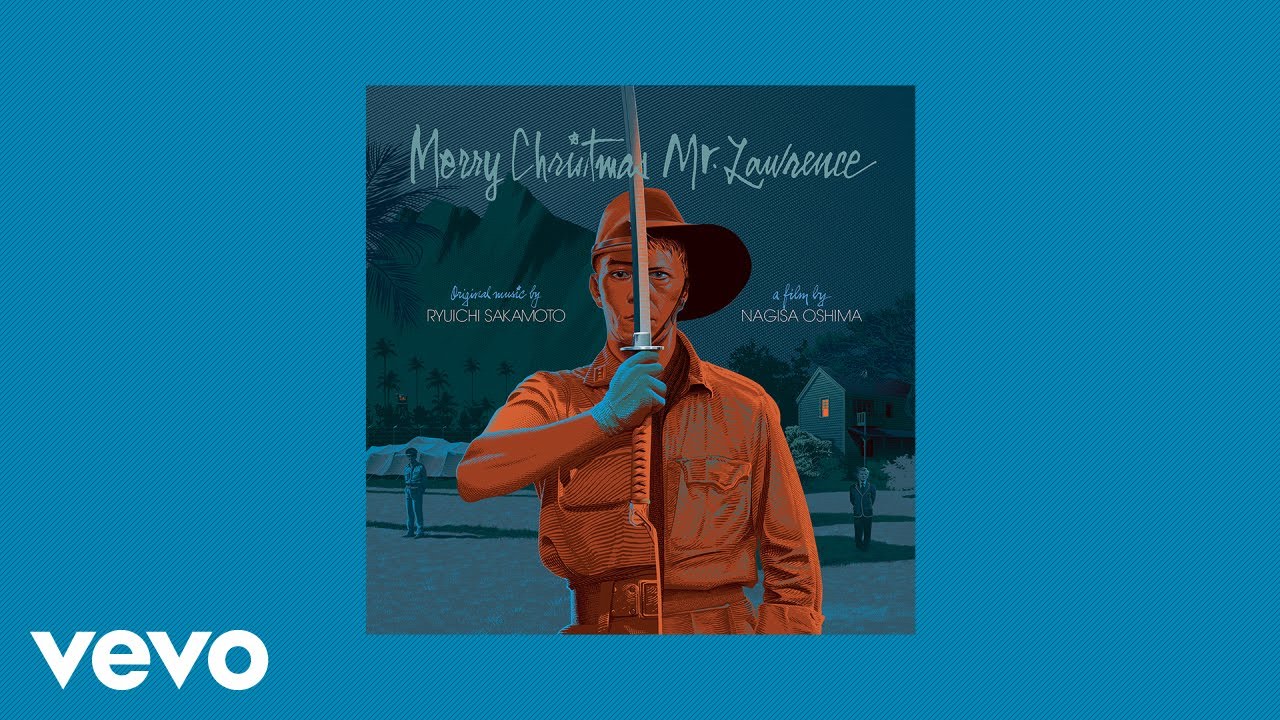
There are several versions of the main theme to this film, including versions which make greater use of acoustic instrumentation, but we are going to concentrate on the music theory that underpins the original theme from the soundtrack; a layered tapestry of acoustic piano and early 80s music technology, including a Prophet-5, LinnDrum and Fairlight CMI.
For the moment, we are going to dive in at the point where we hear the main theme for the first time. We’ll come back to the introduction later
In its most basic form, the pianistic inspiration is pretty obvious. The right hand plays the melody, which is set in the key of Bb minor.
Adopting Asian influence, the melody is completely based around the minor pentatonic - starting on the note Eb, it rises up to F, back to Eb and then down to Bb, before settling back on Eb.
If we analyse these first five notes, the role of the note Eb is central, yet it arguably plays against the harmony.
We’ll ignore the synthesizer chords for the moment and concentrate on the harmony which is provided by the left hand on the piano.
The influence of Claude Debussy is obvious here, as French piano composition from this era often found the left hand playing extended chords as arpeggios, a popular device which Sakamoto similarly exploits here.

Coinciding with the start of the main theme, the left hand plays a low Gb, followed by Db and Bb. This first chord provides us with a beautifully-voiced chord of Gb major. The second arpeggiated chord (playing Ab, Gb and C) adopts a similar style and arrangement, for a chord of Ab7, before the final arpeggiated chord (Bb, F and Db) brings us home to Bb minor.
These chords are repeated, but not before the left hand plays two higher pitched triads of Bb minor and F minor, before dropping to Gb to repeat the cycle.
The coupling of the French accompaniment with the pentatonic melody, creates the perfect hybrid. It has minimalist sensibilities, thanks to considerable degrees of repetition.
With our analysis of the harmony, we have purposely left the pad-like and higher pitched synthetic elements out of the equation. These also appear in a similar guise during the fade-in introduction, so let’s revisit this element now.
These upper musical colours offer jazz-like chord extensions, which add a tremendous amount of sweetness to the overall harmonic impact. Arguably, part of this extension format is added by the melody too.
Take the very first chord of the theme - Gb Major - if we take the first note of the melody into account (Eb), it arguably turns this chord into Gb add13.
However, the synth pad element adds all sorts of other notes, as a form of cluster, with one of the most important notes being F, which is the Major 7th of Gb. Hence, this first chord, adopting the synth-cluster, could also be described as Gb major13.
As with all harmony, especially harmony with a heavy influence from jazz, chords can be described in various ways. However, we cannot ignore one of the strongest elements of this theme, which is that in its most reduced and pianistic form, the simplicity adds to the glacial beauty of the piece. The synth and chordal extensions are merely icing on top.

The initial theme adopts another form of jazz construction, being in a form similar to an AABA, 32 bar jazz-form.
Turning to the B section, it takes a slightly darker turn, with a melody which is played in unison, but two octaves apart.
The chordal accompaniment here is more sedentary; Abm7, followed by Gb major 7, Abm7 and F7sus, which resolves to F7, before returning to the main theme in order to repeat the A section.
Calling upon Sakamoto's influences again, this final A section adds a further Asian colour. If you listen closely, you can hear the melody is joined by an additional note, a perfect 4th below.
This is a highly recognisable and archetypal trait of traditional Asian music, and one that serves to enforce the melody and harmony further, as well as adding a notable flavour.
Given that this fantastic theme was to become one of the film’s calling cards, it was decided that Sakamoto should add a vocal to the track, resulting in the single Forbidden Colours in August 1983.
The theme remains identical in form, structure and harmony, but with the addition of a beautifully haunting vocal, provided by friend and co-creative David Sylvian, the former frontman of Japan (who'd only recently broken up).
In an interview with Sakamoto on the film's Blu-Ray release, he stated that originally, he asked his co-star if he wanted to take the lead. “I really wanted to work with David Bowie, so I asked him to sing on this but he didn’t want to. He said that he wanted to focus on this project just as an actor, purely as an actor. I understood, so then I asked another of my friends, David Sylvian, to work on this and he said yes. He did it beautifully.”
Sakamoto had previously worked with Sylvian, both as a solo artist and as part of Japan, occasionally playing with them live.
The connection, through influence, was very obvious but the addition of the vocal to the theme not only added another dimension to the material, but added a valuable marketing tool. The single made the top 10 in the UK and became perhaps the most enduring legacy of the (underrated) film.
Ryuichi Sakamoto continued to work as a solo artist, throughout the 80s and 90s, beyond his time with the Yellow Magic Orchestra. Merry Christmas Mr. Lawrence was the film which launched his scoring career. Film composition became an increasingly important part of his life's work, and he was awarded many gongs, including an Oscar for 1987’s The Last Emperor.
Sakamoto’s sad passing in 2023 left us with an extraordinary legacy of cinematic, emotive and highly original music, amongst which sits themes that have transcended their original purpose. Merry Christmas, Mr. Lawrence in particular remains his most evocative gem.
