
MusicRadar Verdict
The Tascam DR-40XP is a phenomenal four-track field recorder, with high-fidelity recording thanks to some excellent on-board microphones and some even more excellent built-in HDDA preamps. It’s everything anyone could need in a handheld recording device, and it’s good at it all too.
Pros
- +
Four-track recording with overdubs.
- +
32-bit float/96kHz capability.
- +
Excellent, quiet HDDA preamps.
- +
Intuitive to use.
Cons
- -
MicroSD card not included.
- -
Audio interface limited to stereo input.
MusicRadar's got your back Our team of expert musicians and producers spends hours testing products to help you choose the best music-making gear for you. Find out more about how we test.
What is it?
The words “field recording” and “four-track” elicit a fair few associated words, but it’s highly likely that the first one to come to mind is “Tascam”. The Japanese audio brand has been there on the ground floor of every new technological moment, ready with a suite of user-friendly recording devices to launch a thousand bands.
Tascam’s reel-to-reels were amongst the first recording devices to bridge the gap between studio and musician. Its four-track Portastudio cassette recorders were definitive home-recording fare, and are still sought-after today for their inspiringly limited features and sonic capabilities. Tascam’s digital field recorders are similarly definitive, for capturing a nascent market as a flagship standard. Which brings us to now, and to the Tascam DR-40XP.
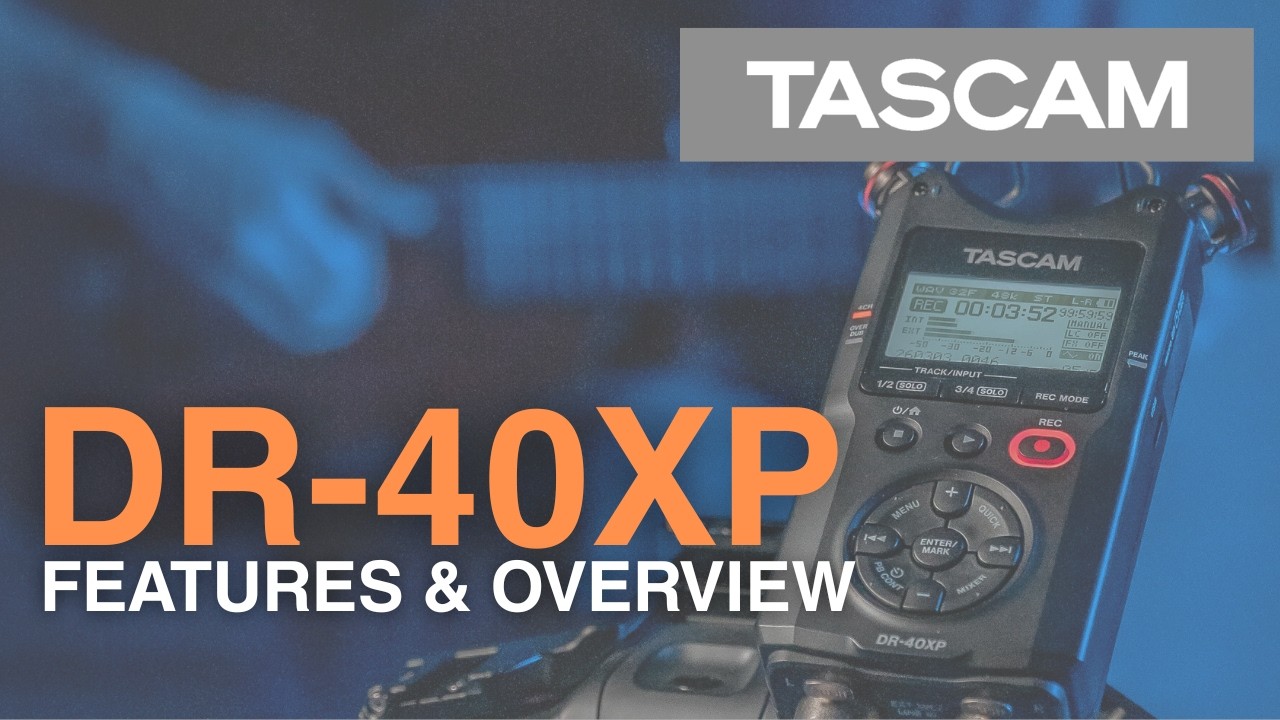
The Tascam DR-40XP is the brand’s new flagship for handheld field recording, part of a range that takes some very familiar field-recorder designs and imbues them with the foolproof majesty that is 32-bit float recording. It’s a direct sequel to the DR-40X, keeping much of the same form and features, but with some vital future-friendly upgrades.
First, the basics. The DR-40XP is a four-track field recorder in sheep’s clothing, possessing a pair of on-board cardioid condenser mic capsules and two TRS/XLR combo mic/line inputs. The on-board mic capsules can be toggled between XY or AB configuration, for focused capture or a broad stereo field; the combo inputs are phantom-powered for favourable communication with any mic from your own cabinet.
The DR-40XP iterates on the DR-40X by adding the aforementioned 32-bit float recording capability up to 96kHz, but it goes further too. It adds Tascam’s proprietary HDDA (High Definition Discrete Architecture) mic preamps, with an EIN (Equivalent Input Noise) of less than -126dBu; it adds a more RF-resilient on-board mic design; and it adds USB-C connectivity – a welcome graduation from the micro-USB standard that held on for a few years too long.
That USB-C port isn’t just for delivering power or data, either. Like the DR-40X before it, the DR-40XP also works as a 2-in/2-out audio interface, with either the on-board microphones or the external inputs as your source. If you’re not running the DR-40XP on USB-C bus power, you’re running it using three AA batteries – which, in the right atmospheric conditions, will offer up to 30 hours of on-time.
And in that on-time, the DR-40XP will handily show up for practically any recording undertaking you have in mind. The on-board mics can handle a high SPL, which, combined with its 32-bit float capabilities, makes the DR-40XP suitable for practically any sound capture. Not only that, but an on-board tuner and six-preset reverb modifier mean you’re set for live performances or location-based multitracking. Throw in the overdub and file bounce features, and you’ve got a mini mobile studio on your hands.
Performance


Once up and running, the Tascam DR-40XP is a dream to use, and capable of capturing some magnificent audio
For starters, the DR-40XP feels reliable in-hand. It’s a moderately dense bit of handheld kit, and reassuringly solid despite its all-plastic chassis and connection ports. The metal bars protecting the mic capsules are another reassuring touch; it could certainly handle an accidental drop or three. The tactile experience is a good one, too, with responsive clicky buttons in front of every user input.
My first attempt at using the DR-40XP in the wild was thwarted by a wrongly formatted microSD card from another of my devices. These are minuscule grumbles, made larger by already being outside and by the sad omission of a complementary microSD card in the first place.
Now, not testing before departure was my fault entirely, besides which Tascam doesn’t necessarily owe anyone free storage, and data storage has of course gotten more expensive lately. Still, it’s a modern convenience we’ve come accustomed to from other brands and products; a modicum of on-board storage for emergencies would be a nice feature indeed; and, curmudgeon that I am, I want my 90 minutes of pointless traipsing back. Devoting over a hundred words to a problem of my own making might seem a bit ridiculous, but I assure you there’s a good reason: namely, that it’s almost all I have to complain about.
Once up and running, the Tascam DR-40XP is a dream to use, and capable of capturing some magnificent audio. Even without acknowledging the freedom to use whatever mics or inputs you want, the on-board microphone array is a real wonder – a world apart from the noisier capsules of older field recorders, and easily a new standard for mobile audio captures. The HDDA preamps are impossibly quiet, too. All told, it’s an uneasy feeling, getting professional-grade field recordings just from wandering outside with the DR-40XP and a camera tripod.


I did, briefly, have some issues with getting computer audio back out through the device’s headphone output, a problem I narrowed down to a driver issue
Navigating the on-board menus seems like it should be more difficult than it is, a precedent set by early digital recorders with dense and impregnable user interfaces. The DR-40XP, with its ergonomic button layout and well-signposted utilities, is a simple thing with multitudes beneath. Also, a small change that’s huge enough for me: the DR-40XP has added one-press recording at long last, its lack being the only tactile bugbear I’ve had with Tascam field recorders past.
At home, I tried out the DR-40XP in its ancillary function as an audio interface. In this mode, it’s limited to 24-bit/48kHz at maximum – a small shame for those hoping to twin that bottomless dynamic range with a hard-wired DAW setup, but functionally no problem at all. Just with it sat on my desk, pointed vaguely towards the 12th fret of my acoustic guitar with the mics in XY configuration, I got a stunningly natural, bell-clear sound. It’s effortless stuff. Remarkable, even.
I did, briefly, have some issues with getting computer audio back out through the device’s headphone output, a problem I narrowed down to a driver issue. A reinstall, and a reboot of both computer and field recorder, and full functionality was there. Seamless. A breeze. And for what it’s worth, that monitor output is clear, full and transparent in exactly the way you’d hope.
Verdict


The DR-40XP is, in my opinion, the new standard for all portable field recorders. The feature-set is outsized for the form, meaning more freedom to do more with it – with less than ever. It’s built well, it’s supremely user-friendly, and its results are, in a word, pristine. It might reach a little above some budgets accordingly, but as a versatile box for recording setups big and small, it can’t be beat.
MusicRadar verdict: The Tascam DR-40XP is a phenomenal four-track field recorder, with high-fidelity recording thanks to some excellent on-board microphones and some even more excellent built-in HDDA preamps. It’s everything anyone could need in a handheld recording device, and it’s good at it all too.
Audio examples
Also consider
Hands-on demos
Tascam Official
Specs
- Microphones: stereo cardioid condenser capsules, XY/AB configurable
- Inputs: x2 TRS/XLR mic/line
- Outputs: 3.5mm TRS headphone, USB-C
- Phantom power: 24/48V
- Recording formats: WAV/BWF, MP3
- Recording fidelity: 16-bit/24-bit/32-bit float, 44.1/48/96kHz
- Recording media: microSD, microSDHC, microSDXC (up to 512GB)
- No. of channels: x2 stereo input tracks, x4 recording tracks
- EIN (equivalent input noise, mic preamp): ≤–126dBu
- Dynamic range: ≥112dB
- Display: Backlit LCD
- Power requirements: x3 AA batteries; USB-C bus power; AC adapter (sold separately)
- Battery life: 30 hours
- Dimensions (WHD): 70 mm × 155 mm × 35 mm
- Weight: 282g (with batteries)
- Contact: Tascam
