
MusicRadar Verdict
Whether you’re a solo performer after a simple stage mixer, a desktop producer looking for a compact setup or video user with multiple audio sources to handle, this excellent mixer could be just what you’re after.
Pros
- +
Very easy to use.
- +
Good connectivity.
- +
Well spec’d USB audio options.
- +
Great accompanying desktop app.
- +
Fully featured when used as a standalone device.
Cons
- -
Some processing options unavailable at 96kHz and 192kHz.
- -
Smart phone app lacks features.
MusicRadar's got your back Our team of expert musicians and producers spends hours testing products to help you choose the best music-making gear for you. Find out more about how we test.
What is it?
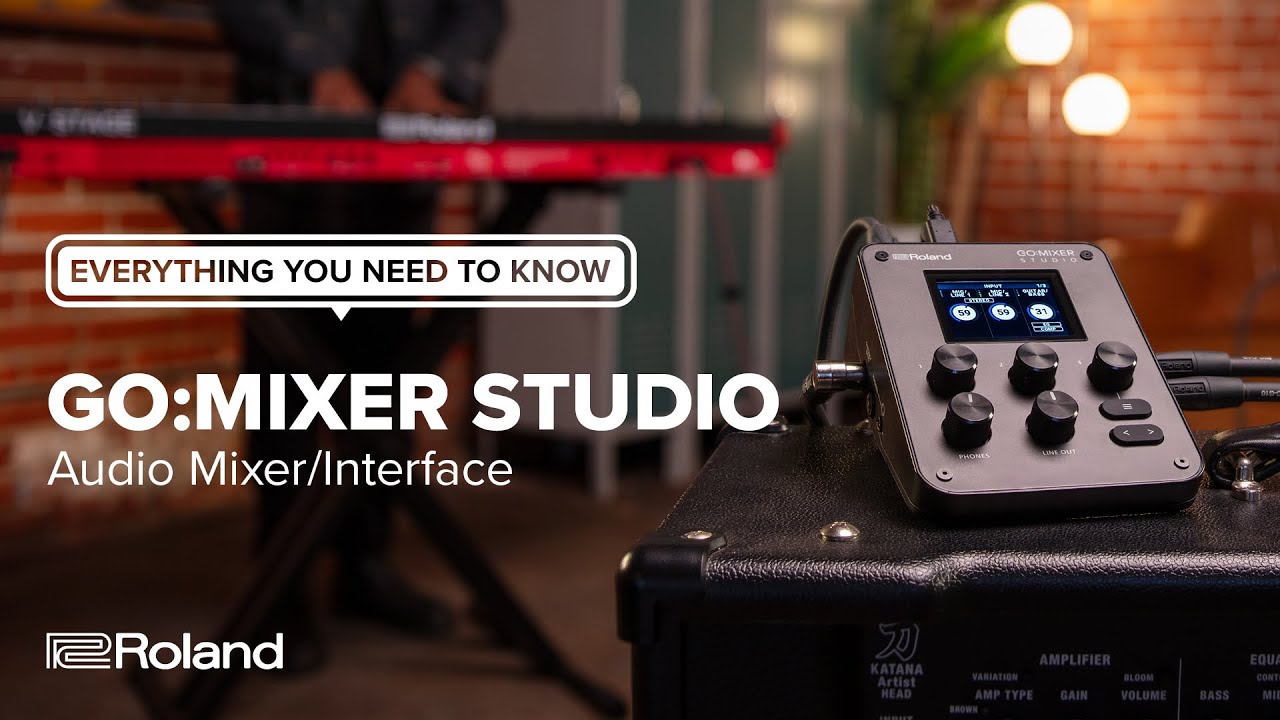
Go:Mixer Studio is a desktop and tripod-mountable digital mixer with an integrated 12-in / 6-out USB audio interface, recording up to 24-bit / 192kHz. It joins Roland’s growing range of Go: badged portable products, which includes keyboards, pianos and mixers.
Go:Mixer Studio is designed for both standalone use and via USB, and is supported by both desktop and smartphone software apps: Go:Mixer Editor desktop (Mac OS and Windows), Go:Mixer Cam (iOS) and Camcorder for Go:Mixer (Android). The unit can be powered directly via the main USB-C interface connector, but you also have an additional USB-C power connector, which is helpful for mobile device use or if you want to use it as a standalone mixer. The box includes a regular 1.5m USB-C to USB-C cable but no further adapters, so factor that in if you want to use it with USB-A or Lightning-equipped devices.
The Go:Mixer Studio has a good selection of physical connectors on the back and side panels. On the back you get two XLR mic/line inputs with individually selectable 48V phantom power, two ¼” jack line outputs, MIDI in and out on 3.5mm mini jacks (breakout cables not included) and two USB-C ports (power and USB).
On the left is a dedicated instrument impedance input ¼” jack and also two headphone connectors, ¼” and 3.5mm mini jack, which you can use simultaneously. The headphone mini jack is also the TRRS type, providing access to the headset mic on combined devices. Finally, on the right there are two ¼” line inputs and a 3.5mm TRRS-style auxiliary connection for stereo input and mono output with suitably equipped devices.
The top panel combines physical controls with a colour display. The top three knobs are continuous rotaries with push-button action. Below these are two dedicated output levels for Phones and Line Out. Rounding things off are menu and navigation buttons.

Performance
Go:Mixer Studio is designed to be straightforward to use. You’ll find the screen system is easy to navigate, with parameters aligned with the three rotaries, while deeper options are accessed via the push button. In addition to the basics such as gain and phantom power, there is excellent functionality across the inputs, including 3-band EQ, compression and reverb as well as input stereo linking, pan and mute. There’s also independent control over input assignment to headphones and the line outputs.
Further options include independent level settings for the headphones, routing of the auxiliary input (line out or headphones) and source select for the USB audio outputs (direct, pre-fader, and post-fader). In typical mixer fashion, this last setting lets you control the recording level with the input gain and the fader (in this case, the corresponding rotary controller), or use only the analogue input gain, which you’ll find in the channel parameters. Overall, we found setting up inputs, setting levels and adding processing very simple. That said, there are some limitations to the processing options at higher sampling rates (96kHz and 192khz), where you’ll find the compressor and reverb become unavailable on some inputs.
If you choose to use the Go:Mixer in tandem with the desktop Editor app, all these options become even easier, with each channel’s Setup page providing quick editing and excellent visual feedback. There’s also a full mixer page for analogue inputs, USB inputs and analogue outputs. If you’re using the mobile app, options are more limited in terms of control, as the app is designed primarily as a video and audio recorder. However, there is control of input fader levels and the app also records the Go:Mixer Studio audio in a multitrack manner to individual tracks. Formats are limited to 48kHz WAV or AAC (64 to 320kbps), but you can export the recorded tracks as individual audio files, which is very handy.

Verdict
Go:Mixer Studio is a highly flexible compact mixer and USB interface that’s perfect for desktop recording and live performance. Even fader fans will find the screen based system easy to navigate, and the onboard effects provide the icing on the cake.


Hands-on demos
RolandChannel
Alternatives
Specifications
Price |
£257 / $300 / €289 |
Analogue inputs |
2x Mic/Line XLR, 1x Instrument, 2x Line in ¼” jack, headset mic 3.5mm jack, stereo auxiliary input 3.5mm jack |
Analogue outputs |
2x Line out ¼” jack, headphone ¼” jack, headphone 3.5mm mini jack |
USB audio interfacing |
12-in / 6-out at up to 24-bit / 192kHz |
Onboard effects |
EQ, compressor, reverb |
Internal processing |
32-bit floating point |
Power |
USB-C audio or separate USB-C power input |
MIDI |
in/out on 3.5mm mini jacks |
Accessories |
1.5m USB-C to USB-C |
Dimensions |
110(w) x 65(h) x 156(d) mm |
Weight |
440g |
Contact |
