





MusicRadar Verdict
Even more so than the DJM-V10, the DJM-V5 is designed for a specific style of slow, subtle mixing that means it will miss the mark for all but a narrow niche of DJs. But its focused design also makes it more interesting and musical than most other DJ mixers on the market.
Reasons to buy
- +
Excellent sound and build quality
- +
Long-throw faders and four-band EQs offer lots of precision
- +
Effects setup is a joy to perform with – particularly the return level fader
Reasons to avoid
- -
Still expensive, particularly for just 3-channels
- -
Soft fader mode is too subtle for our tastes
MusicRadar's got your back Our team of expert musicians and producers spends hours testing products to help you choose the best music-making gear for you. Find out more about how we test.
AlphaTheta DJM-V5 review: What is it?
Launched in 2020, Pioneer DJ’s DJM-V10 is an all-singing, all-dancing six-channel DJ mixer that has proved remarkably popular with professional house and techno DJs.
A big part of the V10’s appeal lies in its sound and build quality, both of which are a noticeable step up from much of the DJM range. Beyond that though, the mixer also offers a fresh approach towards performance effects, ditching the Sound Color FX found on other Pioneer/AlphaTheta products in favour of a focus on effect sends more akin to the design of Allen & Heath’s top-end Xone mixers.
For all that the DJM-V10 gets right, it’s an undeniably high-end device, and a significant commitment in terms of both its hefty size and near-$4k price. It’s also overkill for the needs of many DJs and smaller clubs.
The DJM-V5 is a response to this. Released earlier this year – now under Pioneer DJ’s parent brand AlphaTheta – the V5 has three mixer channels based on the V10’s design ethos, resulting in a smaller footprint and a more affordable price, relatively speaking.
The V5 isn’t simply a cut-down version of the V10 though. In the process of streamlining the design AlphaTheta has also introduced some new features and refined others, resulting in a mixer that feels like a more focused and, in some areas improved version of its bigger sibling.
Pricing
Launch price: €1,999 inc VAT, £1,739 incl VAT, $2,199 excluding sales tax (US only), $1,999 excluding tax (Canada and Latin America)
AlphaTheta DJM-V5 review: Performance
The three mixer channels found on the V5 are actually based on those found on the later DJM-V10-LF. These offer 60mm long-throw faders with no crossfader.
This is one of several significant ways in which the V5 feels specifically aimed at a certain type of house or techno DJ likely to emphasise slow, methodical track blends over quick cuts or scratching – a style perfectly suited to those long-throw faders.
Realistically, the bottom third of a channel fader often feels redundant on most mixers, since it’s only at around 40% volume that a track begins to make itself known under the master output. The extra length of the long-throw faders means there’s considerably more ‘active’ space between that lower level where a track is first audible and the maximum, which makes it possible to introduce a track more subtly and to be more precise when changing the emphasis from one track to the next.


Above each fader is a 4-band EQ that splits the mid-range frequencies into low and high mids. As with similar design found on Allen & Heath’s top-end Xone mixers, I have mixed feelings about having this extra EQ compared to a more common 3-band setup. It’s useful for slower transitions, which is certainly fitting for the V5’s design, although it can make things a little more fiddly if you want to quickly swap the low end between two tracks.
The V5’s channel faders can be switched between three different curve modes, including a new ‘soft’ mixer curve. In this mode, reducing the fader level cuts the volume of the track while simultaneously rolling off the high frequencies, the aim being to ‘soften’ the output as it's mixed out in a musically flattering manner.
I really like this as a concept, although I wish the effect was a little more pronounced. While subtlety is the name of the game for the V5, which is generally a good call, the difference between soft and non-soft mixer modes can be hard to discern, at least to my rave-aged ears.

More successful is the new XPF, or cross-pass filter mode. This combines both high- and low-pass filters so that, as the cutoff knob is turned to the right, the filter sweeps up through the high frequencies but keeps the very lowest frequencies in the mix, like a widening band-pass. This is a really fun tool for creating builds and raising tension without messing with the sub elements of a track.
On the subject of the filters, it’s worth noting that the filters on each channel are controlled by a single-direction cutoff knob. This means that, unlike most DJ mixers where the cutoff is turned to the left for a low-pass effect and right for high-pass, here the filter type is selected using the buttons to the left of the interface and then the cutoff knob is turned from left to right to increase the prevalence of the filter effect. This setup can feel a little counter-intuitive and is likely to divide user opinion, but it does mean that there’s more travel and – again – more space for subtlety when engaging each filter mode.
The highlight of the V5’s design, however, is the way it handles effects. The V5 ditches the tempo-synced Beat FX and swept Sound Color FX found on most of AlphaTheta’s other gear. Instead it makes use of both internal and external effect sends, with the internal processors putting most of the emphasis on delay and reverb.
The internal effects are housed in the Send FX module, which offers six reverb and delay effects divided into tempo-synced and non-synced types. In a neat design trick the time knob – which is a shared control dictating the length of each effect – adapts to provide haptic feedback marking the beat division when used with synced effects, but offers smooth free-flowing movement when used with non-synced modes.
With just six options, there are significantly fewer effect types than found on the V10 – or on many cheaper DJM mixers for that matter – but rather than feel like a downgrade, the design of the V5 feels more considered and focused on what its target users are likely to actually use.


Another significant change compared to the V10 lies in the fact that the return level is now controlled by a fader, as opposed to a knob. This might sound like a minor change on paper, but in practice it makes for a far more expressive way of manipulating the effects channel. It’s a really smart update.
Along with its internal routing, the V5 also has both a ‘multi-I/O’ channel that can be used for either analogue send/return connectivity on its rear panel, or a top-panel USB-C port that, among other things, allows for single-cable connectivity with AlphaTheta’s recent RMX-Ignite effects unit.
AlphaTheta DJM-V5 review: Verdict
Verdict
While the V5 is cheaper and smaller than the V10, this is still a pro level piece of kit offering the same top-end sound and build quality.
The choice of three mixer channels rather than a more conventional four-channel setup might seem odd to some, but in-use it feels like a good level of compromise. The V5’s neat size and streamlined feature set make it a more approachable and immediate DJ mixer than the V10.
The combination of that third channel and the multi-I/O connectivity provides just enough flexibility for DJs looking to push their sets beyond a basic two-deck setup, whether that involves adding an additional player or turntable, an external effects loop or some ‘live’ element like a drum machine or sampler.
The inclusion of one-knob compression on each channel is a nice touch on this front, providing an easy way to balance disparate inputs or compensate for the difference in mastering between a modern track played from a CDJ and classic played on aged vinyl.
Again, this combination of features really lends itself to a specific type of DJ. The V10 was already a mixer aimed more at club DJs than multi-format or scratch DJs, but by refining things further AlphaTheta has doubled down on this identity.
With its long faders, playable spatial effects and interesting filter design, the V5 is a mixer specifically suited to DJs that like to blend long, looping forms of dance music, where mixes for one track to the next might take several minutes and involve carefully cutting and emphasising individual frequencies.
Does this focus on a specific type of DJ risk alienating some of the potential market? Definitely. Even among house and techno DJs, the V5’s specific set of tools won’t suit everyone. But that commitment to the bit is worth celebrating.
In recent years the DJ market has seen a lot of releases that aim to be all-things to all-DJs, particularly when it comes to controllers and all-in-one systems. The DJM-V5 is a mixer that knows who it’s for and which encourages a certain style of mixing. The result is a more interesting, creative and musical piece of DJ kit.
AlphaTheta XDJ-AZ review: Hands-on demos
AlphaTheta / PioneerDJ Global
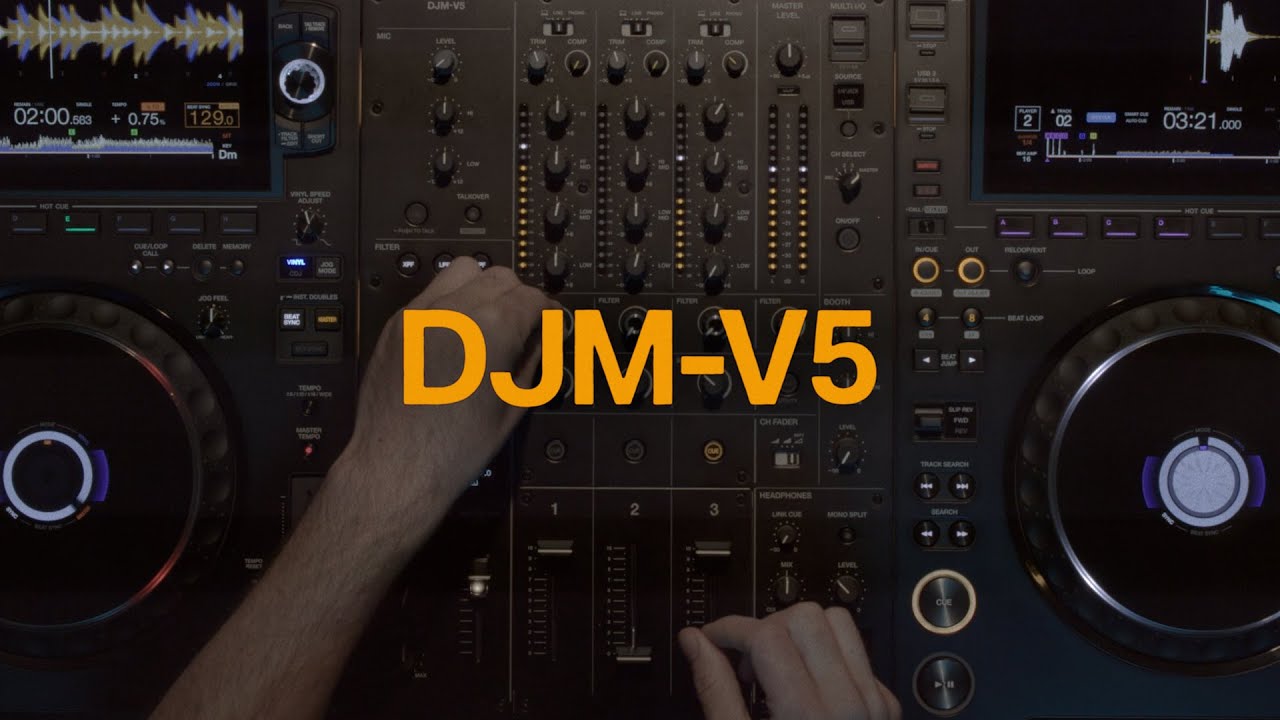
AlphaTheta XDJ-AZ review: Specifications
- MIDI Control: Full assignable MIDI controls
- DVS Control: djay Pro, rekordbox , Serato DJ Pro
- Dimensions (W × D × H): 302.0 × 437.5 × 107.9 mm / 11.89″ × 17.22″ × 4.25″
- Main unit weight: 8.0 kg / 17.6 lbs.
- Input / Output terminals
- Input: PHONO × 3 (RCA), LINE × 3 (RCA), MIC × 1 (XLR / 1/4-inch TRS jack)
- Output: MASTER × 1 (XLR), BOOTH × 1 (1/4-inch TRS jack), REC OUT × 1 (RCA), PHONES × 2 (1/4-inch / 3.5 mm)
- SEND/RETURN: SEND × 1 (1/4-inch TS jack), RETURN × 1 (1/4-inch TS jack)
- LAN × 1
- USB Type-C × 2 (MULTI I/O × 1, PC/Mac × 1)
- Sampling Rate: 96 kHz
- A/D Converter: 32 bit
- D/A Converter :32 bit
- S/N Ratio: LINE 105 dB / PHONO 88 dB / MIC 79 dB
- EQ4 Band
- Contact: AlphaTheta
