





MusicRadar Verdict
The Tascam FR-AV4 is a four-track field recorder with its gaze levelled squarely at the audio-visual world. It’s a multimedia darling, with HDMI pass-through, sync and audio embedding – but for me, the real smarts are in the audio. High-fidelity multitrack recording through phantom-powered XLR ins and whisper-quiet discrete preamps, all in a box the size of your lunchtime sandwich? Genius.
Reasons to buy
- +
High-fidelity audio captures
- +
Seamless AV integration
- +
Extensive on-board signal processing
- +
Highly portable
Reasons to avoid
- -
Short battery life under heavy use
- -
Small screen can be tricky to use
- -
Bluetooth functionality requires separate adapter
MusicRadar's got your back Our team of expert musicians and producers spends hours testing products to help you choose the best music-making gear for you. Find out more about how we test.
What is it?
Tascam’s a tried and tested brand in the field recorder space. It’s a frequent flier in our guides to the best field recorders, a brand that fields fierce competition in just about every price bracket, and the source of some of music’s most iconic recording devices (looking at you, Portastudio).
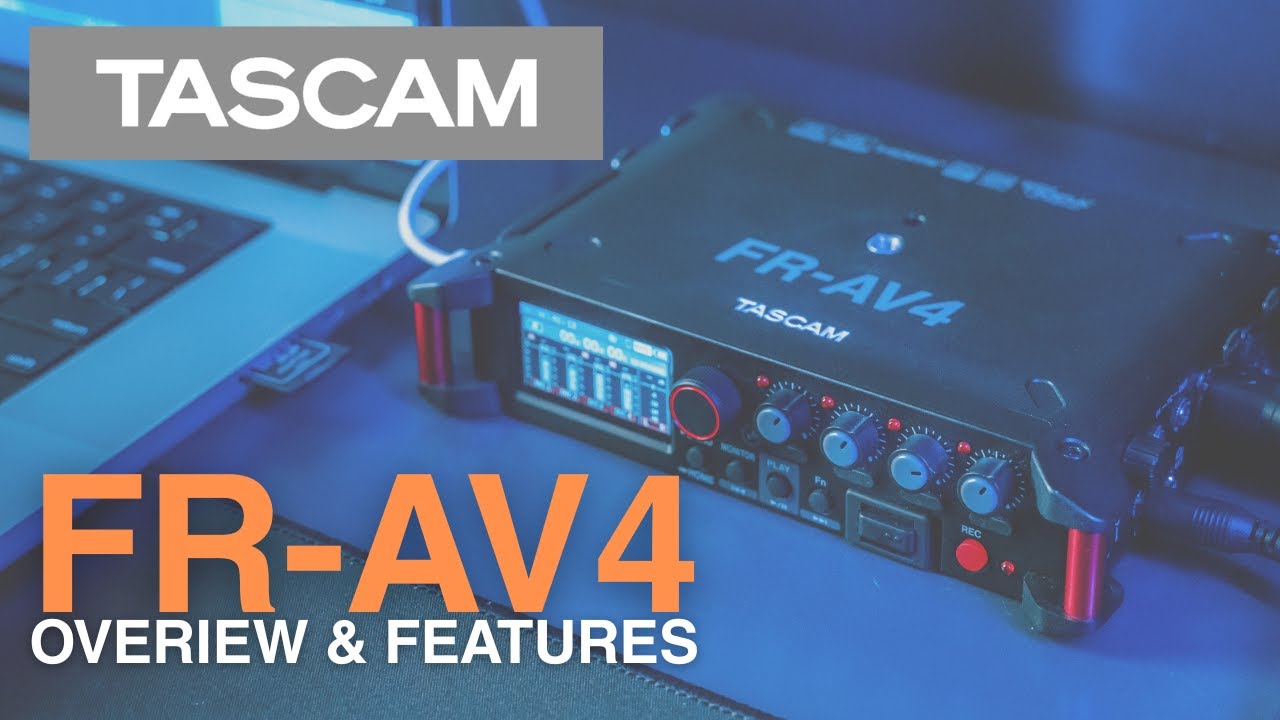
In previous products, Tascam’s already flirted with the audio-visual market, but the new FR-AV series goes all-in. This is the FR-AV4 – a brand-new four-track field recorder, designed as a compact and high-performance device for location recording, and as a compellingly seamless addition to audio-visual shoots.
The FR-AV4 is the second and largest in the FR-AV series, which takes some cues from camera-friendly Tascam recorders past, but also takes things in a maximalist – and thrillingly pint-sized – new direction. The FR-AV4 boasts 32-bit float recording at up to 192kHz, built-in timecode generation and HDMI sync, in a form factor so slim you could probably post two through someone’s letterbox.

The four tracks in the FR-AV4 are serviced by four combo XLR/TRS inputs, each of which is furnished with individually toggleable 24/48V phantom power, and Tascam’s own Ultra HDDA preamp design – which offers a wide gain range and an impressively low noise floor too. Inputs three and four can be superseded by a separate stereo 3.5mm input, for receiving audio from another camera or external device. There’s 3.5mm TRS ins and outs for the FR-AV4’s built-in timecode generator, and, handiest of all, a pair of HDMI ports that cover a great deal of clever business.
For one, connecting a camera via the FR-AV4’s HDMI port allows audio and video to sync, as well as enabling the camera to control record start/stop. With a monitor recorder plugged in at the other end too, via the FR-AV4’s HDMI out, 4K/8K video can be passed through with the FR-AV4’s audio embedded (and with the camera’s own audio, too, if you like). Game-changing simplicity for small rigs! Finally, the HDMI ports can also be used to daisy-chain multiple FR-AV4s, for virtually limitless extra tracks, all synced, and all slaved to the record button on the first in the chain.
There’s clever digital business going on inside the FR-AV4 too. It’s a high-fidelity field recorder, capable of recording up to 32-bit/192kHz audio. The dynamic range of 32-bit float trivialises gain-staging and, coupled with the four XLR inputs, makes this a potent partner for sound design and literal, bona fide field recording.
Each channel in the FR-AV4 gets some sound-sculpting tools too, including a four-band EQ, limiter and noise gate. All of this, in something roughly sandwich-sized – and powered by four AA batteries, or 5V bus-power from the USB-C port. Which is also a conduit for the FR-AV4’s second life as a six-in/two-out audio interface. It works hard for its price point.
Performance


Getting it situated, connected to my four pencil condenser mics and ready to record was a matter of minutes
As a musician with little professional experience shooting video, and being that I’m reviewing this field recorder for a publication with Music in the title, I’m actually not touching any of the Tascam FR-AV4’s AV-friendly features. I’ll leave the evaluation of anything video-like to other, more video-y people, and focus instead on its core multitrack field-recording functionality, which is excellent.
My first session with the Tascam FR-AV4 was to capture the ambient sound of an industrial passageway in the same building as my studio space; I wanted to experiment with quadraphonics, capture some spooky atmospheric sounds, and grab an impulse response for that spooky, atmospheric industrial-passageway reverb. Setting up for this was a dream, and a healthy portent of sessions to come.
The FR-AV4 has two embedded screw holes for camera tripods, on the top and bottom, so you can mount it any which way you choose. Getting it situated, connected to my four pencil condenser mics and ready to record was a matter of minutes – which, looking at the front panel for the first time (and not having looked at the manual at all), was far quicker than I expected.
Navigating the FR-AV4 is actually extremely intuitive, if a little tedious when you want a setting quite deep in the multi-page menu. Thankfully, almost everything I wanted to adjust was only a couple screens away, and I instinctively found it with ease.
As well as the big-picture cool stuff on display with the FR-AV4 – the per-channel EQs, the limiters, the ambisonics decode function in the menu that Tascam don’t even mention on their product page – there’s also a number of small, user-friendly touches that demonstrate a real thoughtfulness on the part of Tascam’s engineers. My favourite is that you can easily group multiple tracks to a single gain control, allowing you to keep your relative levels while broadly adjusting the whole mix.
The only place where the thoughtfulness outstrips its returns is with the screen, which is a touchscreen, but also far too small to reliably use without fat-fingering the odd input. Still, in places, using the screen is a small and welcome time-saver.


As a USB audio interface, the FR-AV4 is almost as seamless to use
As for the results: I was blown away, in the most boring of ways. I recorded at 32-bit float/192kHz, and captured everything. The cold, sustained quality of the passage in three dimensions; the soft hum of air conditioning units some hundred metres away; birdsong and children played in the neighbourhood past the car park; even the band rehearsing in the studio below. I messed around with gain settings, and, predictably, could not create a situation with poor results. The audio is clean, clear and uncoloured; a reliably professional standard.
As a USB audio interface, the FR-AV4 is almost as seamless to use. Being able to run it in 32-bit float is a welcome feature, and one which is conspicuously absent from Tascam’s new entrants in its DR-X series. A tiny bit of menu-diving and you can manage all the FR-AV4’s functions in-unit, including a handy SD card browser and exporter.
If I were the type to nit-pick, I’d throw a minuscule amount of shade at the placement of the USB-C port. It’s on the left-hand side, close as can be to the front face – and in front of all the I/O accordingly. It might be easy to access on location, but when transferring files or using the FR-AV4 as an audio interface, the trailing USB-C wire only gets in the way.
A broader nit-pick would be that Bluetooth monitoring and timecode sync – a key feature in Tascam’s eyes – is locked behind the purchase of a separate Bluetooth adapter. I’m generally not a fan of paywalling core features, particularly when this paywall seems a bit arbitrary (£47/$61 for the necessary Tascam AK-BT2 adapter). Still, I ultimately consider these nit-picks small for a small four-track with big features.
Verdict

It’s safe to say that I’m a big fan of the Tascam FR-AV4. It’s trivialised multitrack recording in the field in a number of ways, most impressively through its diminutive form factor. Seriously, it will probably fit in your coat pocket.
There’s so much more to this device than covered in this review that makes it a compelling buy for multimedia creators at any level – though the £699/$999 cost will naturally give some pause for thought. I think the price is actually quite justifiable, given its outsized feature set and sheer practical utility.
MusicRadar verdict: The Tascam FR-AV4 is a four-track field recorder with its gaze levelled squarely at the audio-visual world. It’s a multimedia darling, with HDMI pass-through, sync and audio embedding – but for me, the real smarts are in the audio. High-fidelity multitrack recording through phantom-powered XLR ins and whisper-quiet discrete preamps, all in a box the size of your lunchtime sandwich? Genius.
Audio examples
Also consider
Hands-on demos
Tascam Official
Specs
- Inputs: x4 TRS/XLR mic/line; x1 3.5mm TRS line/camera; x1 HDMI-A; x1 3.5mm TRS timecode input
- Outputs: x1 3.5mm TRS line/camera/timecode; x1 3.5mm TRS headphone; x1 HDMI-A; x1 USB-C
- Phantom power: 24/48V
- Recording formats: WAV/BWF, MP3
- Recording fidelity: 16-bit/24-bit/32-bit float, 48/96/192kHz
- Recording media: SD/SDHC/SDXC (up to 512GB)
- No. of channels: x4 input tracks, x6 recording tracks (inputs + stereo mix)
- EIN (equivalent input noise, mic preamp): ≤–127dBu
- Dynamic range: ≥133dB (inputs 1-4)
- Display: 1.9-inch (4.8 cm) LCD touchscreen
- Power requirements: x4 AA batteries; USB-C bus power; AC adapter (sold separately)
- Battery life: 17 hours
- Dimensions (WHD): 184 mm × 42 mm × 130 mm
- Weight: 756 g (including batteries)
- Contact: Tascam
