
When it comes to assessing the elements that make up the creation of a great song, most artists will acknowledge that luck can sometimes be a significant factor. Such was the case in early February 1971 when a chance encounter prompted Neil Young to record the song Heart Of Gold in Nashville, Tennessee.
Young was in Nashville to appear on The Johnny Cash Show, alongside other guests James Taylor and Linda Ronstadt. This edition of the hugely popular TV show was taped on 6 and 7 February 1971 at the Ryman Auditorium in Nashville.
On the evening of 5 February, Young, Taylor and Ronstadt were invited to an impromptu dinner party hosted by record producer Elliot Mazer at his new studio, Quadrafonic, built in a converted two-storey house on Nashville’s Music Row. By the end of the evening arrangements had been made for Young and a hastily-assembled band of Nashville session musicians to begin recording the following day at Quadrafonic.
These were the sessions that would kickstart Harvest, Young’s fourth studio album and a massively successful acoustic country-rock masterpiece.
Harvest would top the charts and become the bestselling album of 1972 in the US – and it was the lead single Heart Of Gold that really drove radio play and fuelled the album’s ascent.
Heart Of Gold was a massive crossover hit, a folk-infused country-rock song that became Neil Young’s first and only chart-topping single, reaching No 1 in the US and Canada and going top 10 in five other countries.
Heart Of Gold and the album from which it came cemented Neil Young’s songwriting legacy. And it became a template for countless artists who followed in his wake.

Young had arrived in Nashville straight off the back of his Journey Through The Past solo tour. During the tour, fans were treated to early versions of songs that would make it on to the Harvest album, such as Heart Of Gold, Old Man, The Needle And The Damage Done and A Man Needs A Maid.
These were raw, stripped-down acoustic songs featuring the solitary figure of Young, crouched over a Martin D-45 acoustic, banjo or piano.
The decision to perform acoustically and seated was not driven not by creative factors, but by a serious back injury.
“I was in and out of hospitals for the two years between After The Gold Rush and Harvest,” Young told Cameron Crowe in an interview for Rolling Stone in 1975. “My discs slipped. I couldn’t hold my guitar up. That’s why I sat down on my whole solo tour.
“I couldn’t move around too well, so I laid low for a long time on the ranch and just didn’t have any contact, you know. I wore a brace [and] I recorded most of Harvest in the brace. That’s a lot of the reason it’s such a mellow album. I couldn’t physically play an electric guitar.”
By the time Neil Young attended Elliot Mazer’s dinner party, he was itching to record the new acoustic-based songs he had been playing live night after night. It was the first time the two men had met but Young was already impressed by Mazer’s work with the Nashville session musician supergroup, Area Code 615.
He was also drawn by the charm of Mazer’s studio, built in a converted two-storey late-19th century house.
“The control room was the old porch,” recalled Mazer. “The living room and dining room became the two live rooms, and the kitchen became a drum area. We called it Quadrafonic as a joke, although it did have four speakers in the control room. I did one quad mix there.”
The first sessions took place on Saturday 6 February 1971, after taping for The Johnny Cash Show was completed. Mazer had booked four stellar musicians from the Nashville session scene: Kenney Buttrey on drums, Tim Drummond on bass, Ben Keith on pedal steel and Teddy Irwin on second acoustic guitar.
“Elliot Mazer chose the musicians for the session and put the whole thing together,” Young recalled on the Neil Young Archives website. “Harvest would have never happened without Elliot. He is great. He was at the board, recording. We captured Bad Fog Of Loneliness, Old Man and Heart Of Gold that first day. James and Linda sang with me, overdubbing on the choruses and James played banjo with us live on Old Man.
“These were all brand new fresh songs that I had been performing on my solo tour,” continued Young. “The sessions were an amazing time with Kenny Buttrey on drums and I could not believe how great he was, so locked in with my right hand. He had his drums set up so that he could see my hand on the guitar. Tim Drummond played bass and Ben Keith was on [pedal] steel guitar.”
According to the Songfacts website, Ben Keith had never heard of Neil Young and recalled showing up late and sitting down to play right away. He reportedly said they recorded five songs before they stopped for introductions.
These four musicians comprised the band that Young dubbed The Stray Gators, a loose collective of Nashville session musicians who provided the beautifully-judged rustic country-rock instrumentation on Harvest.
“These were great musicians and wonderful people,” recalled Young on the Neil Young Archives website. “They were so tuned in to what I was doing; it was easy going and that was the beginning of lifelong friendships between us. Ben Keith played with me for over 40 years. Tim Drummond was with me for a very long time as well. What a wonderful group of musicians they were. Elliot got a pure clean sound, using a bit of tape repeat on my vocal.”
Heart Of Gold was the first track recorded on the evening of 6 February at Quadrafonic Studios. It was recorded live with Young and the band getting the performance they wanted on the second take. “Two passes, and it was finished,” recalled Elliot Mazer in Mix magazine in 2023. “I guess it took less than two hours to record everything on Heart Of Gold.”
The following evening, on Sunday 7 February 1971, James Taylor and Linda Ronstadt arrived at the studio to record their backing vocals.
In an interview with Mojo magazine, Linda Ronstadt recalled the session. “We were sat on the couch in the control room, but I had to get up on my knees to be on the same level as James because he’s so tall,” said Ronstadt. “Then we sang all night, the highest notes I could sing. It was so hard, but nobody minded. It was dawn when we walked out of the studio.”
In an interview with Tape Op magazine, Mazer recalled Young’s drive and the magical atmosphere at the sessions.
“Neil was very specific about what he wanted. When Neil Young plays a song, his body language dictates everything about the arrangement. Neil sat in the control room of Quadrafonic and played Heart Of Gold. Kenny and I looked at each other, and we both knew it was a number one record.
“We heard the song and all we had to do was move Neil into the studio and get the band out there, start the machine and make it sound good. It was incredible.”
For Young, the icing on the cake was the fact that the studio was located on Nashville’s famed Music Row, where many historic studios were located at the time. “I was over my head with good fortune and luck combined,” he recalled.
Listening back to Heart Of Gold, 55 years after it was recorded, the song still exudes an effortless warmth and emotional purity, a credit to the strength of the song, which was structured around the most simple of chord sequences – Em-C-D-G.
Theories abound about the precise meaning of Heart Of Gold, but at its core it seems to reflect a quest for true love and inner peace. Young had recently got divorced and had embarked on a new relationship with actress Carrie Snodgress, who he had contacted after seeing her in the film Diary Of A Mad Housewife (1970). In 2022, Young is quoted as saying on Neil Young Radio on Sirius XM that the song was inspired by his blossoming love for Snodgress,
There is a real sense of optimism and hope in the lyrics, set against a backdrop of ageing and loneliness: “I want to live/I want to give/I’ve been a miner/For a heart of gold/It’s these expressions/I never give/That keep me searching/For a heart of gold/And I’m getting old”
Heart Of Gold was one of six songs recorded at the Quadrafonic Studio and all are devastatingly simple and strong.
Heart Of Gold is a testament to Young’s vision and talent, Elliot Mazer’s production skills and the impeccable feel and empathy of the seasoned musicians in the room.
There’s a sense of emotional desolation in Young’s vocal, a graceful, mournful delivery on a song that bridges folk, country and rock.
James Taylor and Linda Ronstadt’s pristine, high backing vocals only enter the mix towards the end but push the song to a whole new level.
Drummer Kenny Buttrey and bassist Tim Drummond’s feel is impeccable, nestling in with Young’s guitar, the gentle groove and the pushes on the track. Young’s harmonica and Ben Keith’s inspired flourishes on pedal steel echo and enhance the emotion of the song.
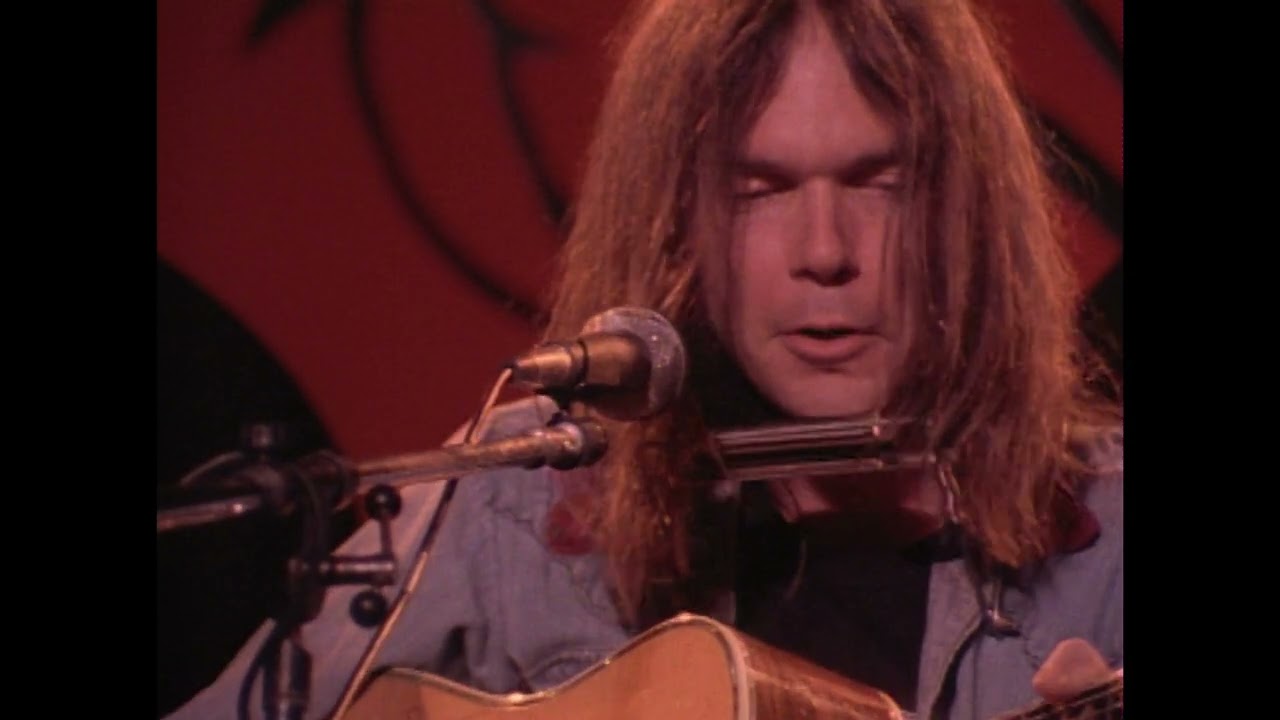
Heart Of Gold was released as the lead single from Harvest in January 1972, one month ahead of the album. For Young, the commercial success of the song came as something of a shock.
Heart Of Gold thrust him into the mainstream and it was a place that did not suit him. In the liner notes for his 1977 compilation Decade, Young wrote that Heart Of Gold took him to a creative place that he soon stopped visiting. Despite the huge hit and mainstream praise, Young took a creative left-turn and made sure that he never went anywhere near the top 10 ever again.
Young reflected on Heart Of Gold: “This song put me in the middle of the road. Travelling there soon became a bore so I headed for the ditch. A rougher ride but I saw more interesting people there.”
