





MusicRadar Verdict
Harley Benton has delivered again with a powered pedalboard that will genuinely save players time and money. You can neatly and safely run a bunch of different pedals without the need for an external power source, plus it really holds its own against the bigger names in this arena.
Reasons to buy
- +
Comprehensive selection of power outputs.
- +
No unwanted noises.
- +
Plenty of accessories.
- +
Sturdy board.
Reasons to avoid
- -
Space wasted along the sides by the pre-installed hook-and-loop.
- -
Battery light hard to read.
MusicRadar's got your back Our team of expert musicians and producers spends hours testing products to help you choose the best music-making gear for you. Find out more about how we test.

What is it?
Though it's made waves for its affordable acoustic and electric guitars, Harley Benton has consistently proved it has much to offer when it comes to accessories too. Having previously impressed me with its pedal power supply offerings, it's now time to see what it can offer in terms of forward-thinking pedalboards.
The Spaceship Power 40-B I have here is an ideal example; a lightweight pedalboard that's part of a range housing its own rechargeable power supply. Sizing up around 45 x 30cm, it’s almost the same size as a Pedaltrain Classic Jr and you can fit around 8-10 pedals on there, depending on size.
There are seven isolated outputs with different voltages and currents for powering a multitude of pedals, from analog fuzzes to high-powered digital reverbs. There are also some non-isolated outputs, including some for USB connection – ideal for charging tablets and phones, but most notably a 9V, 3A output for power-hungry multi-effects pedals like the Line 6 HX Stomp.

Included with the pedalboard are a variety of accessories and cables for connecting the power supply to your pedals, a padded gig bag with shoulder strap and mains power supply.
Worthy of note here is its ability to run your entire rig without mains power. The unit has a rechargeable lithium battery, which Harley Benton claims will operate a fully loaded board for around 50 minutes after a 1.7-hour charge.
For decades, players have been purchasing pedalboards and pedalboard power supplies separately. There are many ways of neatly integrating the two – many people attach their PSU to the bottom of their board, either with a purpose-made clip or cable ties. Others have the power brick sat on their board in place of a pedal, or maybe even have it separate from their 'board.
It only makes sense then that manufacturers would figure out a way of incorporating the two things together in one product to save hassle, money and aesthetic. So, does the Spaceship do the job of both things just as well, or is it just a novelty?
Specs

- Price: $155 | £139 | €159
- Type: Powered pedalboard
- Features: Robust powder-coated aluminium frame, built-in lithium battery, LED monitoring at each output, voltage and current display, gig bag, selection of pedal power cables including 3 x 30 cm, 3 x 60 cm and 3 x 90 cm, 200 x 4.5 cm hook and loop fastener included
- Power: Isolated: 2 x 9 V / 250 mA, 3 x 9 V / 500 mA and 2 x 9/12/18 V / 500 mA. Non-isolated: 1 x 9 V / 3 A, 1 x 24 V / 2 A, 1 x USB-A, 1 x USB-C, total power output must not exceed 31.5W
- Dimensions: 450 x 305 x 75.5
- Weight: 1.67kg / 3lbs 11oz
- Options: 40, 50C, 50M, 60, 60XL
- Contact: Harley Benton
Usability and sounds

Upon getting the Spaceship Power 40-B out of the bag, I'm impressed by the build quality of it. The powder-coated aluminium frame is sturdy and the rubber feet gripped nicely on the tiled floor I have it on.
I also notice that it doesn’t weigh much more than my current, power supply-less board (a Pedaltrain Classic Jr). The scales confirm it too with the PT coming in at 1.36kg and the Spaceship weighing 1.67kg.
I move all my pedals over and actually managed to fit a couple of extra ones on, in total, I have nine pedals on there. For reference, they are: Korg Pitchblack tuner > Magnetic Effects Lonely Robot fuzz > MXR Custom Badass Modified > EHX Soul Food > Orange Kongpressor > EHX Micro Pog > MXR Phase 90 > TC Skysurfer > JHS Colour Box V2.
Fitting the pedals on is easy. The bars of the 'board are already covered with the soft loop side of hook-and-loop and the unit comes with a long strip of the corresponding hook-and-loop adhesive material for you to attach to the bottom of your pedals to secure them in place.

You’ll be able to run some really power-hungry pedals with this pedalboard
One slight grievance is that the hook-and-loop doesn’t go right to the edges of the board – there’s about a 2cm border on each side, so you miss out on that extra space.
Getting them plugged in is relatively fuss-free. You get nine cables for connecting the board to your pedals – three 30cm, three 60cm and three 90cm. You do have to plug the power cables into the board from the underside of it, but if your pedals are securely fixed in place then that shouldn’t be an issue.
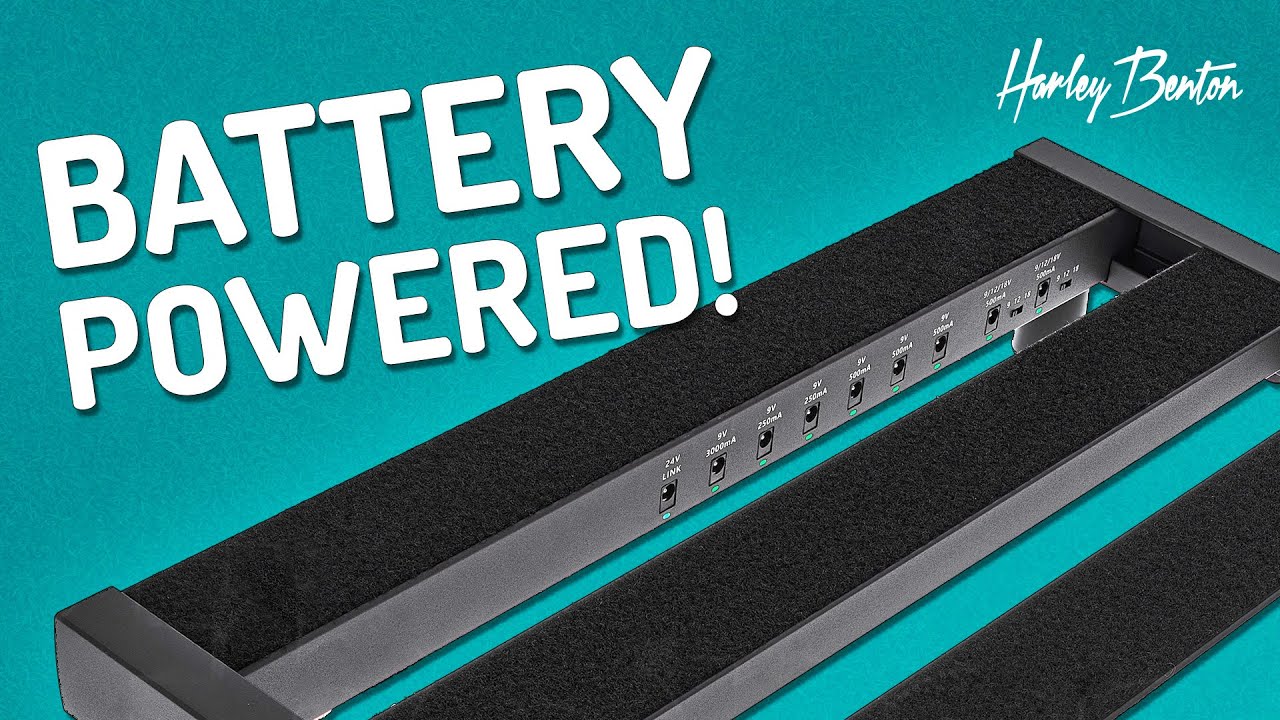
For power, the 'board has seven isolated outputs. Two of them are 9V and 250mA each. Three are 9V and 500mA each and the other two have switchable voltage - 9/12/18V with 500mA each. This means you’ll be able to run some really power-hungry pedals with this pedalboard, including some amp modellers.
The addition of a non-isolated 9V 3000mA output will even allow you to run some high-powered multi-effects pedals.

Underneath each of the power outputs is an indicator LED that lights up when voltage is present. If you overload it or there’s an issue, the light will go off so you’ll quickly be able to identify the problematic output. That said, when the 'board is full of pedals, it’s quite hard to see the lights properly – you have to tip it upside down to get a good look underneath.
Once everything is set up and connected, I plug my Jazzmaster in at one end and hook up my Orange head and cab at the other and I am greeted by beautiful silence. No 60-cycle hum, no mystery buzz; nothing that shouldn’t have been there.
Convenience really is king when it comes to wiring up pedalboards
I have had the JHS Colour Box cause some noise with lesser power supplies in the past, but having this on its own isolated output with 500mA of current meant it's comfortably taken care of. Being able to run my Kongpressor at 12V instead of 9 also gives me increased headroom.
Testing this Spaceship Power 40 out makes me realise a couple of things: blasting your favorite guitar through a loud tube amp and a selection of pedals is tremendous fun, and convenience really is king when it comes to wiring up pedalboards. Spending money on a power supply isn’t particularly exciting, but having that power built into a board does tick a few more boxes and makes the purchase seem more worthwhile.
I probably wouldn’t risk running it on the battery at a gig
Not only does the board house a power supply, it also has lithium battery built in. I tested it further and didn’t notice any difference in performance with it running off the battery.
To be honest, I probably wouldn’t risk going battery-only at a gig, given that it only gives you up to around 50 minutes, but it is nice to have the option for added flexibility. There’s a battery indicator light on the back of the board that has four stages but when you’re playing and operating the Spaceship 40-B you can’t see that, plus even when you can see it, it’s hard to see how many stages are lit.

There’s a small display screen on the back of the board too. This shows what voltage and current is being supplied. I didn’t find this to be a particularly useful feature, but it certainly doesn’t take anything away from the overall positive impression here.
The Spaceship Power 40-B even boasts AC switching so if you’re travelling to countries that run on different voltages, it will detect that and automatically switch.
So, would I take this to gigs and use it with confidence, knowing that my pedals are being powered sufficiently and safely? I absolutely would, yes. It’s great that it comes with a gig bag too. It’s of a decent quality – chunky zips, sturdy accessory pocket, a bit of padding and a rigid bottom.
However, if you’re doing lots of gigging, or if you’re travelling with a van or trailer, it would be prudent to find a more knock-resistant hard case that offers increased protection.
Verdict
Verdict: ★★★★½

This is an excellent pedalboard option for any level of player. Its comprehensive selection of power outputs provides enough juice for all manner of digital and analog pedals; from power-hungry Strymons and the like, to old fuzz boxes.
It also makes for a great choice for guitarists and bassists using hybrid setups containing traditional pedals and amp modellers. For example, you could fit a Line 6 HX Stomp XL along the bottom and have some of your favorite pedals above it, whilst still being able to power it all from the Spaceship 40-B.
The build quality and usability is impressive, though there a couple of features that could be improved upon. It would have been nice to have the hook-and-loop stretch the entire width of the board
The fact that you have multiple 500mA outputs does give some real peace of mind that you can run more than one high-powered pedal without the fear of unwanted noise or hum impacting your tone.
The build quality and usability is impressive, though there a couple of features that could be improved upon. It would have been nice to have the pre-installed hook-and-loop stretch the entire width of the board, and the battery indicator light could be a little easier to read. I’d also be wary of using the board without mains power for more than 30 minutes or so.
MusicRadar verdict: Harley Benton has delivered again with a powered pedalboard that will genuinely save players time and money. You can neatly and safely run a bunch of different pedals without the need for an external power source, plus it really holds its own against the bigger names in this arena.
Hands-on videos
Harley Benton
Desire Guitars

John Nathan Cordy

