





MusicRadar Verdict
A fairly uniquely voiced drive circuit housed in a rock-solid enclosure with minimal controls. Yes, we’d prefer more options on board for tone sculpting, but all in all, this is another great pedal by Strymon – and it proves that it doesn't need digital wizardry to sound good.
Reasons to buy
- +
Simple to dial in.
- +
Unique drive sound.
Reasons to avoid
- -
The drive can get a little fuzzy around the edges.
- -
Extra tone shaping controls would be handy.
MusicRadar's got your back Our team of expert musicians and producers spends hours testing products to help you choose the best music-making gear for you. Find out more about how we test.
What is it?
Think Strymon and you think digital modelling at its finest, right? Sure, digital sorcery has long been the company's bread and butter, but now these pedal titans are going back to basics. With its latest stompbox, the US company is ditching the cyber wizardry and embracing a fully analogue unit with the Fairfax.
Strymon bills this brand-new pedal as “a complete miniature amplifier in 100% analogue form.” The Fairfax gets its distinct flavour of drive from the Garnet Amplifiers Herzog, a cult-classic tube device built for none other than Randy Bachman of The Guess Who and Bachman-Turner Overdrive back in 1965. The OG Herzog ran on 12AX7 and 6V6 tubes, delivering a tone all its own. It even packed a built-in speaker load so you could slam its output straight into another amp for gloriously singing sustain. Its most legendary usage would be the rock anthem American Woman by The Guess Who .

Strymon set out to resurrect this under-the-radar gem using JFETs to mimic the original’s tubey goodness. Of course, it wouldn’t be a Strymon box without some clever engineering under the hood. To give the Fairfax a fighting chance at real tube amp feel, it needs juice - a lot of it. Thanks to a transformer-based power supply, that humble 9VDC input gets cranked up to a whopping 40V, gifting the Fairfax some seriously high headroom.
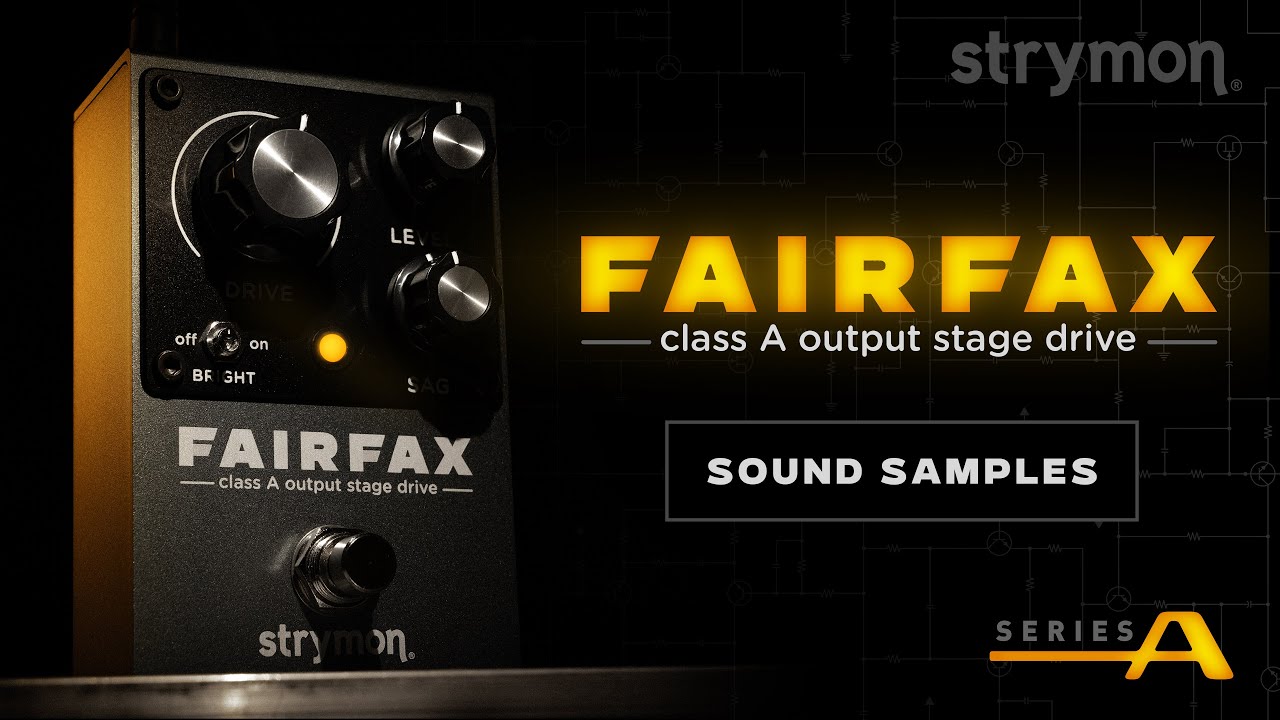
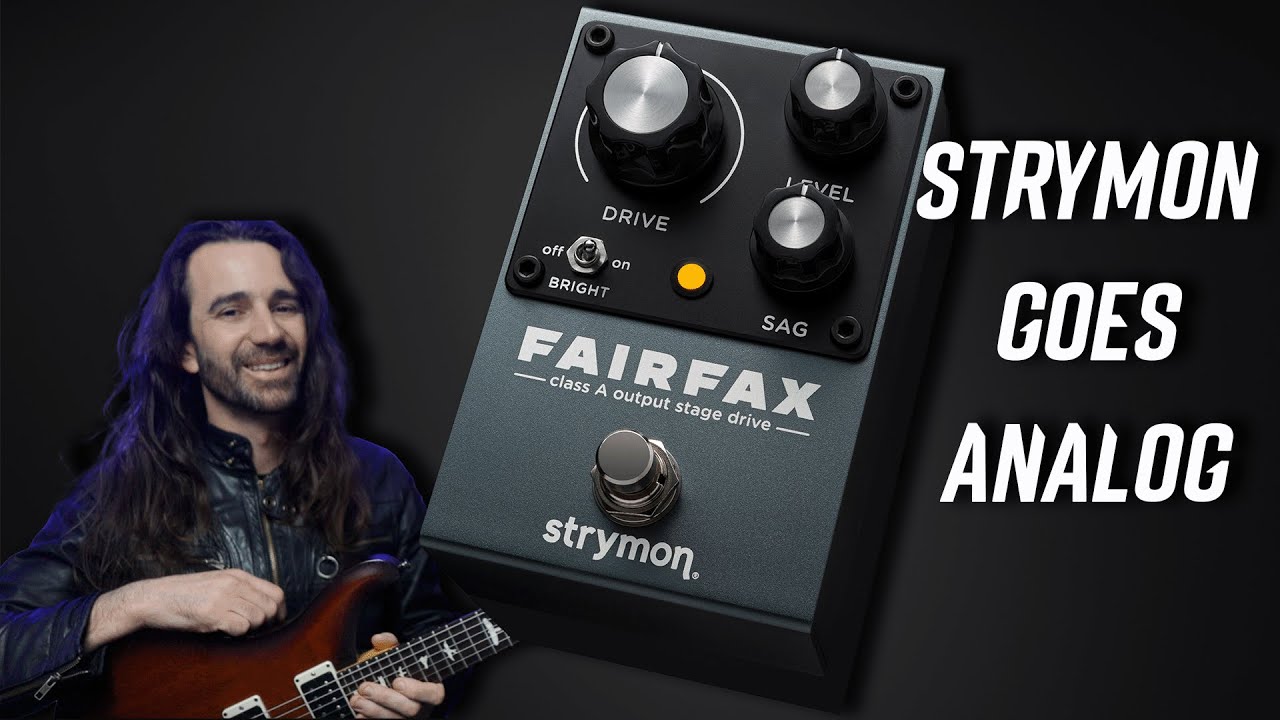
When it comes to controls, the Fairfax keeps it refreshingly simple with only Level, Drive, and Sag. The first two are self-explanatory, but the variable Sag knob is where things get interesting. This dial lets you fine-tune how the “Sag circuit” responds, shaping everything from subtle compression to wild, sputtering breakup. The amount of sag depends on how hard you’re hitting the power amp section and your own playing dynamics. Crank it, and you’ll get chortle and sputter galore; dial it back, and things clean up.
Other notable features include a Bright switch to help you dial in the perfect top end for your rig, true-bypass switching, and standard mono ins and outs. Power comes from a 9V DC centre-negative supply, with the Fairfax drawing a minimum of 500mA.
Specs

- Launch price: $199/£199
- Type: Overdrive
- Controls: Drive, Level, Sag, Bright
- Features: Custom analogue circuits recreate multiple tube stages and the critical output transformer
- Connectivity: Mono in/out
- Bypass: True-Bypass
- Power: 9V, DC center-negative, with a minimum of 500mA
- Dimensions: 11.51 cm x 7.19 cm x 5.92 cm
- Weight: 0.28kg
- Contact: Strymon
Build quality

Build quality rating: ★★★★★
There’s a satisfying heft to the enclosure, which feels strong, sturdy, and built to take a kicking on the road
First impressions? The Fairfax looks the business. The oversized gain knob is a real eye-catcher, and it’s clear Strymon has sweated the details when it comes to build.
There’s a satisfying heft to the enclosure, which feels strong, sturdy, and built to take a kicking on the road. Despite that, it’s not a pedalboard hog – the size strikes a sweet spot, big enough for easy tweaking mid-song, but tidy enough to slot into most boards without a fuss.
The finish is sleek, with a hint of retro class thanks to the simple graphics and tactile knobs. Housed inside are a fully-analogue drive circuit, a clever voltage converter that ups the 9V to 40V internally via a “galvanically isolated power supply”, and standard true-bypass switching. Everything about the build inspires confidence that this pedal is built for the long haul.
Usability

Usability rating: ★★★★½
From a subtle boost to thick, chewy overdrive, it’s all there
In terms of usability, it doesn’t get more straightforward than this, but there’s still plenty to explore. Level, Drive, and Sag are your main ports of call, and each is genuinely interactive.
The Level control’s got a decent sweep, making it easy to dial in unity gain or push your amp a bit harder. Drive does exactly what it says on the tin. From a subtle boost to thick, chewy overdrive, it’s all there. It is worth noting that things can get a little frayed around the edges if you push the gain too far. It can get almost fuzz-like.
The real star, though, is the Sag control. This is where the Fairfax comes alive, letting you dial in everything from a tight, punchy response to a spluttery, on-the-edge feel that’s pure rock ‘n’ roll mischief.
That said, one thing I very much appreciate about this stomp is that there are no menus, no presets, and no MIDI, just twist and play. So, if you favour pedals that let your playing style and guitar do the talking, the Fairfax is the unit for you.
Sounds

Sounds rating: ★★★★½
There’s a lovely, tactile attack under the fingers – like a good valve amp, it responds to your pick attack and guitar volume with proper character
Plugging in with a P-90-loaded Firebird, the Fairfax immediately impresses with its amp-like response. There’s a lovely, tactile attack under the fingers – like a good valve amp, it responds to your pick attack and guitar volume with proper character. Crank the Sag, and you get this chewy, almost toffee-like drive that’s addictive for lead work.
Now, I’d say it's pretty difficult to pinpoint the true character of this drive. It’s not quite talking in that Marshall British accent, and it certainly doesn’t speak with American-scooped mids either; it’s very much its own thing.
The gain structure feels organic, especially with the Drive set around halfway and hitting an already cooking amp – in my case, a trusty Vox AC30. Push the Drive higher, and things get a bit wild; there’s plenty of fuzzy, slightly fizzy energy on tap, though I did find myself wishing for a touch more tone shaping.
Yes, the Bright switch is a neat touch. It’s simple, but effective for waking up darker amps or adding sizzle to high-gain passages, but I’d prefer more nuanced control. I’m not asking for a full set of EQ controls, but a tone knob would make this unit eminently more versatile, in my opinion.
Still, what’s here is inspiring. The Fairfax excels at those singing, sustaining lead tones and touch-sensitive rhythm sounds that keep you glued to your guitar for hours.
Verdict

Strymon’s Fairfax is a bold move for a company so intrinsically linked to digital pedals. It’s a loving nod to a legendary, if slightly obscure, bit of amp history, wrapped up in a no-nonsense all-analogue stompbox. It nails the touch, feel, and spirit of a classic tube amp in a compact pedal format with enough headroom and attitude to stand out from the crowd.
It’s not the most versatile drive out there – players who want surgical EQ control or a Swiss Army knife of tones might look elsewhere. But if you want a pedal that oozes character, feels alive under your fingers, and encourages you to play just a little bit louder, the Fairfax is a seriously tempting proposition.
MusicRadar verdict: A fairly uniquely voiced drive circuit housed in a rock-solid enclosure with minimal controls. Yes, we’d prefer more options on board for tone sculpting, but all in all, this is another great pedal by Strymon – and it proves that they don't need digital wizardry to sound good.
Test |
Results |
Score |
|---|---|---|
Build quality |
Expertly crafted and assembled. No complaints here from us. Nice colour too! |
★★★★★ |
Usability |
Easy to operate and smooth to dial in. We’d prefer more tone shaping options, though. |
★★★★½ |
Sounds |
This stomp definitely has its own voice, and that has to be a good thing – even if it can get a little fizzy if you dime the gain. |
★★★★½ |
Overall |
A truly unique drive pedal that’s a lot of fun to play with, that could do with extra EQ controls to make it more versatile. |
★★★★½ |
Also try
Hands-on videos
Strymon
Leon Todd
- Best distortion pedals: our pick of the top gain stages for guitar
