
It must be tough being on Strymon’s analogue engineering team. Clocking in each day, knowing that all the DSP team is probably going to take all the applause for the brand's latest new programmable reverb pedal, or for its plugins.
But not today. Today, the analogue team gets its place in the sun, as Strymon unveils an all-new range of pedals, Series A, debuting with the Fairfax – a compact reproduction of the Herzog tube drive unit favoured by Randy Bachman back in the day.
Could you even call it a distortion pedal? An overdrive pedal? Strymon says that isn’t quite right. Think it as a miniaturised tube amp circuit, recreated in a pedalboard-friendly format with all-analogue components – and it can do a lot of different jobs when it comes to electric guitar tone. Sean Halley, head of marketing at Strymon, says it is not leaving his pedalboard.
“Man, this thing is such a chameleon”, says Halley. “It can be a creamy and gooey boost that works great with any style of amp, and it can also breathe saturated fire. Because it’s really an amp circuit, it doesn’t change your core tone, and it stacks brilliantly with other drive pedals. This thing is not leaving my board, full stop.”
You can often tell a lot about a guitar effects pedal’s intentions from the control setup. Here we have dials for Level, Sag and Gain, but it should be all-caps on GAIN. This dial is oversized, dominating the control surface. There is also a Bright switch, just like a guitar amp.

Strymon CEO Gregg Stock is one of the company’s senior analogue engineers and he pours one out for his aforementioned colleagues. He says there is much more to come from Series A. Watch this space.
“Even though we’re more known for DSP, our analogue engineers are always coming up with interesting ideas for fully analogue designs, so we created Series A to give them an outlet,” says Stock. “There will be a number of pedals in the line by the end of next year, so we’re really excited to see some of these products come to market – it’s been a blast to work on this stuff.”
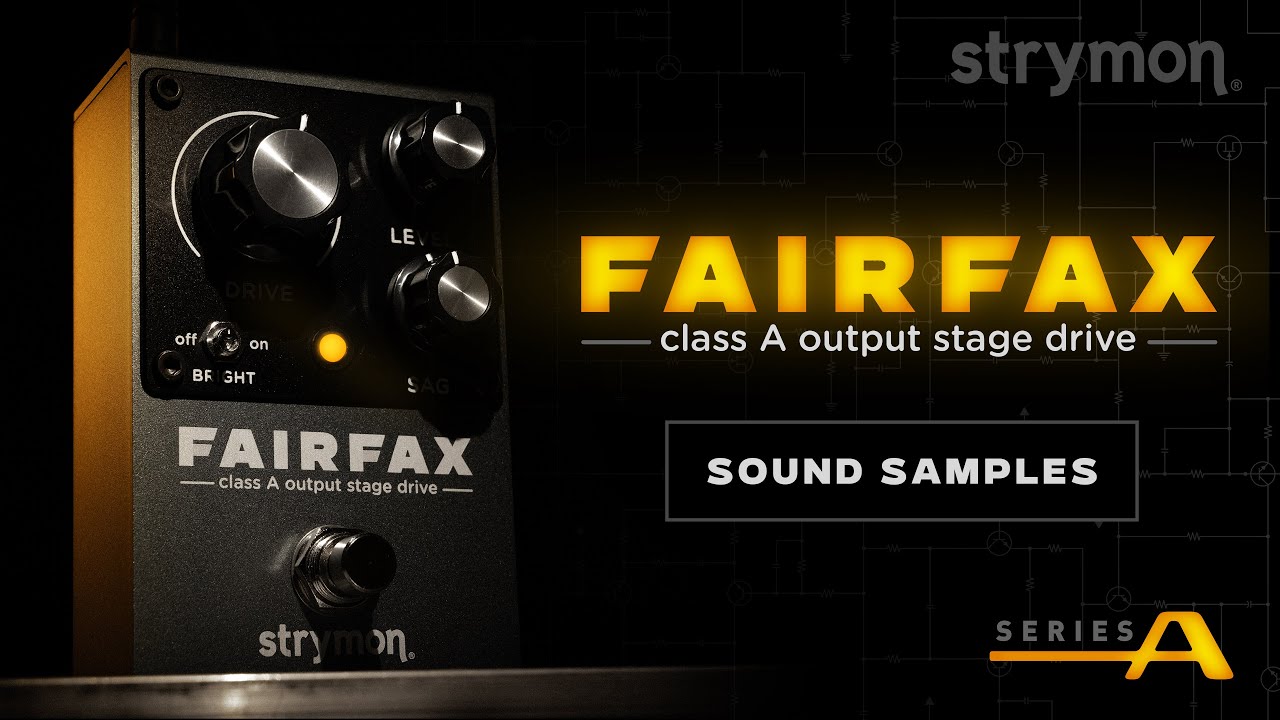
Halley calls the Fairfax a “chameleon” but there will be some key tones that ‘70s rock fans will be looking to dial in post haste, such as the blissful fuzzed-out sound Randy Bachman used on the Guess Who’s American Woman.
Garnet Amplifiers developed the Herzog unit especially for him. To recreate this, Strymon used a tube-driven preamp, a Class A power amp, and an all-new circuit designed to replicate the “saturation” of the Herzog’s output transformer.

There is an internal power supply that pumps the incoming 9V up to 40V, giving you more headroom and a more amp-like feel.
The Sag control is where you shall find some of that gnarly Bachman magic. It produces “dynamic artefacts at low values, and full sputtering and gated sounds more commonly associated with fuzz pedals at extreme settings”.
The Fairfax is available now, priced £/$199. See Strymon for more details.
